
How to Make UV DTF Sticker – A Beginner‘s Guide for POD Business in 2026
What this guide covers
The 5-step UV DTF production process, why UV DTF works well for POD, how it compares with vinyl and screen-printed stickers, the cost and profit shape of a UV DTF sticker business, the surfaces UV DTF actually sticks to, the surfaces you should avoid, and practical promotion tips. This is an industry guide, not a product pitch. Inkedjoy is preparing to add UV DTF stickers to its catalog; specific SKU launch date is not yet announced.
Search interest for UV DTF stickers and related keywords (uv dtf transfer, uv dtf wraps, uv dtf cup wrap) is rising across 2024–2026, while competition in the niche is still low compared to general print-on-demand categories. The result is a wide, under-supplied funnel, which is exactly the shape of market that rewards small, well-positioned sellers.
What are UV DTF stickers?
UV DTF (ultra-violet direct-to-film) stickers are a category of custom transfer stickers. A design is printed on a special film using UV-curable ink, then laminated with a second transfer film, and finally applied to a hard surface by pressing the laminate onto the surface and peeling the backing film. The end result is a glossy, full-color, photo-quality decoration that needs no weeding, no heat press, and no cutting plotter.
The common use cases are tumblers, glass cups, water bottles, hard phone cases, metal signs, acrylic keychains, and other smooth, hard goods. UV DTF is one of the few print technologies that handles curved hard surfaces cleanly without heat or weeding, which is why the niche is growing quickly among POD sellers.
Why POD sellers are paying attention to UV DTF
UV DTF fits POD because the production model and the customer promise line up. Industry-standard properties include no residue, no weeding, waterproof surface, UV-resistant ink, manufacturer-typical outdoor life of 3–5 years, and the ability to start with no minimum order quantity when ordering prints from a UV DTF print farm. For a new POD seller, that means the inventory and equipment risk is close to zero, while the margin profile on a finished wrap is high.
Inside this article
- How to make UV DTF sticker – step-by-step process
- UV DTF vs vinyl vs screen-printed: which is better for your business
- How to make money with custom UV DTF stickers: cost and profit in 2026
- Best products for UV DTF wraps – and which to avoid
- How UV DTF stickers boost branding and content marketing
- FAQ
How to make UV DTF sticker – step-by-step process
The standard industry process for producing UV DTF sticker transfers is five steps. Each step is short, but the order matters: misaligning the films is the most common reason a transfer fails to release cleanly.
The 5-step UV DTF production process
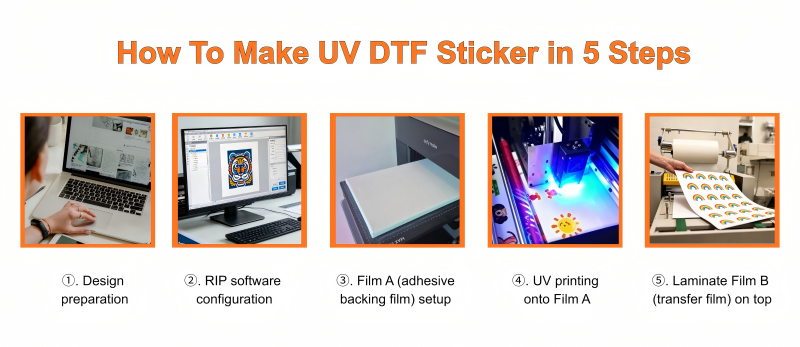
- Design preparation: Create or finalize the artwork in a vector or 300 DPI raster file. Set the canvas to the exact transfer size and add a small bleed margin so trimming never exposes a white edge.
- RIP software configuration: Load the design in a UV DTF-compatible RIP (such as the RIP bundled with Mutoh, Roland, or Mimaki UV printers). Set the white-ink layer first, then CMYK, and confirm the print profile matches the film brand.
- Film A (adhesive backing film) setup: Load the clear adhesive film onto the printer. This film becomes the layer that sticks to the final product.
- UV printing onto Film A: The printer lays down white ink first, then full-color CMYK, all cured instantly by the integrated UV lamp. The print sits face-down on Film A.
- Laminate Film B (transfer film) on top: Press the matte transfer film onto the printed image. The transfer film is what the customer actually presses onto the final product; Film A stays as a backing layer and is peeled off after application.
Why UV DTF sticker works for print on demand
UV DTF aligns with the way POD sellers run their stores. The compatibility is structural, not coincidental.
- Low MOQ: UV DTF print farms (and the equipment) commonly accept single-unit orders, which matches the POD model of one-off customer designs.
- Multi-surface capability: The same transfer applies to glass, ceramic, metal, hard plastic, acrylic, and finished wood, expanding the SKU list without adding production complexity.
- No inventory required: Transfers are made to order and shipped flat. There is no pre-printed sticker stock to warehouse.
- Easy customization: Customer names, dates, and small graphic changes are a 5-minute edit in the artwork file, not a screen change.
- Strong product-expansion potential: A POD store that already sells mugs, tumblers, or water bottles can add UV DTF wraps as a personalization layer without acquiring a new audience.
- Durable, premium-looking results: UV-cured ink sits on top of the surface in a continuous film, producing a glossy, photo-quality finish that reads as premium in unboxing photos.
UV DTF stickers vs. vinyl vs. screen-printed: which is better for your business
What is the main difference between UV DTF wraps and vinyl stickers?
The best type of sticker depends on your product line and business model. The table below compares UV DTF, vinyl, and screen-printed stickers across the criteria that matter for a POD operator. Before reading the table, identify the surfaces and materials your store actually sells.
If your core catalog is hard, curved goods (tumblers, glass cups, water bottles), UV DTF is the most natural fit. If your core catalog is flat, smooth, indoor goods, vinyl is often cheaper and faster. If your core catalog is fabric (t-shirts, hoodies, totes), neither vinyl nor UV DTF applies; DTF fabric transfers or screen printing are the right answer.
| Criteria | UV DTF Sticker | Vinyl Sticker | Screen-Printed Sticker |
| Best used on | Hard, smooth, curved or flat surfaces (tumblers, glass, metal, acrylic) | Flat, smooth surfaces (laptops, water bottles, journals, car windows) | Flat surfaces, large production runs (packaging, promotional decals) |
| Heat required? | No | No (transfer tape, optional heat for permanent vinyl) | No (curing happens in the screen process) |
| Weeding required? | No | Yes (every design) | No |
| Durability (industry-typical) | 3–5 years outdoor; waterproof; UV-resistant | 2–4 years; waterproof; UV-fade over time | 3–7 years for high-quality inks; long outdoor life |
| Texture | Smooth, glossy, photo-quality, raised clear layer | Matte or glossy; thin to the touch | Slightly raised ink layer; can be matte or glossy |
| MOQ | 1 transfer (most print farms); equipment available at small scale | 1 sheet from print farm; pre-cut rolls for plotter workflow | Higher (setup cost amortized over many units) |
| Curved surfaces? | Yes (most curve-friendly option) | Limited (warps on tight curves) | Limited |
| POD beginner-friendly? | High (use a print farm) | High (cutting plotter + adhesive vinyl) | Low (significant equipment and setup) |
| Per-unit cost (rough) | $1.50–$3.50 per A4 / A3 print | $0.20–$0.80 per A4 sheet | $0.10–$0.40 per sticker at scale |
Which is the best for your business?
Scenario 1: You mainly sell fabric (t-shirts, hoodies, totes). Skip vinyl and UV DTF. Use DTF fabric transfers or screen printing. DTF on fabric is heat-pressed and behaves like a transfer, not a sticker.
Scenario 2: You mainly sell flat, hard-surface products (mugs, journals, laptops). Vinyl stickers can work, but UV DTF produces a more premium finish with no weeding, which means less labor and fewer rejected sheets on a personalized order.
Scenario 3: You mainly sell curved, hard-surface products (tumblers, glass cups, water bottles, candles). UV DTF is the best fit. Vinyl warps on tight curves and screen printing cannot print full-color photo-quality designs economically in small runs.
How to make money with custom UV DTF stickers: cost and profit in 2026
Understanding the cost structure of UV DTF stickers
- Equipment investment (in-house production). A small UV DTF printer starts at roughly $3,000–$8,000 for a desktop unit; a production-grade UV printer with auto-lamination starts at $15,000+. Add a curing station, RIP software license, and a small finishing area. Beginners usually do not buy this equipment on day one.
- Outsourcing option. Most beginners use a UV DTF print farm (or a local print shop) and sell transfers made by someone else. Cost per transfer is roughly $1.50–$3.50 for an A4 / A3 sheet, depending on the design's white-ink coverage and the farm's lead time.
- Material cost per sticker. For a typical 2×3 inch to 4×6 inch custom wrap, material cost lands at roughly $0.40–$1.20 per finished sticker when the sheet is cut into 4–8 stickers. This is the cost you compare against the retail price.
- Hidden costs to consider. Design labor (real or AI-tool time), customer-proof revisions, returns on misapplied transfers, application tool (squeegee or scraper), and the time it takes to package a personalized order. Build these into your margin from day one.
Retail pricing and profit margins
A typical 40oz tumbler wrap (about 4×12 inches of custom artwork) retails for $8–$12 in the mid-range. Premium positioning (full-color photo-quality artwork, name personalization, themed bundle) can push the same wrap to $15–$20, with the same material cost in the $1.20–$2.00 range. The table below shows the rough shape of the margin at three positioning tiers, based on operator estimates and varies by market.
| Positioning | Retail price | Material cost | Gross profit | Gross margin | Typical example |
|---|---|---|---|---|---|
| Low-end | $4–$6 | $0.40–$0.80 | $3.20–$5.20 | ~80% | Single-color small wrap |
| Mid-range | $8–$12 | $0.80–$1.50 | $6.50–$10.50 | ~85% | Full-color tumbler wrap, simple personalization |
| Premium | $15–$20 | $1.20–$2.00 | $13.00–$18.00 | ~90% | Photo-quality custom artwork + name + bundle pack |
Worked example (mid-range, single tumbler wrap): A customer orders one personalized 40oz tumbler wrap for $10. Material cost from a print farm is about $1.20. Shipping subsidy and packaging add about $0.80. The remaining $8.00 is gross margin before ad spend. At a 15% ad-spend ratio, net contribution is around $6.50 per order. These numbers are operator estimates and will vary by market, ad channel, and customer acquisition cost.
How to create sticker design ideas that sell
- Personalization ideas. Names, dates, birth flowers, zodiac signs, dog breeds, lake names, inside jokes, and family-role titles (Mom, Dad, Grandma). Personalization alone is enough to lift a $5 wrap to a $12 wrap.
- Design for specific audiences. Nurses, teachers, dog moms, brides-to-be, new homeowners, college students, and remote workers all have visual languages that are easy to research on Pinterest, Etsy, and TikTok.
- Popular design trends for 2026. Y2K revival, retro-cottage floral, max-color typography, boho-line illustration, and "ugly-cute" pet portraits all over-index in the early 2026 POD market. Use these as starting points, then narrow to your specific audience.
- Use free or low-cost design tools. Canva, Kittl, Photopea, and free-tier AI image tools cover the bulk of personalization work. The goal is to keep the design step under 10 minutes per order.
- Connect the design to the product. A design that looks great on a 2D screen often needs adjustment (contrast, line thickness, color saturation) to look great on a curved tumbler. Print a proof, apply it, photograph it in real light, and adjust before selling the design at scale.
Business promotion tips for selling UV DTF stickers
- Sell on Etsy, Shopify, and TikTok Shop. These three channels cover the bulk of search-driven UV DTF demand. Etsy captures personalization queries; Shopify gives you brand control; TikTok Shop captures short-form video proof.
- Partner with local businesses. Cafes, salons, bakeries, gyms, and small event venues are good wholesale partners. They need a small number of personalized wraps for staff gifts, customer loyalty, or branded merchandise.
- Offer bulk and event packages. Weddings, birthdays, bachelorette parties, baby showers, and corporate events all need 20–100 wraps in matching artwork. Bundle pricing on a 25-pack or 50-pack is the easiest way to lift AOV.
- Use application-effect videos as ad creatives. A 15-second video of a transfer being applied to a tumbler converts better than a static product photo. The tactile, peel-and-press motion is the visual hook.
- Sell themed sticker bundles. A "Teacher Appreciation 5-Pack" or "Dog Mom Starter Bundle" lifts the average order from 1 wrap to 4–6 wraps without acquiring a new customer.
Best products for UV DTF wraps – and which to avoid
A product is suitable for a UV DTF wrap if the surface is hard, smooth, non-porous, and reasonably clean. The reason is that the UV-cured ink film needs an even, sealed surface to bond to. Anything that flexes, breathes, or repels adhesive will reject the transfer within days or weeks.
Top 10 products you can customize with UV DTF stickers in 2026
- Tumblers (stainless steel, 20oz / 30oz / 40oz) – the most common UV DTF surface
- Glass cups and clear plastic cups – works on the outside, not the food-contact surface
- Water bottles (stainless steel or hard plastic, single-wall or insulated)
- Phone cases (hard plastic or polycarbonate) / laptop shells / iPad covers
- Metal tags and locker plates
- Acrylic signs and small acrylic blanks
- Smooth wood products (finished / sealed, not raw)
- Pens (metal or hard plastic, with a flat application area)
- Candle jars (glass with smooth exterior)
- Keychains and small accessories (acrylic, metal, hard plastic)
Surfaces that are not suitable for UV DTF stickers
- Fabric – use DTF fabric transfers or screen printing instead
- Silicone, rubber, or soft TPU – the surface flexes and releases the adhesive
- Waterproofed or waxed surfaces – the existing coating blocks adhesion
- Objects with uneven, curved surfaces (textured, ribbed, or bumpy)
- Porous or rough surfaces (unfinished wood, stone, brick walls, concrete)
How to test a new product before committing in 5 steps
- Order one sample of the product from your supplier or print farm.
- Apply a UV DTF sticker using the standard 5-step process.
- Use it yourself for 1–2 weeks. Wash it, carry it, leave it in the sun.
- Check for peeling at the edges, bubbling in the center, or color fade.
- If it passes, list the product in your store. If it fails, retire the SKU before you commit ad spend.
How UV DTF stickers boost branding and content marketing
Stickers as mobile branding tools
A UV DTF wrap on a tumbler or a water bottle is a small, durable, photo-quality surface that travels. A customer using a personalized tumbler at a gym, a coffee shop, or a remote-work co-working space is producing 30–60 brand impressions per day, at zero ad cost. The visual quality of UV DTF (glossy, photo-real) lifts the perceived value of the underlying product and makes the wrap itself shareable.
Using UV DTF wraps to upgrade unboxing experiences
A personalized tumbler that arrives with the wrap already applied turns a fragile product into a finished, ready-to-gift item. The unboxing photo is dramatically better than a blank product, and the perceived value of "ready to use" usually justifies a 20–30% price premium over selling the wrap separately.
Content marketing ideas for UV DTF stickers
- "How I made this wrap in 5 minutes" – application-effect short video, native to TikTok and Instagram Reels
- "Tap to reveal your personalized design" – interactive story post on Instagram
- "Customer of the week" – UGC roundup of real customer applications, with credit
- "Before / after" – side-by-side of a blank tumbler and the wrapped version
- "5 designs that sold out this month" – recurring series that creates anticipation
FAQ
What are UV DTF transfer stickers?
UV DTF transfer stickers are a category of custom full-color transfers. A design is printed with UV-cured ink on a special film, laminated with a transfer film, and applied to a hard surface by pressing and peeling. The result needs no weeding, no heat press, and no cutting plotter.
How to make UV DTF wraps?
Prepare the design, configure the RIP software with white-first ink layering, print onto the adhesive backing film, and laminate with the transfer film. The full 5-step process is described in detail in the article above.
How to print UV DTF cups?
Print the cup wrap design as a UV DTF transfer following the 5-step process, then apply the laminate to the curved surface of the cup, smooth it with a squeegee, and peel the backing film. The result is a full-color, glossy decoration on the cup exterior.
What products can UV stickers be used on?
Smooth, hard, non-porous surfaces: tumblers, glass cups, water bottles, hard phone cases, laptop shells, acrylic signs, finished wood, metal tags, pens, candle jars, and small acrylic or hard-plastic accessories. Not suitable for fabric, silicone, soft TPU, waterproofed or waxed surfaces, uneven textures, or porous materials like unfinished wood, stone, or concrete.
Is UV transfer suitable for print on demand business?
Yes. UV DTF fits POD because the print farms accept single-unit orders, the production cost is low, the durability is high, and the application process is fast. A POD seller can list and sell a UV DTF wrap on a tumbler, water bottle, or cup with no upfront inventory, using a print farm for fulfillment.
Conclusion
UV DTF stickers offer a high-margin, low-competition opportunity for POD sellers in 2026. The 5-step production process is well-documented, the cost per transfer is low, the surface compatibility is broad within the hard-goods category, and the finished product is durable and photo-ready for content marketing. The market is not yet saturated, and the technology rewards small sellers who can move quickly.
Read more
- How to Create Custom Print-on-Demand Products That Stand Out in 2026
- Print on Demand Stickers: Grow Your Business with Premium Stickers
- What is DTF Printing? The Ultimate Guide to Direct-to-Film
- Print on Demand Mugs: A Profitable Custom Product for Ecommerce Sellers
- DTF vs Sublimation: Which Printing Method Is Better for Your Designs
Written by
Gina
A skilled marketing specialist with expertise in e-commerce marketing, and print-on-demand product research. She has extensive experience in keyword research, market analysis, and content strategy, helping brands find uncover profitable opportunities, improve search visibility, and drive sustainable growth through data-driven marketing.