
How Much Does Print on Demand Cost Costs, Pricing & Profit

How Much Does Print on Demand Cost Costs, Pricing & Profit

Jul 29, 2026 by Gina POD Business Tips

Key Takeaways

  • Print on demand remains profitable in 2026, with steady search demand year-round and spikes during holiday and back-to-school seasons.
  • Total POD cost = Product Cost + Shipping + Platform Fees + Marketing + Other Expenses — understanding each component is essential for pricing.
  • Blank product costs are your biggest fixed expense, ranging from $6–$12 for t-shirts to $18–$28 for hoodies depending on quality and supplier.
  • Different printing methods (DTG, DTF, embroidery, sublimation) each have unique cost structures and quality outcomes — choose based on your product type.
  • Successful sellers maintain 20%–40% profit margins by carefully managing costs across product, shipping, platform fees, and marketing while pricing competitively.

If you've ever looked up "how much does print on demand cost" on Google before launching your shop, you are not alone. Understanding the intricacies of print on demand cost is quite a challenge at first glance, particularly with various suppliers and platforms around, plus the possibility of hidden charges.

The fact is, the cost of print on demand is a function of your product type, your chosen printing technique, and your shipping plan. In this article, we will explore each cost item so you will have a clear idea of the things to budget for in 2026, such as blank products and marketing, etc., which would help in setting your prices confidently.

Is Print on Demand Still Profitable in 2026?

The print on demand industry has strengthened consistently with each passing year, driven by rising consumer demand for personalized products. A greater number of people want personal stuff made to their specific requirements rather than mass-produced articles. Birthday celebrations, wedding anniversaries, small businesses, and fan clubs all create the demand for unique products.

Google Trends indicates the pattern we've described. Searches for "print on demand" and "custom t shirt" have remained steady throughout the year, while "print on demand" and other search terms have even increased sharply during the holiday periods and back-to-school season. This tells us that not only have searches for customized products increased, they have also spread out to become available at all times of the year.

Why Choose the Print on Demand Model to Start Your Business

Print on demand sets itself apart from other online business models for several reasons:

  • No need for holding stock since things are produced once a person places an order.
  • Initial expenses don't rise to the level of those in traditional retail.
  • A multitude of items like tops, caps, bottles, etc., can all be selected.
  • You do not need to invest your whole budget if an idea is going well, as you are able to rapidly change things.
  • You do not get charged until a buyer pays you and you have given the supplier the amount they are supposed to receive.

Starting a business with print on demand involves a minimum level of risk.

The way to make money in this field still basically centers on the matter of the price and cost relationship, where you have to be able to know and manage your expenses to set your price. Leaving that out would mean a very popular shop, too, could make a loss for each item sold.

Here is a quick startup cost table to fill in as you plan your shop.

Expense Estimated Cost
POD platform $0 to $39/month
Product samples $20 to $100
Design tools $0 to $50/month
Ecommerce platform $0 to $299/month
Marketing budget $50 to $500+/month
Total startup cost Varies by scale

How Much Does Print on Demand Cost?

All of these factors go into determining how much you spend on print on demand; your total cost of production will be the sum of several different parts that together create a complete picture of your overall expense.

Total POD Cost = Product Cost + Shipping + Platform Fees + Marketing + Other Expenses

Below, you will find each part that contributes to the total cost that you can read about one at a time. You can click on the part that you want to check out most: blank product costs, design costs, printing costs, packaging, platform fees, shipping, marketing, or hidden costs.
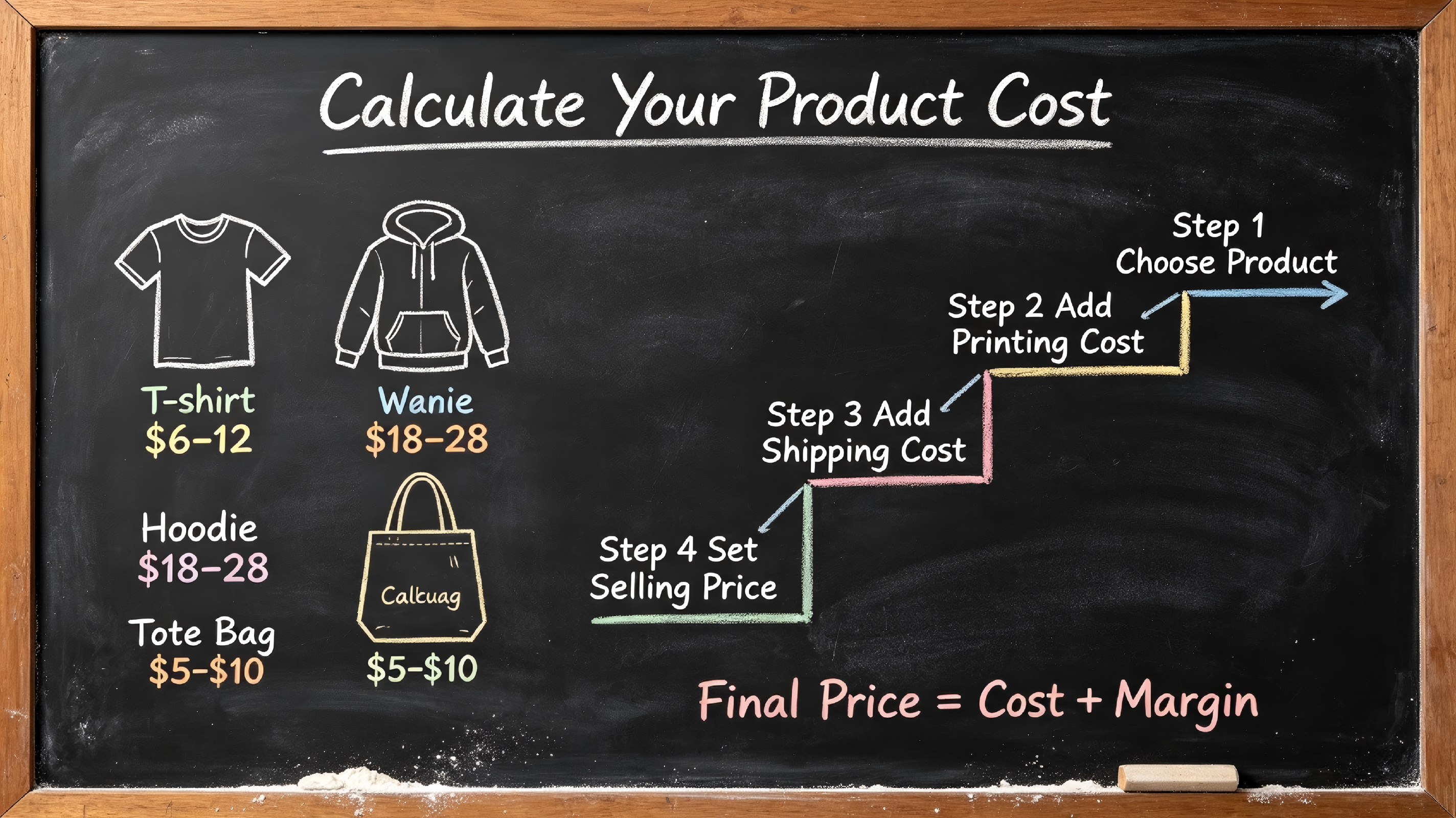
print on demand cost

Blank Product Cost: Your Main POD Expense

In almost all cases, the blank product is your single biggest fixed cost. A generic Gildan shirt might cost between $6 and $9 depending on who your supplier is, while a premium Bella+Canvas tee often costs nearer to $9 to $11. Hoodies and totes have roughly the same pattern, with the actual price varying based on brand, fabric, and fit.

The kind of product you end up getting influences the price significantly as well. High-quality materials will drive up the costs at first, but in the long run you can charge more for the product, and your customers will keep on coming.

Typical product costs:

  • T-shirts: around $6 - $12 each
  • Hoodies: about $18 - $28 each
  • Tote bags: roughly $5 - $10 each

How to Reduce Product Costs Without Sacrificing Quality

  • Shop from a few POD providers before you actually choose one for your business.
  • Before you start advertising products you have never seen, request free sample kits from the manufacturers.
  • Select items according to the preferences of your target market, but do not just pick the cheapest products.
  • If you can, get volume discounts from your suppliers by placing bulk orders when your store grows larger.

Design Costs: Time, Money, or Both?

The cost you spend in the design stage comes largely down to how you generate the artwork. Some sellers create artwork themselves, while others seek assistance from designers.

The designers or creators are probably the ones you will be charging for if you do not design your own products. You may have to fork out cash on several things:

  • A subscription for a design app like Canva or Adobe
  • Buying an AI design tool for quick mockups
  • Cost of courses to teach you to use the tools better

Designer options if you choose to pay someone else:

  • Freelancers at various rates on Fiverr or Upwork
  • Paid artworks or design packages on design marketplace sites that already have pre-designed pieces for you
  • Sticker a collaboration with a designer for regular and constant style updates

Find your per-product cost for design like this:

Design Cost Per Product = Total Design Cost / Number of Products You Are Going to Sell

Suppose you pay $150 to a designer, and at the same time plan on making 30 different designs; each will cost $5 to design at that rate. If you sell out 200 units of them all together, the cost per unit drops down to $0.75 per design.

How to Save on Design Costs

  • If you start with free or almost free design software, you will save both money and time in the long run.
  • Develop a set of basic design abilities so that you don't often have to turn to someone who has to charge you.
  • Utilize AI software to accelerate the process of making sketches and different designs.
  • Repeat designs that have already done well just with different colors.
  • Develop templates and work faster on future designs by saving some of your steps.

Printing Cost: Quality vs. Profit Margins

Changing printing method usually affects both a product's price and its print quality. Sellers who are unaware of different printing methods often can't get both the lowest price and the highest quality at the same time, because each printing method has its own suitability for different fabric types.

  • Printing directly onto clothes (DTG): it is ideal for detailed, bright designs and soft-touch printing on cotton shirts.
  • Direct transfer printing on film (DTF): is suitable for most fabric blends and fabric compositions; it gives slightly better results with durability; cost remains mid to low.
  • Embroidery: the best option for embroidering logos and small designs. Price is higher; the feeling is of high-quality material, and durability is very long.
  • Sublimation: used very successfully for full print on polyester clothing like T-shirts and sweatshirts or even on products like drinking mugs and phone cases (with sublimation paper). Vibrant colors - but mainly limited to light-colored materials.

How to Lower Printing Costs

  • Choose the printing technique suitable for the type of product rather than the same technique for all of the products.
  • Do not go for the high-end finishes unless that's what the customer wants.
  • Do not forget to keep the designs from becoming too complicated, as this can lead to more printing costs.
  • Try to find suppliers who can give you lower printing prices at your order level.

Packaging Cost: Small Costs, Big Impact

Your choice of packaging and its quality impact on your operating expenses as well as the first impression of the customer

Packaging which is basic in nature will usually have poly mailers, standard boxes & shipping labels. It costs about $0.10 -$0.50 per item to ship a shirt with a simple envelope package.

Environmentally friendly packaging comes at a higher price point, but the brand image is enhanced. The use of recycled mailers, compostable bags, along with custom branded inserts are all ways to raise your cost per order to a few dollars. Nevertheless, many customers are expecting sustainable packaging and are ready to cover the extra cost.

Platform or Website Fee: Small Charges That Add Up

Setting up an online store means you will pay platform fees, either in the form of using a marketplace (like eBay or Amazon, etc.) or running your own website through Shopify or similar platforms.

Platform Fees Advantages Best For
Etsy Listing fees plus about 6.5% transaction fee Built-in shoppers, low startup effort Beginners testing designs
Shopify Monthly plan from $29 to $299 Full control, custom branding Growing brands
Amazon Merch Royalty-based, no upfront fee Huge audience, no marketing needed Passive sellers
WooCommerce Free software, hosting from $10 to $30/month Flexible, low ongoing cost Sellers wanting full control

When you decide to build your own ecommerce store on Shopify, the monthly fee usually starts from $29 and rises based on additional features you may purchase later. WordPress coupled with WooCommerce leaves the software free, but you are not free of hosting costs, and usually, that is a sum in the range of $10-$30 per month.

Shipping and Fulfillment Cost

What you pay for shipping varies according to different factors:

  • Weight of product
  • Country where the product is shipped
  • Method of shipping selected
  • Where the supplier's warehouse is

If the supplier's warehouse is located near your customer zone, shipping becomes faster and cheaper. Besides this, delivery speed and customer satisfaction increase.

Another great value is automated fulfillment. Orders are handled automatically, tracking updates come without effort on your side, and most importantly, manual work takes far less time for you.

How to Reduce Shipping Costs

  • Use as many local suppliers as possible.
  • Reduce the size and weight of product packaging.
  • Select types of shipping that your customers are happy with regarding the speed.
  • You may need to customize the packaging depending on shipping regions.

Marketing Costs

From one seller to another, the main point that affects marketing the most is how fast you are willing to expand your business.

For example, through paid ads on Facebook, Instagram, Google, or TikTok, you can get your brand and products on different advertising platforms for a much lower cost, like $50, or you need to pay hundreds if you are already a big company.

SEO includes, for example, creating new content, selecting specific keywords, and having traffic generated for your page after publishing a blog post.

Influencer marketing is about working with micro-influencers, running affiliate programs, or sending products in exchange for posts or reviews.

Free Marketing Ideas for POD Beginners

  • Keep updating your social media regularly.
  • Using product pins on Pinterest is an excellent long-term traffic-generating source.
  • Better your Etsy item appearance with a very good choice of words
  • It's possible from the very first day of your business to get a very small customer mailing list with your brand.
  • Finding your community in social groups or forums
  • Helping a mini content creator for a shoutout

Other Hidden Print on Demand Costs

You will miss many costs when you start as a seller.

  • Regular expenses for software subscriptions (such as online designing tools, marketing tools, etc.)
  • You may need some additional materials (like stickers, custom thank you cards, inserts to promote your brand, etc.)
  • Losses due to returns and refunds from customers who were unhappy with the product or the damaged item
  • For quality control and product photography, you may need some product samples.

How to Calculate Your Profit and Stay Profitable

Your Real Cost Per Product

To find your real cost per piece, just sum up each element involved in the production of one product. A basic t-shirt costs about $8, and printing adds $3. If the shipment is a bit expensive, $4 as well, while the platform charges $1.50 as a fee, then the real cost is equal to $16.50. If the seller sells the shirt for $24.99, the profit would be approximately $8.49, not counting marketing.

What Is a Good Profit Margin for Print on Demand?

Knowing your print on demand costs is only the first step. The next question most sellers ask is: How much profit should you actually make from each product?

A good profit margin for print on demand depends on several factors, including your product type, selling price, target customers, and marketing strategy. A product with a higher margin does not always mean higher earnings, because sales volume and profit per order also play an important role.

For example, a sticker with a 60% margin may only bring you a few dollars per sale, while a hoodie with a lower margin can generate much more profit from each order.

Before calculating your expected earnings, it is helpful to understand the typical profit potential of different POD products.

Estimated Profit Potential of Print on Demand Products

Your actual profit will usually be lower after all operating expenses are included. However, this comparison can help you understand which products have stronger profit potential and how pricing affects your earnings.

Product POD Cost (avg.) Retail Price (avg.) Estimated Profit Margin
T-Shirt $10 $25 $8–$10 32%–40%
Hoodies $22 $50 $15–$20 30%–40%
Hat $12 $30 $10–$14 33%–47%
Sweatshirt $18 $45 $15–$20 33%–44%
Sticker $2 $5 $2–$3 40%–60%
Sock $8 $22 $8–$12 36%–55%
Wall Art $8 $25 $10–$15 40%–60%
Phone Case $8 $25 $10–$14 40%–56%
Tote Bag $6 $20 $8–$10 40%–50%

*Product Margin is calculated before additional expenses such as shipping, platform fees, advertising costs, discounts, and refunds.


How to Price Your Print on Demand Products

Find Your Ideal Price and Minimum Price

Put variable costs first, then profit margin. Remember to add your local tax to avoid any mistakes.

To determine your price floor:

  • Know your industry average profit
  • Add the total unit costs of printing on demand
  • Add your minimum acceptable margin on top

Stay Competitive Without Sacrificing Profit

Price should cover your cost with a decent profit while still being attractive to your potential customers. Here is what you must evaluate:

  • Check the pricing of similar products at online stores or competitors' websites
  • Discover the price of the best-selling products in your niche
  • Assess what your customers in the niche expect from a product
  • Check whether or not free shipping would cut too much of your profit margins

Charge More for What Makes You Different

In the event that your offerings are different from the competition, price it higher.

  • Design you came up with and no one else can do it
  • Well-known logo mark for the product
  • Products made under a license with famous brands
  • Quality fabric and finishing
  • Gift-ready packaging

Which POD Products Have Better Profit Potential for Beginners?

  • Customized shirts: no need for huge startup funds; unit price of a shirt varies from $8 to $12. High profitability and wide target audience.
  • Handy tote bags: low-priced, simple, and eco-friendly product type that should catch the attention of an environmentally conscious buyer.
  • Funny bumper stickers: cheapest items with minimum investment, fast to design.
  • Phone cases: higher unit price, but perceived value is very strong. Very popular among the target demographic - teens and young adults
  • Custom socks
  • Premium-priced garden flags
  • Customized Garden Flags: the demand is seasonal, the margins of profit are acceptable, and they are very popular in the home decor department.


Frequently Asked Questions

How much do print on demand startup costs run?

The majority of sellers usually start off between zero and about $200; this is mainly based on whether or not they are buying samples, paying for design tools, etc.

Is print on demand profitable in 2026?

Yes, sellers who are good at pricing will do just fine. You would usually have a margin of 20% to 40% after you have deducted all your product, shipping, and platform expenses.

How much does print on demand shipping cost?

Usually, the first item shipping domestically will cost somewhere between $4 and $6. Shipping overseas will be from $8 to $15 depending on where it will be sent

What is the average cost of print on demand fulfillment?

Fulfillment costs include the basic manufacturing expense for the product, including the printing fee and transportation cost, which may vary from approximately $12 to $20 per shirt based on the type of supplier.

Can you start a custom shirt business with no money?

Yes. A large portion of online printing services are absolutely on board with free samples that can give you insight into what your finished product will look like. You just pay when someone actually orders.

How much can a beginner make selling print on demand?

Many new sellers make some extra cash per month, for example, selling hundreds of products on the internet. Their profit usually increases with the number of design options and the quality of campaigns they run.

What print on demand products sell best in 2026?

Printed t-shirts, sweatshirts, bags, and phone accessories stay among the most popular items alongside unique gifts suitable for holidays and major events.

Should you charge more for personalized shirts or other print-on-demand products?

Yes. Personalization increases value, so it's perfectly fine and reasonable for customers to pay more for custom names or messages.

Final Thoughts

Understanding print on demand costs is the foundation of building a profitable business. From blank product costs to shipping, platform fees, and marketing, every expense matters when calculating your margins.

The good news is that POD is one of the most accessible business models in 2026. With startup costs as low as $0–$200, you can test ideas quickly, scale what works, and adjust your pricing strategy as you grow. Focus on delivering quality, understanding your true costs, and pricing competitively without undervaluing your work.

Ready to turn your designs into a profitable POD business? Inkedjoy makes it easy with seamless integration, quality printing, and automated fulfillment. Start your journey today and build a brand that stands out.

Read more

G

Written by

Gina

A skilled marketing specialist with expertise in e-commerce marketing, and print-on-demand product research. She has extensive experience in keyword research, market analysis, and content strategy, helping brands find uncover profitable opportunities, improve search visibility, and drive sustainable growth through data-driven marketing.




Like the article

0
How Much Does Print on Demand Cost Costs, Pricing & Profit

How Much Does Print on Demand Cost Costs, Pricing & Profit

Key Takeaways

  • Print on demand remains profitable in 2026, with steady search demand year-round and spikes during holiday and back-to-school seasons.
  • Total POD cost = Product Cost + Shipping + Platform Fees + Marketing + Other Expenses — understanding each component is essential for pricing.
  • Blank product costs are your biggest fixed expense, ranging from $6–$12 for t-shirts to $18–$28 for hoodies depending on quality and supplier.
  • Different printing methods (DTG, DTF, embroidery, sublimation) each have unique cost structures and quality outcomes — choose based on your product type.
  • Successful sellers maintain 20%–40% profit margins by carefully managing costs across product, shipping, platform fees, and marketing while pricing competitively.

If you've ever looked up "how much does print on demand cost" on Google before launching your shop, you are not alone. Understanding the intricacies of print on demand cost is quite a challenge at first glance, particularly with various suppliers and platforms around, plus the possibility of hidden charges.

The fact is, the cost of print on demand is a function of your product type, your chosen printing technique, and your shipping plan. In this article, we will explore each cost item so you will have a clear idea of the things to budget for in 2026, such as blank products and marketing, etc., which would help in setting your prices confidently.

Is Print on Demand Still Profitable in 2026?

The print on demand industry has strengthened consistently with each passing year, driven by rising consumer demand for personalized products. A greater number of people want personal stuff made to their specific requirements rather than mass-produced articles. Birthday celebrations, wedding anniversaries, small businesses, and fan clubs all create the demand for unique products.

Google Trends indicates the pattern we've described. Searches for "print on demand" and "custom t shirt" have remained steady throughout the year, while "print on demand" and other search terms have even increased sharply during the holiday periods and back-to-school season. This tells us that not only have searches for customized products increased, they have also spread out to become available at all times of the year.

Why Choose the Print on Demand Model to Start Your Business

Print on demand sets itself apart from other online business models for several reasons:

  • No need for holding stock since things are produced once a person places an order.
  • Initial expenses don't rise to the level of those in traditional retail.
  • A multitude of items like tops, caps, bottles, etc., can all be selected.
  • You do not need to invest your whole budget if an idea is going well, as you are able to rapidly change things.
  • You do not get charged until a buyer pays you and you have given the supplier the amount they are supposed to receive.

Starting a business with print on demand involves a minimum level of risk.

The way to make money in this field still basically centers on the matter of the price and cost relationship, where you have to be able to know and manage your expenses to set your price. Leaving that out would mean a very popular shop, too, could make a loss for each item sold.

Here is a quick startup cost table to fill in as you plan your shop.

Expense Estimated Cost
POD platform $0 to $39/month
Product samples $20 to $100
Design tools $0 to $50/month
Ecommerce platform $0 to $299/month
Marketing budget $50 to $500+/month
Total startup cost Varies by scale

How Much Does Print on Demand Cost?

All of these factors go into determining how much you spend on print on demand; your total cost of production will be the sum of several different parts that together create a complete picture of your overall expense.

Total POD Cost = Product Cost + Shipping + Platform Fees + Marketing + Other Expenses

Below, you will find each part that contributes to the total cost that you can read about one at a time. You can click on the part that you want to check out most: blank product costs, design costs, printing costs, packaging, platform fees, shipping, marketing, or hidden costs.

print on demand cost

Blank Product Cost: Your Main POD Expense

In almost all cases, the blank product is your single biggest fixed cost. A generic Gildan shirt might cost between $6 and $9 depending on who your supplier is, while a premium Bella+Canvas tee often costs nearer to $9 to $11. Hoodies and totes have roughly the same pattern, with the actual price varying based on brand, fabric, and fit.

The kind of product you end up getting influences the price significantly as well. High-quality materials will drive up the costs at first, but in the long run you can charge more for the product, and your customers will keep on coming.

Typical product costs:

  • T-shirts: around $6 - $12 each
  • Hoodies: about $18 - $28 each
  • Tote bags: roughly $5 - $10 each

How to Reduce Product Costs Without Sacrificing Quality

  • Shop from a few POD providers before you actually choose one for your business.
  • Before you start advertising products you have never seen, request free sample kits from the manufacturers.
  • Select items according to the preferences of your target market, but do not just pick the cheapest products.
  • If you can, get volume discounts from your suppliers by placing bulk orders when your store grows larger.

Design Costs: Time, Money, or Both?

The cost you spend in the design stage comes largely down to how you generate the artwork. Some sellers create artwork themselves, while others seek assistance from designers.

The designers or creators are probably the ones you will be charging for if you do not design your own products. You may have to fork out cash on several things:

  • A subscription for a design app like Canva or Adobe
  • Buying an AI design tool for quick mockups
  • Cost of courses to teach you to use the tools better

Designer options if you choose to pay someone else:

  • Freelancers at various rates on Fiverr or Upwork
  • Paid artworks or design packages on design marketplace sites that already have pre-designed pieces for you
  • Sticker a collaboration with a designer for regular and constant style updates

Find your per-product cost for design like this:

Design Cost Per Product = Total Design Cost / Number of Products You Are Going to Sell

Suppose you pay $150 to a designer, and at the same time plan on making 30 different designs; each will cost $5 to design at that rate. If you sell out 200 units of them all together, the cost per unit drops down to $0.75 per design.

How to Save on Design Costs

  • If you start with free or almost free design software, you will save both money and time in the long run.
  • Develop a set of basic design abilities so that you don't often have to turn to someone who has to charge you.
  • Utilize AI software to accelerate the process of making sketches and different designs.
  • Repeat designs that have already done well just with different colors.
  • Develop templates and work faster on future designs by saving some of your steps.

Printing Cost: Quality vs. Profit Margins

Changing printing method usually affects both a product's price and its print quality. Sellers who are unaware of different printing methods often can't get both the lowest price and the highest quality at the same time, because each printing method has its own suitability for different fabric types.

  • Printing directly onto clothes (DTG): it is ideal for detailed, bright designs and soft-touch printing on cotton shirts.
  • Direct transfer printing on film (DTF): is suitable for most fabric blends and fabric compositions; it gives slightly better results with durability; cost remains mid to low.
  • Embroidery: the best option for embroidering logos and small designs. Price is higher; the feeling is of high-quality material, and durability is very long.
  • Sublimation: used very successfully for full print on polyester clothing like T-shirts and sweatshirts or even on products like drinking mugs and phone cases (with sublimation paper). Vibrant colors - but mainly limited to light-colored materials.

How to Lower Printing Costs

  • Choose the printing technique suitable for the type of product rather than the same technique for all of the products.
  • Do not go for the high-end finishes unless that's what the customer wants.
  • Do not forget to keep the designs from becoming too complicated, as this can lead to more printing costs.
  • Try to find suppliers who can give you lower printing prices at your order level.

Packaging Cost: Small Costs, Big Impact

Your choice of packaging and its quality impact on your operating expenses as well as the first impression of the customer

Packaging which is basic in nature will usually have poly mailers, standard boxes & shipping labels. It costs about $0.10 -$0.50 per item to ship a shirt with a simple envelope package.

Environmentally friendly packaging comes at a higher price point, but the brand image is enhanced. The use of recycled mailers, compostable bags, along with custom branded inserts are all ways to raise your cost per order to a few dollars. Nevertheless, many customers are expecting sustainable packaging and are ready to cover the extra cost.

Platform or Website Fee: Small Charges That Add Up

Setting up an online store means you will pay platform fees, either in the form of using a marketplace (like eBay or Amazon, etc.) or running your own website through Shopify or similar platforms.

Platform Fees Advantages Best For
Etsy Listing fees plus about 6.5% transaction fee Built-in shoppers, low startup effort Beginners testing designs
Shopify Monthly plan from $29 to $299 Full control, custom branding Growing brands
Amazon Merch Royalty-based, no upfront fee Huge audience, no marketing needed Passive sellers
WooCommerce Free software, hosting from $10 to $30/month Flexible, low ongoing cost Sellers wanting full control

When you decide to build your own ecommerce store on Shopify, the monthly fee usually starts from $29 and rises based on additional features you may purchase later. WordPress coupled with WooCommerce leaves the software free, but you are not free of hosting costs, and usually, that is a sum in the range of $10-$30 per month.

Shipping and Fulfillment Cost

What you pay for shipping varies according to different factors:

  • Weight of product
  • Country where the product is shipped
  • Method of shipping selected
  • Where the supplier's warehouse is

If the supplier's warehouse is located near your customer zone, shipping becomes faster and cheaper. Besides this, delivery speed and customer satisfaction increase.

Another great value is automated fulfillment. Orders are handled automatically, tracking updates come without effort on your side, and most importantly, manual work takes far less time for you.

How to Reduce Shipping Costs

  • Use as many local suppliers as possible.
  • Reduce the size and weight of product packaging.
  • Select types of shipping that your customers are happy with regarding the speed.
  • You may need to customize the packaging depending on shipping regions.

Marketing Costs

From one seller to another, the main point that affects marketing the most is how fast you are willing to expand your business.

For example, through paid ads on Facebook, Instagram, Google, or TikTok, you can get your brand and products on different advertising platforms for a much lower cost, like $50, or you need to pay hundreds if you are already a big company.

SEO includes, for example, creating new content, selecting specific keywords, and having traffic generated for your page after publishing a blog post.

Influencer marketing is about working with micro-influencers, running affiliate programs, or sending products in exchange for posts or reviews.

Free Marketing Ideas for POD Beginners

  • Keep updating your social media regularly.
  • Using product pins on Pinterest is an excellent long-term traffic-generating source.
  • Better your Etsy item appearance with a very good choice of words
  • It's possible from the very first day of your business to get a very small customer mailing list with your brand.
  • Finding your community in social groups or forums
  • Helping a mini content creator for a shoutout

Other Hidden Print on Demand Costs

You will miss many costs when you start as a seller.

  • Regular expenses for software subscriptions (such as online designing tools, marketing tools, etc.)
  • You may need some additional materials (like stickers, custom thank you cards, inserts to promote your brand, etc.)
  • Losses due to returns and refunds from customers who were unhappy with the product or the damaged item
  • For quality control and product photography, you may need some product samples.

How to Calculate Your Profit and Stay Profitable

Your Real Cost Per Product

To find your real cost per piece, just sum up each element involved in the production of one product. A basic t-shirt costs about $8, and printing adds $3. If the shipment is a bit expensive, $4 as well, while the platform charges $1.50 as a fee, then the real cost is equal to $16.50. If the seller sells the shirt for $24.99, the profit would be approximately $8.49, not counting marketing.

What Is a Good Profit Margin for Print on Demand?

Knowing your print on demand costs is only the first step. The next question most sellers ask is: How much profit should you actually make from each product?

A good profit margin for print on demand depends on several factors, including your product type, selling price, target customers, and marketing strategy. A product with a higher margin does not always mean higher earnings, because sales volume and profit per order also play an important role.

For example, a sticker with a 60% margin may only bring you a few dollars per sale, while a hoodie with a lower margin can generate much more profit from each order.

Before calculating your expected earnings, it is helpful to understand the typical profit potential of different POD products.

Estimated Profit Potential of Print on Demand Products

Your actual profit will usually be lower after all operating expenses are included. However, this comparison can help you understand which products have stronger profit potential and how pricing affects your earnings.

Product POD Cost (avg.) Retail Price (avg.) Estimated Profit Margin
T-Shirt $10 $25 $8–$10 32%–40%
Hoodies $22 $50 $15–$20 30%–40%
Hat $12 $30 $10–$14 33%–47%
Sweatshirt $18 $45 $15–$20 33%–44%
Sticker $2 $5 $2–$3 40%–60%
Sock $8 $22 $8–$12 36%–55%
Wall Art $8 $25 $10–$15 40%–60%
Phone Case $8 $25 $10–$14 40%–56%
Tote Bag $6 $20 $8–$10 40%–50%

*Product Margin is calculated before additional expenses such as shipping, platform fees, advertising costs, discounts, and refunds.


How to Price Your Print on Demand Products

Find Your Ideal Price and Minimum Price

Put variable costs first, then profit margin. Remember to add your local tax to avoid any mistakes.

To determine your price floor:

  • Know your industry average profit
  • Add the total unit costs of printing on demand
  • Add your minimum acceptable margin on top

Stay Competitive Without Sacrificing Profit

Price should cover your cost with a decent profit while still being attractive to your potential customers. Here is what you must evaluate:

  • Check the pricing of similar products at online stores or competitors' websites
  • Discover the price of the best-selling products in your niche
  • Assess what your customers in the niche expect from a product
  • Check whether or not free shipping would cut too much of your profit margins

Charge More for What Makes You Different

In the event that your offerings are different from the competition, price it higher.

  • Design you came up with and no one else can do it
  • Well-known logo mark for the product
  • Products made under a license with famous brands
  • Quality fabric and finishing
  • Gift-ready packaging

Which POD Products Have Better Profit Potential for Beginners?

  • Customized shirts: no need for huge startup funds; unit price of a shirt varies from $8 to $12. High profitability and wide target audience.
  • Handy tote bags: low-priced, simple, and eco-friendly product type that should catch the attention of an environmentally conscious buyer.
  • Funny bumper stickers: cheapest items with minimum investment, fast to design.
  • Phone cases: higher unit price, but perceived value is very strong. Very popular among the target demographic - teens and young adults
  • Custom socks
  • Premium-priced garden flags
  • Customized Garden Flags: the demand is seasonal, the margins of profit are acceptable, and they are very popular in the home decor department.


Frequently Asked Questions

How much do print on demand startup costs run?

The majority of sellers usually start off between zero and about $200; this is mainly based on whether or not they are buying samples, paying for design tools, etc.

Is print on demand profitable in 2026?

Yes, sellers who are good at pricing will do just fine. You would usually have a margin of 20% to 40% after you have deducted all your product, shipping, and platform expenses.

How much does print on demand shipping cost?

Usually, the first item shipping domestically will cost somewhere between $4 and $6. Shipping overseas will be from $8 to $15 depending on where it will be sent

What is the average cost of print on demand fulfillment?

Fulfillment costs include the basic manufacturing expense for the product, including the printing fee and transportation cost, which may vary from approximately $12 to $20 per shirt based on the type of supplier.

Can you start a custom shirt business with no money?

Yes. A large portion of online printing services are absolutely on board with free samples that can give you insight into what your finished product will look like. You just pay when someone actually orders.

How much can a beginner make selling print on demand?

Many new sellers make some extra cash per month, for example, selling hundreds of products on the internet. Their profit usually increases with the number of design options and the quality of campaigns they run.

What print on demand products sell best in 2026?

Printed t-shirts, sweatshirts, bags, and phone accessories stay among the most popular items alongside unique gifts suitable for holidays and major events.

Should you charge more for personalized shirts or other print-on-demand products?

Yes. Personalization increases value, so it's perfectly fine and reasonable for customers to pay more for custom names or messages.

Final Thoughts

Understanding print on demand costs is the foundation of building a profitable business. From blank product costs to shipping, platform fees, and marketing, every expense matters when calculating your margins.

The good news is that POD is one of the most accessible business models in 2026. With startup costs as low as $0–$200, you can test ideas quickly, scale what works, and adjust your pricing strategy as you grow. Focus on delivering quality, understanding your true costs, and pricing competitively without undervaluing your work.

Ready to turn your designs into a profitable POD business? Inkedjoy makes it easy with seamless integration, quality printing, and automated fulfillment. Start your journey today and build a brand that stands out.

Read more

G

Written by

Gina

A skilled marketing specialist with expertise in e-commerce marketing, and print-on-demand product research. She has extensive experience in keyword research, market analysis, and content strategy, helping brands find uncover profitable opportunities, improve search visibility, and drive sustainable growth through data-driven marketing.


Like the article

0