

Vistaprint Alternatives: Best Personalized Product Providers for Modern Businesses

Vistaprint Alternatives: Best Personalized Product Providers for Modern Businesses

Jan 3, 2026 by Iris POD e-Commerce 101

If you have been building your brand with Vistaprint, you already understand the power of getting professional print and personalized products without owning a press. Yet as stores scale from a handful of business cards to full omnichannel campaigns and print-on-demand dropshipping, the “good enough” option starts to show its limits.

In my mentoring work with ecommerce founders, this is a common inflection point. Teams realize they need richer product categories, deeper branding options, better integrations, or simply more reliable quality than they are consistently getting from a mass-market provider. At that moment, Vistaprint stops being the obvious default and becomes one option among many.

This guide walks you through the best categories of Vistaprint alternatives, how they differ, and how to choose the right mix for your business model. The focus is practical: if you are running or launching an on-demand printing or dropshipping venture, you will see where each type of provider fits in a modern tech stack.

Where Vistaprint Excels—and Why You Might Outgrow It

Vistaprint is one of the oldest and most recognizable online printers. Reviews of online printing companies consistently describe it as a low-cost, broad-catalog player, covering everything from business cards and marketing collateral to clothing, with intuitive online design tools so non-designers can get to a finished product.

One of its core strengths, highlighted in its own positioning, is the ability to reuse a single design across many different products. That design reuse gives small businesses a straightforward path to consistent branding: once you like your logo layout on a card, you can roll it onto flyers, signage, and other materials in a few clicks.

Vistaprint also extends this expertise into more niche items. For example, a ranking of custom tissue paper providers notes that Vistaprint brings its general custom-printing infrastructure to tissue paper, combining brand familiarity, solid print quality, online design tools, and fast shipping. In other words, it is a classic “generalist” printer with very good breadth.

However, the same generalism creates gaps once your needs become more specialized.

Professionals in communities such as food and wine industry groups openly ask peers for higher-quality, better-value business card printers than Vistaprint, indicating a perception that it is not always the best tradeoff between price and perceived quality. In the packaging world, that tissue paper ranking points out that Vistaprint may lack some specialty finishes compared with boutique providers. And in broader reviews of online printing services, other companies are chosen as best-in-class for speed, premium finishes, or photo output while Vistaprint is positioned as a solid, mainstream marketing solution rather than the top performer.

The bottom line is that Vistaprint remains a strong option for budget-conscious, general-purpose marketing print. You start looking for alternatives when you need one of three things: more specialized print capabilities, tighter integration with your ecommerce stack, or higher perceived quality for critical touchpoints such as premium packaging or photo prints.

How to Choose the Right Vistaprint Alternative

Before comparing providers, you need a selection framework. A recent review of Vistaprint alternatives from a print-on-demand platform for example merchants breaks the decision into several factors, which align closely with what I see in practice.

First, clarify your product category. Are you primarily buying business cards, brochures, and classic marketing materials, or are you building a catalog that includes apparel, wall art, promotional merchandise, and packaging? A Forbes Advisor review of online printing services emphasizes that many providers are best-in-class in narrow segments such as catalogs, photo art, or document printing. If you only ever need postcards and flyers, an all-purpose marketing printer is ideal. If you intend to sell custom sneakers or fine art prints, you must look beyond Vistaprint’s core set.

Second, understand pricing at the level of your real volumes. Some services are optimized for bulk orders with aggressive tiered discounts; others are built for short runs or true on-demand, even a single item at a time. Short-run specialists like Best Value Copy, for instance, explicitly eliminate minimum order requirements and setup fees so that micro-runs remain economical, while high-capacity plants such as Pixartprinting and 48HourPrint are designed to handle large daily volumes of jobs and reward scale. When you are running a dropshipping store, the per-order cost structure of print-on-demand platforms matters more than traditional “per thousand” pricing.

Third, prioritize quality validation. Multiple expert sources converge on the same advice: never rely solely on an on-screen design preview. Forbes Advisor stresses the importance of proofs, highlighting 48HourPrint for offering free next-day hard-copy proofs that let you verify color and print quality in your hands before approving a production run. Web-to-print research from the University of Minnesota recommends automated preflight checks that inspect resolution, color space, and fonts. Canva’s print guidelines advise aiming for around 300 DPI and using automated proofing to flag low-resolution images and bleed issues. Whatever provider you pick, you need an easy way to spot problems before you ship hundreds of flawed pieces.

Fourth, check delivery range and turnaround. A Vistaprint alternative guide from JetPrint notes how some printers only serve specific regions, such as United States– and Canada-only services, while others offer global shipping. If your audience is international, global fulfillment from print-on-demand networks or platforms like JetPrint, Printify, or Gelato becomes a competitive advantage. Speed matters too. Forbes calls out DocuCopies and 48HourPrint for rapid turnarounds, and Nations Photo Lab has been documented by Wirecutter and other testers as reliably meeting or beating quoted delivery windows with options ranging from free economy to expedited shipping.

Fifth, assess customer service and reliability. When you rely on on-demand printing for your revenue, poor service from your print partner quickly becomes your problem. Community discussions and expert reviews repeatedly note that responsive support is vital when something goes wrong with an order, particularly when you have to keep your own buyers updated while the printer resolves an issue.

Finally, consider integrations, automation, and data. The University of Minnesota’s web-to-print analysis emphasizes integration with ecommerce, CRM, ERP, accounting, and logistics tools, along with variable data printing (VDP) capabilities. Platforms that can automatically pull personalized data into print files, route orders to the right production queues, sync shipment status, and reduce manual touchpoints will save you real labor and error costs as you grow.

With that framework in mind, let us look at the main categories of Vistaprint alternatives and how they fit different business models.

Snapshot: Types of Vistaprint Alternatives

To orient yourself, it helps to see the landscape at a glance.

Segment

Best for

Example providers

Distinctive strengths

Online marketing printers

Business cards, flyers, catalogs, signs

UPrinting, Pixartprinting, 48HourPrint, Best Value Copy, PrintPlace, GotPrint, MOO

Bulk pricing, templates, proofs, wide collateral range

POD and dropshipping platforms

On-demand merch and apparel integrated with ecommerce

Printful, Printify, Gooten, CustomCat, Teelaunch, AOP+, JetPrint, Apliiq, Gelato, Spreadconnect, Print Aura, T-Pop, Fourthwall

No inventory, global fulfillment, storefront integrations

Photo and wall-art labs

High-end photo prints, albums, decor

Nations Photo Lab, Mpix, Pro Prints, Printique, Nations-focused services

Color accuracy, paper and finish options, archival quality

Packaging, tissue, and swag

Custom tissue, boxes, onboarding kits, branded gifts

iLovewrapper, Noissue, Packola, Digiwrap, Printfection, Zazzle, Gooten

Unboxing experience, swag boxes, eco-friendly materials

Vistaprint sits mostly in the first and fourth columns. If your needs primarily live in the second or third, you almost certainly need additional providers.

Category 1: Online Printing Companies for Marketing Collateral

If you like the Vistaprint model but want different tradeoffs on speed, price, or quality, consider specialized online printers that focus on marketing print.

UPrinting positions itself as a trusted online printer for business customers. Its messaging centers on quality, precision, and experience, backed by a claim of more than a million business professionals served. It emphasizes a multi-step quality control process, described as 33 checkpoints for “printing perfection,” across a wide range of customizable products from stickers to business cards. This type of provider is attractive when you want business-grade reliability and are willing to treat printing as a core part of your marketing operations rather than a casual purchase.

Pixartprinting, which reports more than 30 years in the market and over a million customers, is another example of a full-service commercial printer operating online. The company handles roughly fifteen thousand orders per day and offers a deep catalog: catalogs and magazines with saddle-stitch or perfect binding, labels and stickers for packaging, a broad set of marketing materials, rigid and retractable signage, cards, posters, promotional products, and drinkware. Its online workflow lets you upload print-ready files, choose paper, binding, format, and finishes, and then receive fast turnaround. This scale and breadth make Pixartprinting a serious Vistaprint alternative for businesses that want to centralize most offline marketing print in one place.

Best Value Copy is designed around short-run jobs with no order minimums, which is especially helpful for small tests or recurring but modest print needs. With more than 20 years of experience and millions of copies produced daily, it focuses on color and black-and-white copies, low pricing, and the ability to place very small or larger jobs without setup fees. If Vistaprint’s minimums or pricing structures are awkward for your use case, a short-run specialist like this fills the gap.

Speed-focused services are another important class of alternatives. FortyEightHourPrint, for example, is known for rapid production with a 48-hour production guarantee on many items. A Forbes Advisor evaluation highlights it for going beyond many competitors by offering free next-day hard-copy proofs, which is invaluable when you need to validate color, paper, and trim before committing to a run. Mimeo takes the same speed obsession into late-night ordering, enabling last-minute corporate document printing that can still arrive by 8:00 AM, using a cloud platform where you upload files from any device.

Some alternatives differentiate primarily on perceived quality and design. MOO has built a reputation as a premium business card and stationery brand, emphasizing thick stocks, refined finishes, and the ability to print multiple designs in a single set. For brands competing on perceived quality, that premium feel matters more than shaving a few cents off each card. Soloprint, by contrast, aims to combine very low prices with high-quality finishes and guided customer support for small businesses and freelancers.

Design-first ecosystems like Canva Print blur the line between design and production. Canva already serves as a design tool for millions of small businesses and creators. Canva Print turns those designs into physical products such as business cards, flyers, posters, labels, stickers, tote bags, and apparel. The platform optimizes outputs for print, recommends minimum and ideal resolutions, and provides automated proofing that checks text size, image resolution, and bleed margins. For merchants who already build assets in Canva, this integration is compelling.

Finally, some marketing-focused printers extend into swag and fulfillment. Printfection notably combines promotional product printing with inventory management and order fulfillment, including pre-assembled swag boxes for onboarding or employee rewards. Gooten appears in several contexts as a white-label provider that stocks inventory and ships to customers when orders arrive. Zazzle serves creators who want to design products and sell them on a marketplace where Zazzle handles both customer discovery and fulfillment.

If your use case is mainly business cards, flyers, posters, and event collateral, your first question is whether you want a generalist such as Vistaprint, a quality-focused provider like MOO or UPrinting, a speed specialist like 48HourPrint or Mimeo, or an integrated design-and-print ecosystem like Canva. From there, you layer in proof options, paper and finish choices, and how much support and advice you expect from the printer.

Category 2: Print-on-Demand and Dropshipping Platforms

Vistaprint was never designed as a backend for an ecommerce brand that sells hundreds of SKUs without holding inventory. For that, you need true print-on-demand platforms that integrate with your storefront and ship directly to your customers.

Printful is a leading global POD provider frequently recommended in Shopify’s own guidance for print-on-demand businesses. It offers a wide product catalog spanning clothing, home decor, and accessories, along with a mockup generator and logo maker so you can build product visuals without external design tools. Operationally, Printful supports multiple printing methods such as direct-to-garment, embroidery, cut-and-sew, and sublimation. It fulfills orders from facilities in the United States, Mexico, Europe, and other regions, with typical fulfillment in a window of roughly two to five business days and many orders completed even faster. Merchants rated it highly for quality, ease of use, and support in Shopify’s app store, and it offers perks such as sample order discounts and bulk discounts for larger runs.

Printify takes a different approach by acting as a supplier network rather than a single printer. According to evaluations by ecommerce experts, it connects merchants to more than a hundred independent print providers worldwide, which enables an enormous product catalog that stretches from standard apparel to niche items like scented candles, yoga mats, and Bluetooth speakers. Its pricing is competitively mid-range, and a premium subscription tier reduces unit costs enough that a relatively small number of monthly sales can cover the fee. Printify’s flexibility is powerful, but quality can vary by provider, so it offers provider rankings based on reprint rates and production times. This model suits entrepreneurs willing to test and manage multiple print partners in exchange for reach and cost advantages.

Gooten operates in yet another mode. It does not own production facilities; instead it routes each order to the most suitable partner in its global network. Shopify’s assessment describes Gooten as particularly strong in homeware and lifestyle products, with more than two hundred items ranging from apparel and wall art to blankets, pillows, and shower curtains. It uses production methods such as direct-to-garment, direct-to-film, dye-sublimation, UV printing, and embroidery, and typically produces within a couple of days, with fulfillment soon after. A separate analysis by a print-on-demand specialist notes that Gooten supports extra print placements, such as shirt sleeves and backs, and uses a fixed pricing strategy that simplifies profit prediction. The tradeoff is that some items are priced higher, and you must handle your own marketing since Gooten does not provide a consumer marketplace.

Beyond these three large players, there is a long tail of specialized POD providers that can serve as targeted Vistaprint alternatives.

AOP+ focuses on all-over printing using dye sublimation, with in-house production and fulfillment from centers in the United Kingdom, United States, and Europe. It lets you include custom packing slips and other branding options such as private labeling and packaging stickers on paid plans. Standard lead times for all-over-print items are longer, often a week to ten business days for production, so it suits brands that prioritize unique print coverage over speed.

Teelaunch positions itself as a versatile POD provider for apparel, wall art, drinkware, home products, and accessories, with most orders to the United States, United Kingdom, and Canada delivered within three to six days. It offers a personalization tool and high-quality mockups so you can easily visualize designs. Some reviewers note limitations in its customer service responsiveness, so it is best for merchants who value product variety and speed but do not expect to lean heavily on support.

CustomCat is notable for its catalog size and variety of print methods. Analyses of Printful alternatives describe it as offering more than five hundred products across apparel, housewares, and accessories, with options including direct-to-garment printing, sublimation, three-dimensional dyes, and embroidery. It provides strong discounts on products through a premium plan, offset by somewhat slower shipping windows, especially for international orders, and higher delivery costs to certain locations.

Print Aura targets entrepreneurs who want flexibility with no order minimums. It covers dozens of products, from face coverings and t-shirts to mugs and bags, with standard turnaround times of approximately three to five days and an expedited option for 48-hour processing. It invests in branding options such as customized return labels, packing slips, and neck labels, and supports global shipping. Slow customer service and expensive shipping to some regions are known challenges.

T-Pop, based in France, serves European brands looking for ethical, eco-friendly print-on-demand. It guarantees that products are produced and packaged in socially conscious ways and enables options like logos on packaging. Orders are prepared in a few days and delivered within roughly a week across much of Europe, but the platform is mainly intended for European store owners and some items have longer timelines.

JetPrint stands out for its focus on unique products such as custom shoes and watches alongside apparel and masks. It typically offers a three-day production time and a delivery window in the range of a week to twenty days worldwide, with options for express shipping. Reviews emphasize both the appeal of its unusual catalog and the tradeoff of potentially slower processing and higher prices.

Other notable POD providers include Apliiq, which offers private-label garment customization with woven labels, custom linings, and patches for brands that want retail-level differentiation; Gelato, which uses a large network of print partners in more than thirty countries and algorithmically routes orders to nearby facilities, making it attractive for global reach and sustainability; and Spreadconnect, which is optimized for fast fulfillment with a more limited product range but a high proportion of orders shipped within 48 hours.

If you are running a Vistaprint-powered business and want to transform it into a fully online merch or apparel brand, these platforms are your primary alternatives. Vistaprint can still be your marketing print provider, while Printful, Printify, Gooten, or their peers quietly handle all production, packing, and shipping in the background when customers place orders in your store.

Category 3: Photo and Wall-Art Specialists

For many brands, especially in photography, art, and luxury products, the most important personalized items are not business cards but prints and wall decor. Here, specialized labs significantly outperform generalists.

Nations Photo Lab is a strong example. Wirecutter’s detailed testing selected Nations Photo Lab as the best combination of quality, price, options, and service for online photo printing. Users can upload images from computers or mobile devices via a simple interface, choose from a wide range of sizes and paper types, and see clear pricing while configuring their order. Available sizes range from wallet sets to large prints, with mounting options on foamcore, gatorboard, matboard, and similar substrates. Testers reported that Nations’ prints showed excellent detail and color accuracy across a wide span of skin tones, and that optional low-cost color correction improved casual snapshots.

Shipping performance and packaging are critical parts of the value proposition. Nations offers multiple shipping speeds and has repeatedly met or exceeded advertised delivery windows, including same-day printing and shipping for some expedited orders and free economy options that arrived earlier than promised in testing. Its packaging is unusually secure: prints arrive in fitted boxes with envelopes or sleeves, cardboard backing, and plastic wrap that keeps everything immobile so corners remain intact, a clear step up from competitors whose prints shifted and were damaged. The lab also provides gift-oriented packaging such as boutique boxes with ribbons and custom presentation boxes that can include images or logos, which is ideal if you want to send prints directly to clients or as gifts.

On the product side, Nations Photo Lab’s catalog covers photo prints in many sizes, albums, photo books, square prints, canvas prints, metal and acrylic prints, and specialized offerings such as custom baseball cards. It invests in fine art Giclée prints that offer museum-quality finishes for wall art. A separate review from its own site highlights a strong focus on holiday gifting with customizable cards and ornaments, as well as a wedding range designed for long-term preservation.

Mpix is another standout photo printer identified in an in-depth review of online photo printing services from WIRED. Mpix, an offshoot of Miller’s Professional Imaging, combines consumer accessibility with professional lab heritage. In testing, it produced high-quality prints on Kodak Endura paper, with the E-surface option delivering rich, deep blacks and very true-to-life colors. Notably, prints ordered in 2013 were reported to look essentially unchanged more than a decade later, indicating excellent fade resistance. Standard 4 by 6 prints were priced in the mid tens of cents, illustrating a price-quality balance that WIRED considered a strong value.

Both Nations and Mpix are focused on photo output rather than general marketing collateral. They invest in paper types, finishes such as glossy, matte, and lustre, archival longevity, and careful color management. For brands where imagery is the product—photographers, artists, premium gift sellers—these labs are powerful alternatives to Vistaprint for any photo-centric product, from loose prints to high-end wall decor.

Category 4: Packaging, Tissue, and Branded Swag

The unboxing moment is a critical piece of brand storytelling. Custom packaging, tissue, and swag can elevate your perceived value far beyond what a generic poly mailer ever could.

A comparative review of custom tissue paper providers ranks iLovewrapper as a top choice for luxury-feeling tissue paper. It uses high-grade, sustainable fibers and offers extensive options for color, texture, and finish, resulting in a durable, premium feel. Its online tools make design selection and customization easy, and it supports fast production and shipping, competitive pricing with bulk discounts, low minimum order quantities suitable for small businesses, and strong customer support.

Noissue focuses on environmentally conscious brands, using recycled and sustainable materials and flexible order quantities. It is recommended as the best eco-focused option in that tissue paper ranking, even though production times can sometimes run longer. For brands that build their story around sustainability, this type of provider is often a better fit than a generalist printer’s tissue extension.

Packola emphasizes custom packaging ecosystems, offering not only tissue paper but also boxes and other packaging elements to build cohesive unboxing experiences. It highlights unique designs, high-quality printing, responsive support, and bulk discounts, making it attractive for companies that want the packaging itself to be a marketing channel. Digiwrap, another tissue paper provider, provides flexible order sizes, sharp printing, and competitive pricing, with the tradeoff that specialty finishes and templates are more limited.

Beyond tissue and boxes, swag management has its own specialists. Printfection, mentioned earlier, combines promotional products with inventory management and fulfillment. Its curated swag boxes are popular for employee onboarding and rewards, and its platform approach helps brands move beyond ad-hoc orders toward a structured swag program. Gooten, Zazzle, and similar services expand this world by enabling white-label merchandise, on-demand stock, and marketplace selling, depending on your model.

Vistaprint does appear in the tissue and packaging space and is praised for bringing its general print quality and design tools to tissue paper. That said, the same comparison shows that niche providers offer features such as more luxurious fibers, customized finishes, low minimums, or eco guarantees that Vistaprint does not always match. If your goal is a memorable unboxing experience or sustainable packaging story, specialized alternatives are usually the better route.

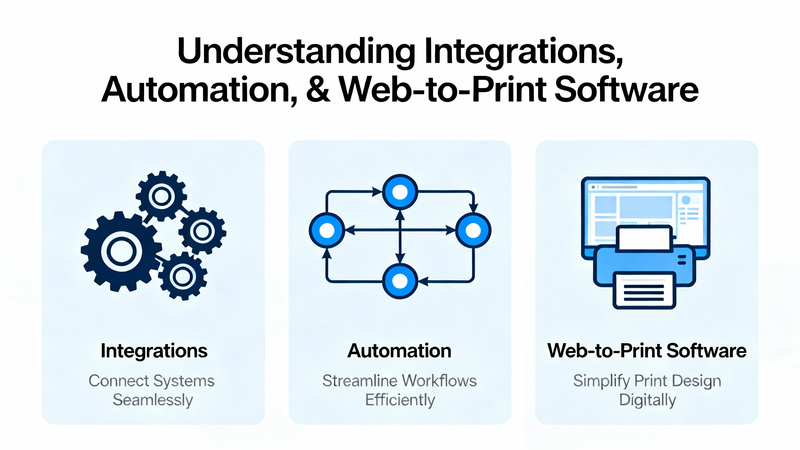
Integrations, Automation, and Web‑to‑Print Software

As you scale, the biggest cost in printing is often not the paper but the workflow. This is where the underlying web-to-print software and integrations matter more than the brand on your box.

Research from the University of Minnesota’s Digital Design and Graphics program defines web-to-print software as the layer that lets customers design, customize, and order materials online, replacing manual proofing with self-service ordering. For print providers and serious ecommerce businesses, the most valuable platforms share several traits.

Strong customization features go beyond a simple template gallery. Flexible templates should allow easy changes to layouts, images, logos, fonts, and colors. Real-time visual previews reduce mistakes and reprints. Integration with professional tools such as Adobe Creative Suite or Canva shortens the distance between design and production.

Template management systems work best when they are searchable, well organized, and enforce brand consistency across users and locations. In regulated sectors, version control and approval workflows are essential: nothing goes to print without passing review.

Order management modules should automate the journey from online order to delivery. That includes automatic data transfer from ecommerce platforms, real-time order tracking, email status updates, windows for modification or cancellation, batch processing, and integration with accounting and shipping systems. This is where POD platforms like Printful and Printify shine: they essentially wrap all of this into a service that feels like a software integration rather than a separate vendor.

Integration compatibility matters beyond ecommerce. Platforms that connect with CRM and ERP tools prevent data silos. They can power variable data printing, where each printed piece has unique data such as names or personalized offers, which research identifies as critical for targeted marketing campaigns and higher response rates. They also support capabilities such as repeat-order recommendations, automated shipment tracking, and personalized follow-up flows.

Workflow automation features such as automated preflight checks, rules-based routing of orders to the right production queues, and digital proofing and approval greatly reduce manual labor and error rates. In practice, this is the difference between a founder who spends hours every week chasing files and status updates and one whose print operations run quietly.

When choosing Vistaprint alternatives, do not overlook this software layer. For some founders, the winning move is pairing a strong marketing printer or tissue provider with a POD platform and then tying everything together through integrations and automations that handle as much of the process as possible.
Top rated online printing services comparison

Practical Steps to Move Beyond Vistaprint

Shifting away from a single-source provider like Vistaprint can feel daunting, but you do not need to switch everything overnight. In my experience mentoring ecommerce entrepreneurs, successful transitions follow a staged, deliberate approach.

Start by mapping your real print and personalized-product needs. Separate them into marketing collateral, on-demand products, packaging and tissue, and photo or wall art. For each category, list your volumes, critical use cases, and where you are currently dissatisfied, whether that is quality, speed, integration, or perceived brand fit.

Next, shortlist two or three providers in each category based on the criteria discussed earlier: product fit, pricing, quality tools such as proofs and DPI checks, delivery range and speed, customer service, and integration capabilities. Use sources like Forbes Advisor, Wirecutter, WIRED, and Shopify’s app recommendations as sanity checks rather than gospel; your own use case matters more than a generic ranking.

Then, always order samples. For marketing print, seek services that offer free or low-cost hard-copy proofs, as 48HourPrint does. For POD platforms, place small orders for key products with your own designs from several providers, then compare color, fabric or material feel, print durability, and packaging. For packaging and tissue, order low-quantity runs from iLovewrapper, Noissue, or similar specialists to hold them next to your existing Vistaprint packaging. For photo labs, compare your images printed by Nations Photo Lab or Mpix against your current supplier.

In parallel, evaluate integration and workflow fit. Connect trial accounts for POD platforms like Printful or Printify to a staging version of your Shopify or other ecommerce store. Test order flows, automated status updates, and how well they handle edge cases such as cancellations or address changes. If you use CRM or marketing automation tools, explore whether print events can trigger campaigns or vice versa.

Finally, roll changes out gradually. You might first move photo prints and wall art to Nations Photo Lab or Mpix, while keeping Vistaprint for basic business cards and flyers. Then you might add a POD platform for apparel and merch, leaving Vistaprint for only a shrinking set of legacy items. Over time, your mix of providers will reflect your actual business model instead of historical convenience.

Brief FAQ

Is Vistaprint still worth using if I adopt other providers?

Yes, very often it is. Vistaprint remains a solid choice for low-cost, general-purpose marketing materials where you are less sensitive to ultra-premium paper, specialized finishes, or tight integrations. Many businesses keep Vistaprint for basic collateral while shifting higher-impact touchpoints such as packaging, photo prints, or ecommerce-driven merch to more specialized providers.

Should I replace Vistaprint with a single alternative or build a stack of providers?

Most growth-stage brands benefit from a stack. For example, you might use UPrinting or Pixartprinting for marketing print, Printful or Printify for on-demand merch, Nations Photo Lab or Mpix for photo products, and iLovewrapper or Noissue for premium tissue and packaging. This lets each provider do what it does best while you orchestrate everything through your ecommerce, CRM, and automation tools.

How do I prevent quality surprises when I switch providers?

The combination of proofs, samples, and preflight checks is your safety net. Follow Canva’s guidance by ensuring images are high resolution, use providers that offer automated proofing to catch technical issues, and insist on physical proofs or small paid samples before large runs. Reviews from Forbes Advisor, Wirecutter, and WIRED all underscore how much real-world proofs reveal compared with trusting only on-screen previews.

When you treat printing and personalized products as an extension of your business strategy rather than a commodity, Vistaprint becomes one tool among many, not the default. The right mix of marketing printers, POD platforms, photo labs, and packaging specialists will give you better quality, stronger branding, and a workflow that scales with the kind of ecommerce business you are building.

References

  1. https://exac.hms.harvard.edu/crown-for-print
  2. https://digitalcommons.calpoly.edu/cgi/viewcontent.cgi?article=1090&context=grcsp
  3. https://ddg.wcroc.umn.edu/best-web-to-print-software/
  4. https://pressbooks.cuny.edu/printing/chapter/custom-tissue-paper/
  5. https://www.48hourprint.com/?srsltid=AfmBOooGKwiI90psVKk1HKohvUQHWNKjv7avUdPDhq-Bj4N0mhB7zrAX
  6. https://www.bestvaluecopy.com/
  7. https://www.gotprint.com/home.html?srsltid=AfmBOooeByDH7_1T3h01hzOoYHROboWrygfiH7U4LODA4PbPOBs2IxHb
  8. https://www.nationsphotolab.com/?srsltid=AfmBOoqL_JTOgmiT8DGn6yad_f1ctYzdmfnixkhnOLuRj8LO6S-Rwzpf
  9. https://www.pixartprinting.com/
  10. https://www.printplace.com/custom-printing?srsltid=AfmBOoppnNje-FxVjx6F2ECWKlIBSMBvPUxGNLHqaYYZZInWkUU7Y92m

Like the article

0
Vistaprint Alternatives: Best Personalized Product Providers for Modern Businesses

Vistaprint Alternatives: Best Personalized Product Providers for Modern Businesses

If you have been building your brand with Vistaprint, you already understand the power of getting professional print and personalized products without owning a press. Yet as stores scale from a handful of business cards to full omnichannel campaigns and print-on-demand dropshipping, the “good enough” option starts to show its limits.

In my mentoring work with ecommerce founders, this is a common inflection point. Teams realize they need richer product categories, deeper branding options, better integrations, or simply more reliable quality than they are consistently getting from a mass-market provider. At that moment, Vistaprint stops being the obvious default and becomes one option among many.

This guide walks you through the best categories of Vistaprint alternatives, how they differ, and how to choose the right mix for your business model. The focus is practical: if you are running or launching an on-demand printing or dropshipping venture, you will see where each type of provider fits in a modern tech stack.

Where Vistaprint Excels—and Why You Might Outgrow It

Vistaprint is one of the oldest and most recognizable online printers. Reviews of online printing companies consistently describe it as a low-cost, broad-catalog player, covering everything from business cards and marketing collateral to clothing, with intuitive online design tools so non-designers can get to a finished product.

One of its core strengths, highlighted in its own positioning, is the ability to reuse a single design across many different products. That design reuse gives small businesses a straightforward path to consistent branding: once you like your logo layout on a card, you can roll it onto flyers, signage, and other materials in a few clicks.

Vistaprint also extends this expertise into more niche items. For example, a ranking of custom tissue paper providers notes that Vistaprint brings its general custom-printing infrastructure to tissue paper, combining brand familiarity, solid print quality, online design tools, and fast shipping. In other words, it is a classic “generalist” printer with very good breadth.

However, the same generalism creates gaps once your needs become more specialized.

Professionals in communities such as food and wine industry groups openly ask peers for higher-quality, better-value business card printers than Vistaprint, indicating a perception that it is not always the best tradeoff between price and perceived quality. In the packaging world, that tissue paper ranking points out that Vistaprint may lack some specialty finishes compared with boutique providers. And in broader reviews of online printing services, other companies are chosen as best-in-class for speed, premium finishes, or photo output while Vistaprint is positioned as a solid, mainstream marketing solution rather than the top performer.

The bottom line is that Vistaprint remains a strong option for budget-conscious, general-purpose marketing print. You start looking for alternatives when you need one of three things: more specialized print capabilities, tighter integration with your ecommerce stack, or higher perceived quality for critical touchpoints such as premium packaging or photo prints.

How to Choose the Right Vistaprint Alternative

Before comparing providers, you need a selection framework. A recent review of Vistaprint alternatives from a print-on-demand platform for example merchants breaks the decision into several factors, which align closely with what I see in practice.

First, clarify your product category. Are you primarily buying business cards, brochures, and classic marketing materials, or are you building a catalog that includes apparel, wall art, promotional merchandise, and packaging? A Forbes Advisor review of online printing services emphasizes that many providers are best-in-class in narrow segments such as catalogs, photo art, or document printing. If you only ever need postcards and flyers, an all-purpose marketing printer is ideal. If you intend to sell custom sneakers or fine art prints, you must look beyond Vistaprint’s core set.

Second, understand pricing at the level of your real volumes. Some services are optimized for bulk orders with aggressive tiered discounts; others are built for short runs or true on-demand, even a single item at a time. Short-run specialists like Best Value Copy, for instance, explicitly eliminate minimum order requirements and setup fees so that micro-runs remain economical, while high-capacity plants such as Pixartprinting and 48HourPrint are designed to handle large daily volumes of jobs and reward scale. When you are running a dropshipping store, the per-order cost structure of print-on-demand platforms matters more than traditional “per thousand” pricing.

Third, prioritize quality validation. Multiple expert sources converge on the same advice: never rely solely on an on-screen design preview. Forbes Advisor stresses the importance of proofs, highlighting 48HourPrint for offering free next-day hard-copy proofs that let you verify color and print quality in your hands before approving a production run. Web-to-print research from the University of Minnesota recommends automated preflight checks that inspect resolution, color space, and fonts. Canva’s print guidelines advise aiming for around 300 DPI and using automated proofing to flag low-resolution images and bleed issues. Whatever provider you pick, you need an easy way to spot problems before you ship hundreds of flawed pieces.

Fourth, check delivery range and turnaround. A Vistaprint alternative guide from JetPrint notes how some printers only serve specific regions, such as United States– and Canada-only services, while others offer global shipping. If your audience is international, global fulfillment from print-on-demand networks or platforms like JetPrint, Printify, or Gelato becomes a competitive advantage. Speed matters too. Forbes calls out DocuCopies and 48HourPrint for rapid turnarounds, and Nations Photo Lab has been documented by Wirecutter and other testers as reliably meeting or beating quoted delivery windows with options ranging from free economy to expedited shipping.

Fifth, assess customer service and reliability. When you rely on on-demand printing for your revenue, poor service from your print partner quickly becomes your problem. Community discussions and expert reviews repeatedly note that responsive support is vital when something goes wrong with an order, particularly when you have to keep your own buyers updated while the printer resolves an issue.

Finally, consider integrations, automation, and data. The University of Minnesota’s web-to-print analysis emphasizes integration with ecommerce, CRM, ERP, accounting, and logistics tools, along with variable data printing (VDP) capabilities. Platforms that can automatically pull personalized data into print files, route orders to the right production queues, sync shipment status, and reduce manual touchpoints will save you real labor and error costs as you grow.

With that framework in mind, let us look at the main categories of Vistaprint alternatives and how they fit different business models.

Snapshot: Types of Vistaprint Alternatives

To orient yourself, it helps to see the landscape at a glance.

Segment

Best for

Example providers

Distinctive strengths

Online marketing printers

Business cards, flyers, catalogs, signs

UPrinting, Pixartprinting, 48HourPrint, Best Value Copy, PrintPlace, GotPrint, MOO

Bulk pricing, templates, proofs, wide collateral range

POD and dropshipping platforms

On-demand merch and apparel integrated with ecommerce

Printful, Printify, Gooten, CustomCat, Teelaunch, AOP+, JetPrint, Apliiq, Gelato, Spreadconnect, Print Aura, T-Pop, Fourthwall

No inventory, global fulfillment, storefront integrations

Photo and wall-art labs

High-end photo prints, albums, decor

Nations Photo Lab, Mpix, Pro Prints, Printique, Nations-focused services

Color accuracy, paper and finish options, archival quality

Packaging, tissue, and swag

Custom tissue, boxes, onboarding kits, branded gifts

iLovewrapper, Noissue, Packola, Digiwrap, Printfection, Zazzle, Gooten

Unboxing experience, swag boxes, eco-friendly materials

Vistaprint sits mostly in the first and fourth columns. If your needs primarily live in the second or third, you almost certainly need additional providers.

Category 1: Online Printing Companies for Marketing Collateral

If you like the Vistaprint model but want different tradeoffs on speed, price, or quality, consider specialized online printers that focus on marketing print.

UPrinting positions itself as a trusted online printer for business customers. Its messaging centers on quality, precision, and experience, backed by a claim of more than a million business professionals served. It emphasizes a multi-step quality control process, described as 33 checkpoints for “printing perfection,” across a wide range of customizable products from stickers to business cards. This type of provider is attractive when you want business-grade reliability and are willing to treat printing as a core part of your marketing operations rather than a casual purchase.

Pixartprinting, which reports more than 30 years in the market and over a million customers, is another example of a full-service commercial printer operating online. The company handles roughly fifteen thousand orders per day and offers a deep catalog: catalogs and magazines with saddle-stitch or perfect binding, labels and stickers for packaging, a broad set of marketing materials, rigid and retractable signage, cards, posters, promotional products, and drinkware. Its online workflow lets you upload print-ready files, choose paper, binding, format, and finishes, and then receive fast turnaround. This scale and breadth make Pixartprinting a serious Vistaprint alternative for businesses that want to centralize most offline marketing print in one place.

Best Value Copy is designed around short-run jobs with no order minimums, which is especially helpful for small tests or recurring but modest print needs. With more than 20 years of experience and millions of copies produced daily, it focuses on color and black-and-white copies, low pricing, and the ability to place very small or larger jobs without setup fees. If Vistaprint’s minimums or pricing structures are awkward for your use case, a short-run specialist like this fills the gap.

Speed-focused services are another important class of alternatives. FortyEightHourPrint, for example, is known for rapid production with a 48-hour production guarantee on many items. A Forbes Advisor evaluation highlights it for going beyond many competitors by offering free next-day hard-copy proofs, which is invaluable when you need to validate color, paper, and trim before committing to a run. Mimeo takes the same speed obsession into late-night ordering, enabling last-minute corporate document printing that can still arrive by 8:00 AM, using a cloud platform where you upload files from any device.

Some alternatives differentiate primarily on perceived quality and design. MOO has built a reputation as a premium business card and stationery brand, emphasizing thick stocks, refined finishes, and the ability to print multiple designs in a single set. For brands competing on perceived quality, that premium feel matters more than shaving a few cents off each card. Soloprint, by contrast, aims to combine very low prices with high-quality finishes and guided customer support for small businesses and freelancers.

Design-first ecosystems like Canva Print blur the line between design and production. Canva already serves as a design tool for millions of small businesses and creators. Canva Print turns those designs into physical products such as business cards, flyers, posters, labels, stickers, tote bags, and apparel. The platform optimizes outputs for print, recommends minimum and ideal resolutions, and provides automated proofing that checks text size, image resolution, and bleed margins. For merchants who already build assets in Canva, this integration is compelling.

Finally, some marketing-focused printers extend into swag and fulfillment. Printfection notably combines promotional product printing with inventory management and order fulfillment, including pre-assembled swag boxes for onboarding or employee rewards. Gooten appears in several contexts as a white-label provider that stocks inventory and ships to customers when orders arrive. Zazzle serves creators who want to design products and sell them on a marketplace where Zazzle handles both customer discovery and fulfillment.

If your use case is mainly business cards, flyers, posters, and event collateral, your first question is whether you want a generalist such as Vistaprint, a quality-focused provider like MOO or UPrinting, a speed specialist like 48HourPrint or Mimeo, or an integrated design-and-print ecosystem like Canva. From there, you layer in proof options, paper and finish choices, and how much support and advice you expect from the printer.

Category 2: Print-on-Demand and Dropshipping Platforms

Vistaprint was never designed as a backend for an ecommerce brand that sells hundreds of SKUs without holding inventory. For that, you need true print-on-demand platforms that integrate with your storefront and ship directly to your customers.

Printful is a leading global POD provider frequently recommended in Shopify’s own guidance for print-on-demand businesses. It offers a wide product catalog spanning clothing, home decor, and accessories, along with a mockup generator and logo maker so you can build product visuals without external design tools. Operationally, Printful supports multiple printing methods such as direct-to-garment, embroidery, cut-and-sew, and sublimation. It fulfills orders from facilities in the United States, Mexico, Europe, and other regions, with typical fulfillment in a window of roughly two to five business days and many orders completed even faster. Merchants rated it highly for quality, ease of use, and support in Shopify’s app store, and it offers perks such as sample order discounts and bulk discounts for larger runs.

Printify takes a different approach by acting as a supplier network rather than a single printer. According to evaluations by ecommerce experts, it connects merchants to more than a hundred independent print providers worldwide, which enables an enormous product catalog that stretches from standard apparel to niche items like scented candles, yoga mats, and Bluetooth speakers. Its pricing is competitively mid-range, and a premium subscription tier reduces unit costs enough that a relatively small number of monthly sales can cover the fee. Printify’s flexibility is powerful, but quality can vary by provider, so it offers provider rankings based on reprint rates and production times. This model suits entrepreneurs willing to test and manage multiple print partners in exchange for reach and cost advantages.

Gooten operates in yet another mode. It does not own production facilities; instead it routes each order to the most suitable partner in its global network. Shopify’s assessment describes Gooten as particularly strong in homeware and lifestyle products, with more than two hundred items ranging from apparel and wall art to blankets, pillows, and shower curtains. It uses production methods such as direct-to-garment, direct-to-film, dye-sublimation, UV printing, and embroidery, and typically produces within a couple of days, with fulfillment soon after. A separate analysis by a print-on-demand specialist notes that Gooten supports extra print placements, such as shirt sleeves and backs, and uses a fixed pricing strategy that simplifies profit prediction. The tradeoff is that some items are priced higher, and you must handle your own marketing since Gooten does not provide a consumer marketplace.

Beyond these three large players, there is a long tail of specialized POD providers that can serve as targeted Vistaprint alternatives.

AOP+ focuses on all-over printing using dye sublimation, with in-house production and fulfillment from centers in the United Kingdom, United States, and Europe. It lets you include custom packing slips and other branding options such as private labeling and packaging stickers on paid plans. Standard lead times for all-over-print items are longer, often a week to ten business days for production, so it suits brands that prioritize unique print coverage over speed.

Teelaunch positions itself as a versatile POD provider for apparel, wall art, drinkware, home products, and accessories, with most orders to the United States, United Kingdom, and Canada delivered within three to six days. It offers a personalization tool and high-quality mockups so you can easily visualize designs. Some reviewers note limitations in its customer service responsiveness, so it is best for merchants who value product variety and speed but do not expect to lean heavily on support.

CustomCat is notable for its catalog size and variety of print methods. Analyses of Printful alternatives describe it as offering more than five hundred products across apparel, housewares, and accessories, with options including direct-to-garment printing, sublimation, three-dimensional dyes, and embroidery. It provides strong discounts on products through a premium plan, offset by somewhat slower shipping windows, especially for international orders, and higher delivery costs to certain locations.

Print Aura targets entrepreneurs who want flexibility with no order minimums. It covers dozens of products, from face coverings and t-shirts to mugs and bags, with standard turnaround times of approximately three to five days and an expedited option for 48-hour processing. It invests in branding options such as customized return labels, packing slips, and neck labels, and supports global shipping. Slow customer service and expensive shipping to some regions are known challenges.

T-Pop, based in France, serves European brands looking for ethical, eco-friendly print-on-demand. It guarantees that products are produced and packaged in socially conscious ways and enables options like logos on packaging. Orders are prepared in a few days and delivered within roughly a week across much of Europe, but the platform is mainly intended for European store owners and some items have longer timelines.

JetPrint stands out for its focus on unique products such as custom shoes and watches alongside apparel and masks. It typically offers a three-day production time and a delivery window in the range of a week to twenty days worldwide, with options for express shipping. Reviews emphasize both the appeal of its unusual catalog and the tradeoff of potentially slower processing and higher prices.

Other notable POD providers include Apliiq, which offers private-label garment customization with woven labels, custom linings, and patches for brands that want retail-level differentiation; Gelato, which uses a large network of print partners in more than thirty countries and algorithmically routes orders to nearby facilities, making it attractive for global reach and sustainability; and Spreadconnect, which is optimized for fast fulfillment with a more limited product range but a high proportion of orders shipped within 48 hours.

If you are running a Vistaprint-powered business and want to transform it into a fully online merch or apparel brand, these platforms are your primary alternatives. Vistaprint can still be your marketing print provider, while Printful, Printify, Gooten, or their peers quietly handle all production, packing, and shipping in the background when customers place orders in your store.

Category 3: Photo and Wall-Art Specialists

For many brands, especially in photography, art, and luxury products, the most important personalized items are not business cards but prints and wall decor. Here, specialized labs significantly outperform generalists.

Nations Photo Lab is a strong example. Wirecutter’s detailed testing selected Nations Photo Lab as the best combination of quality, price, options, and service for online photo printing. Users can upload images from computers or mobile devices via a simple interface, choose from a wide range of sizes and paper types, and see clear pricing while configuring their order. Available sizes range from wallet sets to large prints, with mounting options on foamcore, gatorboard, matboard, and similar substrates. Testers reported that Nations’ prints showed excellent detail and color accuracy across a wide span of skin tones, and that optional low-cost color correction improved casual snapshots.

Shipping performance and packaging are critical parts of the value proposition. Nations offers multiple shipping speeds and has repeatedly met or exceeded advertised delivery windows, including same-day printing and shipping for some expedited orders and free economy options that arrived earlier than promised in testing. Its packaging is unusually secure: prints arrive in fitted boxes with envelopes or sleeves, cardboard backing, and plastic wrap that keeps everything immobile so corners remain intact, a clear step up from competitors whose prints shifted and were damaged. The lab also provides gift-oriented packaging such as boutique boxes with ribbons and custom presentation boxes that can include images or logos, which is ideal if you want to send prints directly to clients or as gifts.

On the product side, Nations Photo Lab’s catalog covers photo prints in many sizes, albums, photo books, square prints, canvas prints, metal and acrylic prints, and specialized offerings such as custom baseball cards. It invests in fine art Giclée prints that offer museum-quality finishes for wall art. A separate review from its own site highlights a strong focus on holiday gifting with customizable cards and ornaments, as well as a wedding range designed for long-term preservation.

Mpix is another standout photo printer identified in an in-depth review of online photo printing services from WIRED. Mpix, an offshoot of Miller’s Professional Imaging, combines consumer accessibility with professional lab heritage. In testing, it produced high-quality prints on Kodak Endura paper, with the E-surface option delivering rich, deep blacks and very true-to-life colors. Notably, prints ordered in 2013 were reported to look essentially unchanged more than a decade later, indicating excellent fade resistance. Standard 4 by 6 prints were priced in the mid tens of cents, illustrating a price-quality balance that WIRED considered a strong value.

Both Nations and Mpix are focused on photo output rather than general marketing collateral. They invest in paper types, finishes such as glossy, matte, and lustre, archival longevity, and careful color management. For brands where imagery is the product—photographers, artists, premium gift sellers—these labs are powerful alternatives to Vistaprint for any photo-centric product, from loose prints to high-end wall decor.

Category 4: Packaging, Tissue, and Branded Swag

The unboxing moment is a critical piece of brand storytelling. Custom packaging, tissue, and swag can elevate your perceived value far beyond what a generic poly mailer ever could.

A comparative review of custom tissue paper providers ranks iLovewrapper as a top choice for luxury-feeling tissue paper. It uses high-grade, sustainable fibers and offers extensive options for color, texture, and finish, resulting in a durable, premium feel. Its online tools make design selection and customization easy, and it supports fast production and shipping, competitive pricing with bulk discounts, low minimum order quantities suitable for small businesses, and strong customer support.

Noissue focuses on environmentally conscious brands, using recycled and sustainable materials and flexible order quantities. It is recommended as the best eco-focused option in that tissue paper ranking, even though production times can sometimes run longer. For brands that build their story around sustainability, this type of provider is often a better fit than a generalist printer’s tissue extension.

Packola emphasizes custom packaging ecosystems, offering not only tissue paper but also boxes and other packaging elements to build cohesive unboxing experiences. It highlights unique designs, high-quality printing, responsive support, and bulk discounts, making it attractive for companies that want the packaging itself to be a marketing channel. Digiwrap, another tissue paper provider, provides flexible order sizes, sharp printing, and competitive pricing, with the tradeoff that specialty finishes and templates are more limited.

Beyond tissue and boxes, swag management has its own specialists. Printfection, mentioned earlier, combines promotional products with inventory management and fulfillment. Its curated swag boxes are popular for employee onboarding and rewards, and its platform approach helps brands move beyond ad-hoc orders toward a structured swag program. Gooten, Zazzle, and similar services expand this world by enabling white-label merchandise, on-demand stock, and marketplace selling, depending on your model.

Vistaprint does appear in the tissue and packaging space and is praised for bringing its general print quality and design tools to tissue paper. That said, the same comparison shows that niche providers offer features such as more luxurious fibers, customized finishes, low minimums, or eco guarantees that Vistaprint does not always match. If your goal is a memorable unboxing experience or sustainable packaging story, specialized alternatives are usually the better route.

Integrations, Automation, and Web‑to‑Print Software

As you scale, the biggest cost in printing is often not the paper but the workflow. This is where the underlying web-to-print software and integrations matter more than the brand on your box.

Research from the University of Minnesota’s Digital Design and Graphics program defines web-to-print software as the layer that lets customers design, customize, and order materials online, replacing manual proofing with self-service ordering. For print providers and serious ecommerce businesses, the most valuable platforms share several traits.

Strong customization features go beyond a simple template gallery. Flexible templates should allow easy changes to layouts, images, logos, fonts, and colors. Real-time visual previews reduce mistakes and reprints. Integration with professional tools such as Adobe Creative Suite or Canva shortens the distance between design and production.

Template management systems work best when they are searchable, well organized, and enforce brand consistency across users and locations. In regulated sectors, version control and approval workflows are essential: nothing goes to print without passing review.

Order management modules should automate the journey from online order to delivery. That includes automatic data transfer from ecommerce platforms, real-time order tracking, email status updates, windows for modification or cancellation, batch processing, and integration with accounting and shipping systems. This is where POD platforms like Printful and Printify shine: they essentially wrap all of this into a service that feels like a software integration rather than a separate vendor.

Integration compatibility matters beyond ecommerce. Platforms that connect with CRM and ERP tools prevent data silos. They can power variable data printing, where each printed piece has unique data such as names or personalized offers, which research identifies as critical for targeted marketing campaigns and higher response rates. They also support capabilities such as repeat-order recommendations, automated shipment tracking, and personalized follow-up flows.

Workflow automation features such as automated preflight checks, rules-based routing of orders to the right production queues, and digital proofing and approval greatly reduce manual labor and error rates. In practice, this is the difference between a founder who spends hours every week chasing files and status updates and one whose print operations run quietly.

When choosing Vistaprint alternatives, do not overlook this software layer. For some founders, the winning move is pairing a strong marketing printer or tissue provider with a POD platform and then tying everything together through integrations and automations that handle as much of the process as possible.

Top rated online printing services comparison

Practical Steps to Move Beyond Vistaprint

Shifting away from a single-source provider like Vistaprint can feel daunting, but you do not need to switch everything overnight. In my experience mentoring ecommerce entrepreneurs, successful transitions follow a staged, deliberate approach.

Start by mapping your real print and personalized-product needs. Separate them into marketing collateral, on-demand products, packaging and tissue, and photo or wall art. For each category, list your volumes, critical use cases, and where you are currently dissatisfied, whether that is quality, speed, integration, or perceived brand fit.

Next, shortlist two or three providers in each category based on the criteria discussed earlier: product fit, pricing, quality tools such as proofs and DPI checks, delivery range and speed, customer service, and integration capabilities. Use sources like Forbes Advisor, Wirecutter, WIRED, and Shopify’s app recommendations as sanity checks rather than gospel; your own use case matters more than a generic ranking.

Then, always order samples. For marketing print, seek services that offer free or low-cost hard-copy proofs, as 48HourPrint does. For POD platforms, place small orders for key products with your own designs from several providers, then compare color, fabric or material feel, print durability, and packaging. For packaging and tissue, order low-quantity runs from iLovewrapper, Noissue, or similar specialists to hold them next to your existing Vistaprint packaging. For photo labs, compare your images printed by Nations Photo Lab or Mpix against your current supplier.

In parallel, evaluate integration and workflow fit. Connect trial accounts for POD platforms like Printful or Printify to a staging version of your Shopify or other ecommerce store. Test order flows, automated status updates, and how well they handle edge cases such as cancellations or address changes. If you use CRM or marketing automation tools, explore whether print events can trigger campaigns or vice versa.

Finally, roll changes out gradually. You might first move photo prints and wall art to Nations Photo Lab or Mpix, while keeping Vistaprint for basic business cards and flyers. Then you might add a POD platform for apparel and merch, leaving Vistaprint for only a shrinking set of legacy items. Over time, your mix of providers will reflect your actual business model instead of historical convenience.

Brief FAQ

Is Vistaprint still worth using if I adopt other providers?

Yes, very often it is. Vistaprint remains a solid choice for low-cost, general-purpose marketing materials where you are less sensitive to ultra-premium paper, specialized finishes, or tight integrations. Many businesses keep Vistaprint for basic collateral while shifting higher-impact touchpoints such as packaging, photo prints, or ecommerce-driven merch to more specialized providers.

Should I replace Vistaprint with a single alternative or build a stack of providers?

Most growth-stage brands benefit from a stack. For example, you might use UPrinting or Pixartprinting for marketing print, Printful or Printify for on-demand merch, Nations Photo Lab or Mpix for photo products, and iLovewrapper or Noissue for premium tissue and packaging. This lets each provider do what it does best while you orchestrate everything through your ecommerce, CRM, and automation tools.

How do I prevent quality surprises when I switch providers?

The combination of proofs, samples, and preflight checks is your safety net. Follow Canva’s guidance by ensuring images are high resolution, use providers that offer automated proofing to catch technical issues, and insist on physical proofs or small paid samples before large runs. Reviews from Forbes Advisor, Wirecutter, and WIRED all underscore how much real-world proofs reveal compared with trusting only on-screen previews.

When you treat printing and personalized products as an extension of your business strategy rather than a commodity, Vistaprint becomes one tool among many, not the default. The right mix of marketing printers, POD platforms, photo labs, and packaging specialists will give you better quality, stronger branding, and a workflow that scales with the kind of ecommerce business you are building.

References

  1. https://exac.hms.harvard.edu/crown-for-print
  2. https://digitalcommons.calpoly.edu/cgi/viewcontent.cgi?article=1090&context=grcsp
  3. https://ddg.wcroc.umn.edu/best-web-to-print-software/
  4. https://pressbooks.cuny.edu/printing/chapter/custom-tissue-paper/
  5. https://www.48hourprint.com/?srsltid=AfmBOooGKwiI90psVKk1HKohvUQHWNKjv7avUdPDhq-Bj4N0mhB7zrAX
  6. https://www.bestvaluecopy.com/
  7. https://www.gotprint.com/home.html?srsltid=AfmBOooeByDH7_1T3h01hzOoYHROboWrygfiH7U4LODA4PbPOBs2IxHb
  8. https://www.nationsphotolab.com/?srsltid=AfmBOoqL_JTOgmiT8DGn6yad_f1ctYzdmfnixkhnOLuRj8LO6S-Rwzpf
  9. https://www.pixartprinting.com/
  10. https://www.printplace.com/custom-printing?srsltid=AfmBOoppnNje-FxVjx6F2ECWKlIBSMBvPUxGNLHqaYYZZInWkUU7Y92m

Like the article

0