
Custom Products in Small Quantities: How to Order Personalized Gifts in Low Volumes

Custom Products in Small Quantities: How to Order Personalized Gifts in Low Volumes

Jan 3, 2026 by Iris POD e-Commerce 101

The Quiet Revolution in Custom Gifting

If you run an on-demand printing or dropshipping business, you are standing right in the middle of a quiet revolution. For years, branded merchandise meant ordering 500 mugs or 1,000 pens, storing them in a warehouse, and hoping you guessed the right color and tagline. Today, more brands are shifting toward low-minimum or even one-off personalized gifts.

Allbranded describes “small quantity promotional items” as fully branded products ordered in relatively low volumes instead of traditional bulk runs. Crestline showcases low-minimum kitting and drop-shipping services that let companies send custom gifts directly to individual home addresses. MOO has gone as far as highlighting a minimum order quantity of one for personalized merchandise, explicitly encouraging businesses to trade bulk swag for high-impact, individual gifts.

From my work advising ecommerce founders, I see the same pattern over and over: the brands that learn to profit from small-quantity custom products tend to build stronger relationships, waste less, and move faster than competitors stuck in bulk-only thinking.

This article will walk you, as a builder in the on-demand printing and dropshipping space, through what “custom products, small quantity” really means, when it makes sense, and how to design a strategy that is financially and operationally sound.

What “Custom Products, Small Quantity” Actually Means

In practical terms, custom products in small quantities are personalized or branded items ordered in low runs instead of traditional bulk quantities. Crestline’s low-minimum catalog includes drinkware, bags, tech accessories, apparel, and curated gift boxes where minimums can start as low as a handful of pieces, sometimes even one to three units for certain sets and tech gifts. Allbranded emphasizes that these low quantities are fully designable and printable; companies can still apply their logos, slogans, or custom artwork, just without committing to massive volumes.

This is not only a corporate gifting story. Marketplaces such as Etsy show entire categories of “small personalized gifts in bulk,” aimed at people planning weddings, local events, or corporate functions. These are typically physically small, low-cost items customized with names, dates, logos, or short messages and purchased across dozens of units, not thousands.

The on-demand printing and dropshipping model fits naturally here. Instead of printing and storing inventory, you spin up a catalog where items are produced only when ordered. MOO’s approach to minimum orders of one is a good example: brands can create highly tailored gifts like engraved pens or water bottles for each recipient without having to pre-buy inventory. Corporate gift vendors such as Marigold & Grey and Packed with Purpose go a step further by offering curated gift boxes and direct-to-recipient logistics, essentially acting as dropshipping partners for multi-address, small-batch programs.

At its core, small-quantity custom gifting is about flipping the equation from cost-per-unit to impact-per-recipient.

Why Low-Volume Custom Gifts Are Growing

Several forces are pushing brands toward smaller, more thoughtful runs of personalized products, and the research you provided reinforces this from multiple angles.

Allbranded highlights exclusivity. When a promotional item exists only in limited quantities, recipients perceive it as more valuable and feel more appreciated, which boosts engagement and loyalty. The item feels like something chosen for them, not a leftover from a trade show crate.

Sustainability is another driver. Allbranded stresses that ordering only what you need reduces overproduction and waste, aligning with eco-conscious expectations without sacrificing brand visibility. Bestowe notes that small, artisan-led businesses cannot instantly ramp production like mass manufacturers, which makes early, thoughtful ordering essential. By planning and ordering smaller but more intentional batches from these makers, companies support more sustainable production instead of fueling wasteful peaks.

Budget control is a third factor. Allbranded and Crestline both point out that low-minimum orders help businesses with tight marketing budgets avoid tying up capital in storage closets full of outdated swag. Yes, the unit cost is often higher than a huge bulk order, but the overall spend can be lower and better aligned with near-term goals.

Finally, there is the relationship and loyalty angle. MOO cites survey data that eighty-three percent of recipients felt closer to companies that sent them a gift. Wirecutter, in its coverage of personalized gifts, emphasizes how items like custom sneakers become unusually thoughtful presents when the design is tailored with colors, prints, and initials. This is exactly the impact brands are chasing when they invest in low-volume, highly personalized items instead of generic giveaways.

Key Use Cases for Small-Quantity Personalized Gifts

Corporate and B2B Relationship Building

Corporate gifting is no longer just about sending a standard basket of cookies in December. Prize Possessions, Bestowe, Marigold & Grey, Small Batch, Packed with Purpose, and others all illustrate how companies are using curated, branded, often artisan-made gifts to deepen relationships with employees, clients, and partners.

Prize Possessions specializes in precision-engraved awards and keepsakes and supports both single-piece retail and low-minimum wholesale orders. This is particularly powerful for programs where each award or recognition piece is personalized with the recipient’s name, title, and milestone, making a run of twenty or fifty items feel like twenty or fifty individual gestures rather than a bulk shipment.

Crestline and VistaPrint highlight mail-friendly gifts and drop-shipping, sending branded drinkware, bags, or curated gift boxes directly to employees and clients at home. That is essential in a world where teams are distributed and in-person events are less predictable.

Impact-driven vendors such as Packed with Purpose and Bestowe go further by curating boxes entirely from small-batch, women-owned, Black-owned, or LGBTQ+ owned brands. A Many Thanks Gift Basket from Packed with Purpose, for example, combines snacks, beverages, and artisan-made goods while telling the story of mission-driven “Impact Partners” whose products create jobs and support equity. For companies with strong DEI or community goals, a small-batch gift program like this turns each send into both a relationship touchpoint and a values statement.

In all of these examples, the volume per send is often modest: dozens or a few hundred gifts, highly tailored to audience and occasion, frequently produced and fulfilled on demand.

Startups, Creators, and Small Ecommerce Brands

For founders running small ecommerce brands or creator-led businesses, low-minimum custom products are often the only viable entry point into physical merchandise. Allbranded notes that small quantity orders are ideal for startups that cannot afford to lock up cash in bulk inventory. By ordering in low volumes, they can “test the waters” with new product types, designs, or slogans without a major financial plunge.

MOO’s minimum of one for branded merchandise underscores this shift. Instead of ordering hundreds of units, a creator can design a single premium item for a top supporter or a small batch for a limited release. Boxup Luxury Gifting demonstrates the same idea on the gifting side, offering curated hampers with a minimum order of only ten units, making premium personalized gifts feasible even for small campaigns or early-stage teams.

Marketplaces such as Etsy aggregate countless small personalized gifts that can be ordered in bulk for events or sold one by one through a storefront. When combined with on-demand printing and dropshipping operations, founders can launch new product lines with almost no inventory risk, then scale the winners into larger runs later.

Events, Launches, and Seasonal Campaigns

Small-quantity custom products shine in time-bound campaigns where relevance matters more than scale. Allbranded points out that limited-time events and short-term promotions are ideal use cases because brands can design items specifically for the occasion without ending up with outdated inventory.

Trade shows, conferences, and community events are classic examples. Allbranded recommends pairing low-minimum higher-value items like padfolios with bulk items such as lanyards to create a layered impression. Crestline echoes this by offering kitting services and curated gift boxes that can be used for new hires, remote teams, or special events where each kit feels coherent and intentional.

Seasonal campaigns add another layer of complexity. Bestowe warns that small-batch artisans cannot scale production at the last minute, especially around holidays, and that supply chain disruptions make early ordering essential. Their advice is clear: if you want small-quantity custom gifts for the holiday window, you need to plan ahead, especially when incorporating custom packaging, branded tags, or wax seals that add lead time.

In practice, what I advise founders is to treat each event or seasonal campaign as a limited collection. Create a design or curated box that lives only for that moment, order in sensible low quantities, and then retire or evolve the concept after the campaign. This mirrors the “drop” culture that has worked so well in fashion and streetwear, but adapted to corporate and B2B gifting.

Pros and Cons of Ordering Custom Products in Low Volumes

Every smart entrepreneur wants the upside of personalization without getting trapped in a high-cost, low-margin corner. To make informed decisions, it helps to look at the trade-offs side by side.

Aspect

Small-Quantity Custom Gifts

Traditional Bulk Orders

Minimums

Very low, sometimes one to a few pieces, ideal for testing and VIPs

High minimums, better suited for large campaigns and standardized swag

Unit Cost

Higher per item, especially for complex personalization

Lower per item through economies of scale

Cash Flow

Lower upfront spend and less money stuck in unsold inventory

Higher upfront investment with potential long-term usage

Personalization Depth

Often supports individual names, tailored messages, curated assortments

Typically logo-centric, with limited recipient-level customization

Flexibility

Easy to change designs, test new products, or align with seasonal trends

Harder to pivot; leftover stock can feel dated

Sustainability

Less overproduction and waste when you order only what you truly need

Risk of discarded or unused items if designs or messaging become obsolete

These trade-offs are not theoretical. Allbranded explicitly notes that while unit costs can be higher, small quantity orders allow greater flexibility and experimentation, and they reduce the risk of investing in bulk stock that might not resonate. Bestowe emphasizes that with small-batch artisan goods, early planning is essential because supply cannot be ramped overnight. SwagMagic illustrates the economics by showing price tiers across pens, keychains, apparel, and tech items; bulk drives the price per piece down, but not every program needs a thousand units.

From an entrepreneurial standpoint, the question is not “Is small quantity always better?” but rather “Which parts of my product mix or gifting strategy deserve small-batch treatment, and where does bulk still make sense?” High-value clients, top employees, limited releases, and special campaigns often warrant low-volume but high-impact custom items. Everyday swag for broad awareness might justify larger runs.

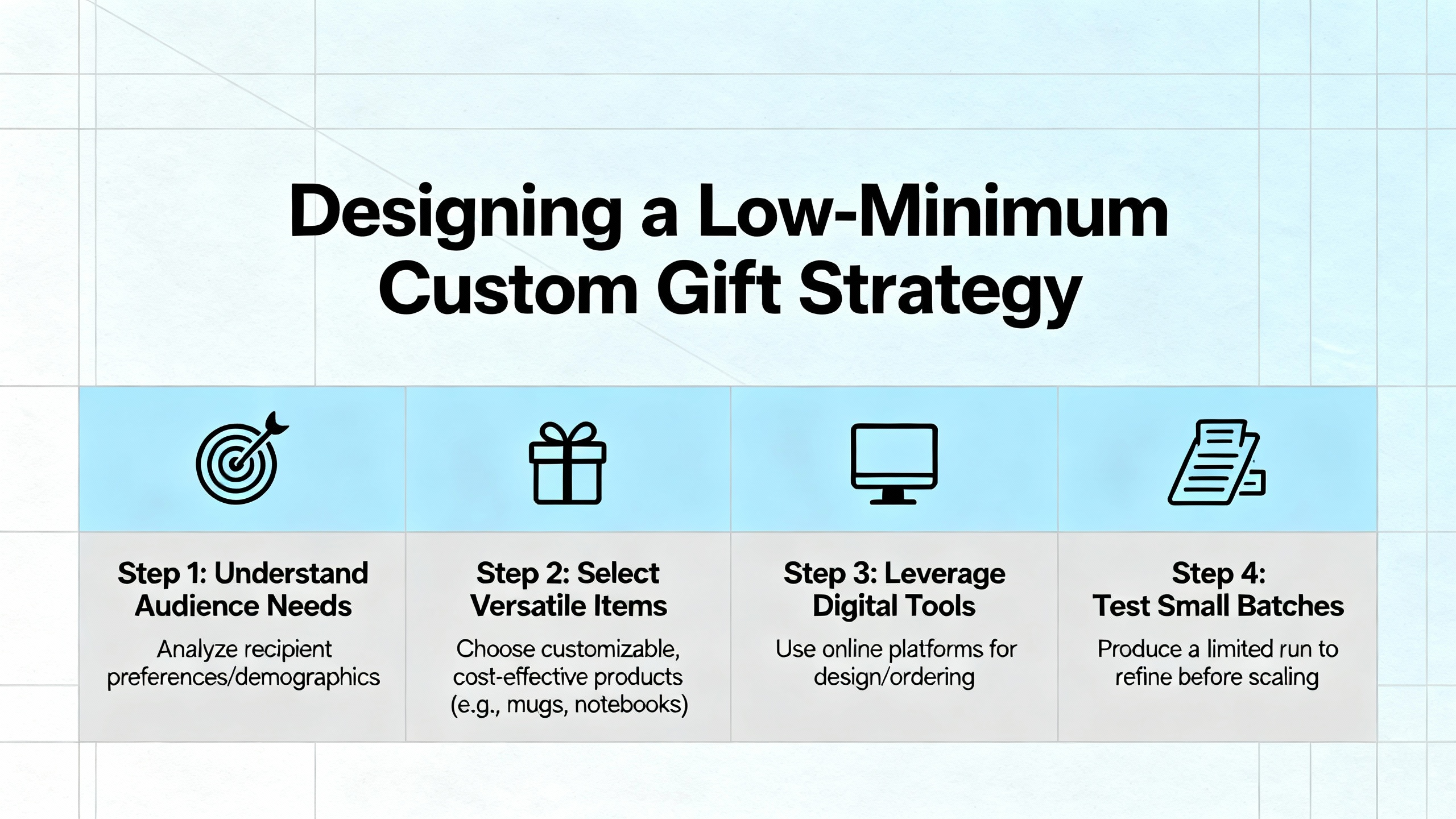
Designing a Low-Minimum Custom Gift Strategy

Clarify Objectives and Recipients

Bestowe’s guidance on corporate gifting starts in the right place: know who the gift is for and what you want it to achieve. There is a meaningful difference between custom gifting centered on recipient tastes and needs and branded gifting centered on your logo. A wellness-themed box for employees, an activity kit for families, or a gourmet snack box from small artisans serves a different purpose than another logo mug.

Before you design the products or hit publish on a new on-demand collection, write down the specific behaviors or feelings you are trying to influence. Are you aiming for higher retention among top clients, more enthusiasm during onboarding, stronger engagement at an event, or deeper alignment with your values around sustainability or DEI? The answer determines both which products you choose and whether small-quantity personalization is worth the premium.

Choose Product Types and Vendors Carefully

Your research notes cover a broad spectrum of vendors, each with its strengths. Prize Possessions excels at precision-engraved awards and keepsakes. Crestline offers a wide mix of corporate gifts and promotional items with direct-mail-friendly options and kitting. Marigold & Grey, Packed with Purpose, Small Batch, and Bestowe focus on curated gift boxes and multi-address shipping, often with social impact baked in. SwagMagic and Swagify specialize in customizable promotional products, swag boxes, and bulk ordering with clear price tiers.

On the design-forward and personalization end, Mark & Graham and MOO focus on high-end or individually tailored gifts. MOO uses personalized Twist Pens and water bottles as examples of everyday items that become powerful relationship anchors when they include names, dates, or even inside jokes. Wirecutter, in its review of personalized gifts, highlights customizable sneakers where you can adjust colors and add embroidered initials, underscoring how detailed personalization drives emotional impact.

For your own on-demand or dropshipping store, you do not need to replicate every category. Instead, match vendors and product types to your strategy. Use engraving-focused partners for formal awards, curated box specialists for VIP or remote-team programs, and broad promo catalogs for practical everyday items. When evaluating vendors, follow Bestowe’s advice and ask about customization capabilities, minimums, lead times, proofing processes, and their ability to handle your volume, whether that is fifty gifts or several thousand.

Decide on Fulfillment: On-Demand, Dropshipping, or In-House

Fulfillment is where many founders underestimate complexity. Crestline and other providers highlight drop-shipping as a way to send custom gifts directly to individual addresses from a single list. Marigold & Grey and Packed with Purpose handle end-to-end logistics for multi-address campaigns, from kitting to shipping. Awards.com notes typical timelines of about one to two weeks after proof approval for customized corporate gifts, and Swagify mentions that some custom items may require one to four weeks of lead time.

If you operate an on-demand printing or dropshipping business, you effectively become the fulfillment backbone. That is an opportunity and a responsibility. You need to design workflows for receiving orders, generating personalization details, pushing jobs to production, packing, and shipping to many addresses with minimal friction. For ongoing corporate gifting programs, some vendors even build private online stores where employees or clients select their own gifts within a controlled catalog; Crestline and SwagMagic both reference this kind of capability.

In practice, you have three main options. You can outsource everything to a gifting partner and focus on sales and strategy. You can build your own lightweight kitting and dropshipping operation using print-on-demand backends and shipping software. Or you can adopt a hybrid approach, using specialist partners for complex boxes or awards while handling simple items in-house.

Budgeting, Pricing, and Margin Management

From a mentor’s perspective, this is where otherwise smart founders get blindsided. They fall in love with a beautifully curated gift box, set a price that feels reasonable, and only later realize they ignored personalization labor, kitting time, and multi-address shipping fees.

Use the data you do have to ground your pricing. SwagMagic’s catalog, for example, shows that everyday-use items like pens, keychains, and stress balls can sit under a few dollars each at volume, while branded apparel, drinkware, and tech accessories carry much higher unit costs. Impactful curated boxes such as Packed with Purpose’s premium gratitude gift can land in the hundreds of dollars. Your own offerings will likely live somewhere in between.

The right way to think about small-quantity custom products is to work backwards from customer lifetime value, not just per-unit margin. When a curated, personalized gift helps retain a client for another year or increases employee engagement in a way that reduces turnover, the economics look very different from a simple resale of merchandise. MOO’s survey insight that a large majority of recipients feel closer to companies that send them gifts supports this relationship-focused ROI model.

Operationally, build a simple model that includes base product cost, decoration or printing cost, kitting labor, packaging, and individual shipping where applicable. Add a margin that reflects not only your expenses but the strategic value you deliver, especially if you are handling creative, vendor selection, and logistics as a managed service.

Managing Branding and Personalization

Bestowe draws a helpful distinction between branding and personalization. Branded gifts center your logo; custom gifts center the recipient. Both can live on the same item when done thoughtfully. Swagify and SwagMagic encourage subtle branding through logos, names, embossed corporate cards, or customized packaging that keeps the brand visible without overwhelming the recipient.

MOO’s examples show how personalization can be anchored in small details: engraving a Twist Pen with a new hire’s start date, printing a water bottle with a team mantra, or adding an inside joke that only the recipient understands. Wirecutter’s discussion of personalized sneakers reinforces that initials on a heel stripe can feel stylish and discreet, yet unmistakably meant for that person.

When you design low-minimum custom products, decide clearly how much of the gift is about your brand and how much is about the recipient. In my experience, the sweet spot is a useful, well-designed product where your logo is present but secondary, and the personalization is what makes the item emotionally sticky.

Logistics, Lead Times, and Risk Management

Every vendor in your research quietly says the same thing: plan ahead. Awards.com indicates that customized corporate gifts typically ship within about one to two weeks after proof approval. Swagify notes that engraved pens, custom address books, and seasonal chocolate assortments can require between one and four weeks. Bestowe warns that small-batch artisans have limited capacity and that holiday shipping delays are likely to intensify.

On-demand and dropshipping models can shorten some of this cycle, but they do not eliminate proofing, personalization, or supply constraints. The safest approach is to work backwards from your in-hand date, build in time for proofs and changes, and add a buffer for shipping disruptions. For complex curated boxes or social-impact collections, order even earlier.

From a risk perspective, low-quantity custom items help you avoid being stuck with large amounts of obsolete stock, but they introduce operational risks if you underestimate complexity. Small errors in names, spellings, or addresses can have outsized emotional impact because each gift feels personal. That makes accurate data collection and quality control non-negotiable parts of your process.

When to Scale from Small Batches to Larger Runs

Eventually, you will discover patterns in your small-quantity experiments. Perhaps a certain personalized tumbler design becomes a favorite across multiple clients, or a particular curated snacks-and-socks box gets reordered repeatedly. This is when it can make sense to graduate that product from small-batch-only status to a larger run.

Vendors like 4imprint and SwagMagic are built exactly for that scenario. They excel at large-scale promotional products where consistent branding and competitive pricing matter more than ultra-deep personalization. The advice from Prize Possessions, Crestline, and others is to match the vendor and order size to the program’s purpose: keep small, highly personalized runs for VIPs, key milestones, and special campaigns; use bulk for broad awareness, everyday swag, and standardized onboarding kits.

As a founder in the on-demand and dropshipping world, this means your store can and should offer both. Lead with small-quantity, high-impact custom products as your differentiator, and then introduce bulk-friendly options once you have enough demand to justify them.

FAQ: Small-Quantity Custom Products and Low-Volume Gifting

Can I profitably sell one-off personalized products?

Yes, but only if you treat them as value-added services, not just decorated commodities. MOO’s move to minimum order quantities of one and its focus on impact-per-person rather than cost-per-unit is a useful mindset shift. If your one-off or very small runs are tied to high-value relationships, premium positioning, or managed corporate gifting programs, your margin comes from strategy, curation, and logistics, not just from printing.

How low should my minimums be?

There is no universal answer, but the market is clearly moving toward lower thresholds. Crestline offers some products in very small batches, Boxup operates at minimums around ten units, and multiple curated-box vendors support orders starting at dozens rather than hundreds. As a rule of thumb in on-demand and dropshipping, default to low minimums and then use pricing tiers to reward clients who commit to larger volumes.

What if my clients still want traditional bulk swag?

You do not have to choose between small-quantity custom products and bulk orders. The most resilient gifting and promo businesses offer both. Use small-batch, highly personalized items for VIP programs, milestone celebrations, and social-impact campaigns, as demonstrated by vendors like Packed with Purpose and Bestowe. Use bulk-friendly items for broad awareness at trade shows or large onboarding cohorts. Your value lies in helping clients decide which approach fits each objective.

Closing Thoughts for Founders and Brand Leaders

The future of gifting and promotional products is not about flooding the world with more stuff; it is about sending fewer, smarter, more personal items that people actually keep and use. Small-quantity custom products, powered by on-demand printing and dropshipping, put that future within reach of even the leanest startup.

If you combine thoughtful recipient-centric design, disciplined unit economics, reliable fulfillment, and the flexibility of low minimums, you will not just sell personalized gifts in low volumes. You will build a durable, relationship-driven business that clients rely on whenever the moment really matters.

References

  1. https://boxfox.com/?srsltid=AfmBOorRZGRhZZ3oBRFTzmmN8TCbYUmCOHdhOLjKhZoSVHWJskRutury
  2. https://marigoldgrey.com/?srsltid=AfmBOoqnqqMPuUVHb-8wIZI8euc0nds_xNPLuKnlDa3kEJhyCld8J8-E
  3. https://www.personalcreations.com/?srsltid=AfmBOooBQovKxj2EwlBxiJVye7L98To1tAuf0WbKVwdrRvQF_3h41bbP
  4. https://www.personalizationmall.com/Personalized-Business-Gifts-s3.store?srsltid=AfmBOor2b0oqHglE7nXwv2RM7wFFNLLbEdFToTJ7AYYsGoxHPEh1Azl8
  5. https://www.thingsremembered.com/
  6. https://www.awards.com/personalized-corporate-gifts/1?srsltid=AfmBOoqaSYlYKYJSLsr6qq7vwad0hIAtIdMV2M6KrJRnHmZ39-6hjhvo
  7. https://corporategift.com/shop-by/no-minimum-customized-gifts.html
  8. https://crestline.com/b/corporate-gifts
  9. https://www.etsy.com/market/personalized_gifts_for_businesses
  10. https://shop.packedwithpurpose.gifts/collections/all-gifts?srsltid=AfmBOopcrNK8aBQk5gPYHoAtN9PKOQVnvOF_Sg8kGFT9Ey8fBvcPz3G4

Like the article

0
Custom Products in Small Quantities: How to Order Personalized Gifts in Low Volumes

Custom Products in Small Quantities: How to Order Personalized Gifts in Low Volumes

The Quiet Revolution in Custom Gifting

If you run an on-demand printing or dropshipping business, you are standing right in the middle of a quiet revolution. For years, branded merchandise meant ordering 500 mugs or 1,000 pens, storing them in a warehouse, and hoping you guessed the right color and tagline. Today, more brands are shifting toward low-minimum or even one-off personalized gifts.

Allbranded describes “small quantity promotional items” as fully branded products ordered in relatively low volumes instead of traditional bulk runs. Crestline showcases low-minimum kitting and drop-shipping services that let companies send custom gifts directly to individual home addresses. MOO has gone as far as highlighting a minimum order quantity of one for personalized merchandise, explicitly encouraging businesses to trade bulk swag for high-impact, individual gifts.

From my work advising ecommerce founders, I see the same pattern over and over: the brands that learn to profit from small-quantity custom products tend to build stronger relationships, waste less, and move faster than competitors stuck in bulk-only thinking.

This article will walk you, as a builder in the on-demand printing and dropshipping space, through what “custom products, small quantity” really means, when it makes sense, and how to design a strategy that is financially and operationally sound.

What “Custom Products, Small Quantity” Actually Means

In practical terms, custom products in small quantities are personalized or branded items ordered in low runs instead of traditional bulk quantities. Crestline’s low-minimum catalog includes drinkware, bags, tech accessories, apparel, and curated gift boxes where minimums can start as low as a handful of pieces, sometimes even one to three units for certain sets and tech gifts. Allbranded emphasizes that these low quantities are fully designable and printable; companies can still apply their logos, slogans, or custom artwork, just without committing to massive volumes.

This is not only a corporate gifting story. Marketplaces such as Etsy show entire categories of “small personalized gifts in bulk,” aimed at people planning weddings, local events, or corporate functions. These are typically physically small, low-cost items customized with names, dates, logos, or short messages and purchased across dozens of units, not thousands.

The on-demand printing and dropshipping model fits naturally here. Instead of printing and storing inventory, you spin up a catalog where items are produced only when ordered. MOO’s approach to minimum orders of one is a good example: brands can create highly tailored gifts like engraved pens or water bottles for each recipient without having to pre-buy inventory. Corporate gift vendors such as Marigold & Grey and Packed with Purpose go a step further by offering curated gift boxes and direct-to-recipient logistics, essentially acting as dropshipping partners for multi-address, small-batch programs.

At its core, small-quantity custom gifting is about flipping the equation from cost-per-unit to impact-per-recipient.

Why Low-Volume Custom Gifts Are Growing

Several forces are pushing brands toward smaller, more thoughtful runs of personalized products, and the research you provided reinforces this from multiple angles.

Allbranded highlights exclusivity. When a promotional item exists only in limited quantities, recipients perceive it as more valuable and feel more appreciated, which boosts engagement and loyalty. The item feels like something chosen for them, not a leftover from a trade show crate.

Sustainability is another driver. Allbranded stresses that ordering only what you need reduces overproduction and waste, aligning with eco-conscious expectations without sacrificing brand visibility. Bestowe notes that small, artisan-led businesses cannot instantly ramp production like mass manufacturers, which makes early, thoughtful ordering essential. By planning and ordering smaller but more intentional batches from these makers, companies support more sustainable production instead of fueling wasteful peaks.

Budget control is a third factor. Allbranded and Crestline both point out that low-minimum orders help businesses with tight marketing budgets avoid tying up capital in storage closets full of outdated swag. Yes, the unit cost is often higher than a huge bulk order, but the overall spend can be lower and better aligned with near-term goals.

Finally, there is the relationship and loyalty angle. MOO cites survey data that eighty-three percent of recipients felt closer to companies that sent them a gift. Wirecutter, in its coverage of personalized gifts, emphasizes how items like custom sneakers become unusually thoughtful presents when the design is tailored with colors, prints, and initials. This is exactly the impact brands are chasing when they invest in low-volume, highly personalized items instead of generic giveaways.

Key Use Cases for Small-Quantity Personalized Gifts

Corporate and B2B Relationship Building

Corporate gifting is no longer just about sending a standard basket of cookies in December. Prize Possessions, Bestowe, Marigold & Grey, Small Batch, Packed with Purpose, and others all illustrate how companies are using curated, branded, often artisan-made gifts to deepen relationships with employees, clients, and partners.

Prize Possessions specializes in precision-engraved awards and keepsakes and supports both single-piece retail and low-minimum wholesale orders. This is particularly powerful for programs where each award or recognition piece is personalized with the recipient’s name, title, and milestone, making a run of twenty or fifty items feel like twenty or fifty individual gestures rather than a bulk shipment.

Crestline and VistaPrint highlight mail-friendly gifts and drop-shipping, sending branded drinkware, bags, or curated gift boxes directly to employees and clients at home. That is essential in a world where teams are distributed and in-person events are less predictable.

Impact-driven vendors such as Packed with Purpose and Bestowe go further by curating boxes entirely from small-batch, women-owned, Black-owned, or LGBTQ+ owned brands. A Many Thanks Gift Basket from Packed with Purpose, for example, combines snacks, beverages, and artisan-made goods while telling the story of mission-driven “Impact Partners” whose products create jobs and support equity. For companies with strong DEI or community goals, a small-batch gift program like this turns each send into both a relationship touchpoint and a values statement.

In all of these examples, the volume per send is often modest: dozens or a few hundred gifts, highly tailored to audience and occasion, frequently produced and fulfilled on demand.

Startups, Creators, and Small Ecommerce Brands

For founders running small ecommerce brands or creator-led businesses, low-minimum custom products are often the only viable entry point into physical merchandise. Allbranded notes that small quantity orders are ideal for startups that cannot afford to lock up cash in bulk inventory. By ordering in low volumes, they can “test the waters” with new product types, designs, or slogans without a major financial plunge.

MOO’s minimum of one for branded merchandise underscores this shift. Instead of ordering hundreds of units, a creator can design a single premium item for a top supporter or a small batch for a limited release. Boxup Luxury Gifting demonstrates the same idea on the gifting side, offering curated hampers with a minimum order of only ten units, making premium personalized gifts feasible even for small campaigns or early-stage teams.

Marketplaces such as Etsy aggregate countless small personalized gifts that can be ordered in bulk for events or sold one by one through a storefront. When combined with on-demand printing and dropshipping operations, founders can launch new product lines with almost no inventory risk, then scale the winners into larger runs later.

Events, Launches, and Seasonal Campaigns

Small-quantity custom products shine in time-bound campaigns where relevance matters more than scale. Allbranded points out that limited-time events and short-term promotions are ideal use cases because brands can design items specifically for the occasion without ending up with outdated inventory.

Trade shows, conferences, and community events are classic examples. Allbranded recommends pairing low-minimum higher-value items like padfolios with bulk items such as lanyards to create a layered impression. Crestline echoes this by offering kitting services and curated gift boxes that can be used for new hires, remote teams, or special events where each kit feels coherent and intentional.

Seasonal campaigns add another layer of complexity. Bestowe warns that small-batch artisans cannot scale production at the last minute, especially around holidays, and that supply chain disruptions make early ordering essential. Their advice is clear: if you want small-quantity custom gifts for the holiday window, you need to plan ahead, especially when incorporating custom packaging, branded tags, or wax seals that add lead time.

In practice, what I advise founders is to treat each event or seasonal campaign as a limited collection. Create a design or curated box that lives only for that moment, order in sensible low quantities, and then retire or evolve the concept after the campaign. This mirrors the “drop” culture that has worked so well in fashion and streetwear, but adapted to corporate and B2B gifting.

Pros and Cons of Ordering Custom Products in Low Volumes

Every smart entrepreneur wants the upside of personalization without getting trapped in a high-cost, low-margin corner. To make informed decisions, it helps to look at the trade-offs side by side.

Aspect

Small-Quantity Custom Gifts

Traditional Bulk Orders

Minimums

Very low, sometimes one to a few pieces, ideal for testing and VIPs

High minimums, better suited for large campaigns and standardized swag

Unit Cost

Higher per item, especially for complex personalization

Lower per item through economies of scale

Cash Flow

Lower upfront spend and less money stuck in unsold inventory

Higher upfront investment with potential long-term usage

Personalization Depth

Often supports individual names, tailored messages, curated assortments

Typically logo-centric, with limited recipient-level customization

Flexibility

Easy to change designs, test new products, or align with seasonal trends

Harder to pivot; leftover stock can feel dated

Sustainability

Less overproduction and waste when you order only what you truly need

Risk of discarded or unused items if designs or messaging become obsolete

These trade-offs are not theoretical. Allbranded explicitly notes that while unit costs can be higher, small quantity orders allow greater flexibility and experimentation, and they reduce the risk of investing in bulk stock that might not resonate. Bestowe emphasizes that with small-batch artisan goods, early planning is essential because supply cannot be ramped overnight. SwagMagic illustrates the economics by showing price tiers across pens, keychains, apparel, and tech items; bulk drives the price per piece down, but not every program needs a thousand units.

From an entrepreneurial standpoint, the question is not “Is small quantity always better?” but rather “Which parts of my product mix or gifting strategy deserve small-batch treatment, and where does bulk still make sense?” High-value clients, top employees, limited releases, and special campaigns often warrant low-volume but high-impact custom items. Everyday swag for broad awareness might justify larger runs.

Designing a Low-Minimum Custom Gift Strategy

Clarify Objectives and Recipients

Bestowe’s guidance on corporate gifting starts in the right place: know who the gift is for and what you want it to achieve. There is a meaningful difference between custom gifting centered on recipient tastes and needs and branded gifting centered on your logo. A wellness-themed box for employees, an activity kit for families, or a gourmet snack box from small artisans serves a different purpose than another logo mug.

Before you design the products or hit publish on a new on-demand collection, write down the specific behaviors or feelings you are trying to influence. Are you aiming for higher retention among top clients, more enthusiasm during onboarding, stronger engagement at an event, or deeper alignment with your values around sustainability or DEI? The answer determines both which products you choose and whether small-quantity personalization is worth the premium.

Choose Product Types and Vendors Carefully

Your research notes cover a broad spectrum of vendors, each with its strengths. Prize Possessions excels at precision-engraved awards and keepsakes. Crestline offers a wide mix of corporate gifts and promotional items with direct-mail-friendly options and kitting. Marigold & Grey, Packed with Purpose, Small Batch, and Bestowe focus on curated gift boxes and multi-address shipping, often with social impact baked in. SwagMagic and Swagify specialize in customizable promotional products, swag boxes, and bulk ordering with clear price tiers.

On the design-forward and personalization end, Mark & Graham and MOO focus on high-end or individually tailored gifts. MOO uses personalized Twist Pens and water bottles as examples of everyday items that become powerful relationship anchors when they include names, dates, or even inside jokes. Wirecutter, in its review of personalized gifts, highlights customizable sneakers where you can adjust colors and add embroidered initials, underscoring how detailed personalization drives emotional impact.

For your own on-demand or dropshipping store, you do not need to replicate every category. Instead, match vendors and product types to your strategy. Use engraving-focused partners for formal awards, curated box specialists for VIP or remote-team programs, and broad promo catalogs for practical everyday items. When evaluating vendors, follow Bestowe’s advice and ask about customization capabilities, minimums, lead times, proofing processes, and their ability to handle your volume, whether that is fifty gifts or several thousand.

Decide on Fulfillment: On-Demand, Dropshipping, or In-House

Fulfillment is where many founders underestimate complexity. Crestline and other providers highlight drop-shipping as a way to send custom gifts directly to individual addresses from a single list. Marigold & Grey and Packed with Purpose handle end-to-end logistics for multi-address campaigns, from kitting to shipping. Awards.com notes typical timelines of about one to two weeks after proof approval for customized corporate gifts, and Swagify mentions that some custom items may require one to four weeks of lead time.

If you operate an on-demand printing or dropshipping business, you effectively become the fulfillment backbone. That is an opportunity and a responsibility. You need to design workflows for receiving orders, generating personalization details, pushing jobs to production, packing, and shipping to many addresses with minimal friction. For ongoing corporate gifting programs, some vendors even build private online stores where employees or clients select their own gifts within a controlled catalog; Crestline and SwagMagic both reference this kind of capability.

In practice, you have three main options. You can outsource everything to a gifting partner and focus on sales and strategy. You can build your own lightweight kitting and dropshipping operation using print-on-demand backends and shipping software. Or you can adopt a hybrid approach, using specialist partners for complex boxes or awards while handling simple items in-house.

Budgeting, Pricing, and Margin Management

From a mentor’s perspective, this is where otherwise smart founders get blindsided. They fall in love with a beautifully curated gift box, set a price that feels reasonable, and only later realize they ignored personalization labor, kitting time, and multi-address shipping fees.

Use the data you do have to ground your pricing. SwagMagic’s catalog, for example, shows that everyday-use items like pens, keychains, and stress balls can sit under a few dollars each at volume, while branded apparel, drinkware, and tech accessories carry much higher unit costs. Impactful curated boxes such as Packed with Purpose’s premium gratitude gift can land in the hundreds of dollars. Your own offerings will likely live somewhere in between.

The right way to think about small-quantity custom products is to work backwards from customer lifetime value, not just per-unit margin. When a curated, personalized gift helps retain a client for another year or increases employee engagement in a way that reduces turnover, the economics look very different from a simple resale of merchandise. MOO’s survey insight that a large majority of recipients feel closer to companies that send them gifts supports this relationship-focused ROI model.

Operationally, build a simple model that includes base product cost, decoration or printing cost, kitting labor, packaging, and individual shipping where applicable. Add a margin that reflects not only your expenses but the strategic value you deliver, especially if you are handling creative, vendor selection, and logistics as a managed service.

Managing Branding and Personalization

Bestowe draws a helpful distinction between branding and personalization. Branded gifts center your logo; custom gifts center the recipient. Both can live on the same item when done thoughtfully. Swagify and SwagMagic encourage subtle branding through logos, names, embossed corporate cards, or customized packaging that keeps the brand visible without overwhelming the recipient.

MOO’s examples show how personalization can be anchored in small details: engraving a Twist Pen with a new hire’s start date, printing a water bottle with a team mantra, or adding an inside joke that only the recipient understands. Wirecutter’s discussion of personalized sneakers reinforces that initials on a heel stripe can feel stylish and discreet, yet unmistakably meant for that person.

When you design low-minimum custom products, decide clearly how much of the gift is about your brand and how much is about the recipient. In my experience, the sweet spot is a useful, well-designed product where your logo is present but secondary, and the personalization is what makes the item emotionally sticky.

Logistics, Lead Times, and Risk Management

Every vendor in your research quietly says the same thing: plan ahead. Awards.com indicates that customized corporate gifts typically ship within about one to two weeks after proof approval. Swagify notes that engraved pens, custom address books, and seasonal chocolate assortments can require between one and four weeks. Bestowe warns that small-batch artisans have limited capacity and that holiday shipping delays are likely to intensify.

On-demand and dropshipping models can shorten some of this cycle, but they do not eliminate proofing, personalization, or supply constraints. The safest approach is to work backwards from your in-hand date, build in time for proofs and changes, and add a buffer for shipping disruptions. For complex curated boxes or social-impact collections, order even earlier.

From a risk perspective, low-quantity custom items help you avoid being stuck with large amounts of obsolete stock, but they introduce operational risks if you underestimate complexity. Small errors in names, spellings, or addresses can have outsized emotional impact because each gift feels personal. That makes accurate data collection and quality control non-negotiable parts of your process.

When to Scale from Small Batches to Larger Runs

Eventually, you will discover patterns in your small-quantity experiments. Perhaps a certain personalized tumbler design becomes a favorite across multiple clients, or a particular curated snacks-and-socks box gets reordered repeatedly. This is when it can make sense to graduate that product from small-batch-only status to a larger run.

Vendors like 4imprint and SwagMagic are built exactly for that scenario. They excel at large-scale promotional products where consistent branding and competitive pricing matter more than ultra-deep personalization. The advice from Prize Possessions, Crestline, and others is to match the vendor and order size to the program’s purpose: keep small, highly personalized runs for VIPs, key milestones, and special campaigns; use bulk for broad awareness, everyday swag, and standardized onboarding kits.

As a founder in the on-demand and dropshipping world, this means your store can and should offer both. Lead with small-quantity, high-impact custom products as your differentiator, and then introduce bulk-friendly options once you have enough demand to justify them.

FAQ: Small-Quantity Custom Products and Low-Volume Gifting

Can I profitably sell one-off personalized products?

Yes, but only if you treat them as value-added services, not just decorated commodities. MOO’s move to minimum order quantities of one and its focus on impact-per-person rather than cost-per-unit is a useful mindset shift. If your one-off or very small runs are tied to high-value relationships, premium positioning, or managed corporate gifting programs, your margin comes from strategy, curation, and logistics, not just from printing.

How low should my minimums be?

There is no universal answer, but the market is clearly moving toward lower thresholds. Crestline offers some products in very small batches, Boxup operates at minimums around ten units, and multiple curated-box vendors support orders starting at dozens rather than hundreds. As a rule of thumb in on-demand and dropshipping, default to low minimums and then use pricing tiers to reward clients who commit to larger volumes.

What if my clients still want traditional bulk swag?

You do not have to choose between small-quantity custom products and bulk orders. The most resilient gifting and promo businesses offer both. Use small-batch, highly personalized items for VIP programs, milestone celebrations, and social-impact campaigns, as demonstrated by vendors like Packed with Purpose and Bestowe. Use bulk-friendly items for broad awareness at trade shows or large onboarding cohorts. Your value lies in helping clients decide which approach fits each objective.

Closing Thoughts for Founders and Brand Leaders

The future of gifting and promotional products is not about flooding the world with more stuff; it is about sending fewer, smarter, more personal items that people actually keep and use. Small-quantity custom products, powered by on-demand printing and dropshipping, put that future within reach of even the leanest startup.

If you combine thoughtful recipient-centric design, disciplined unit economics, reliable fulfillment, and the flexibility of low minimums, you will not just sell personalized gifts in low volumes. You will build a durable, relationship-driven business that clients rely on whenever the moment really matters.

References

  1. https://boxfox.com/?srsltid=AfmBOorRZGRhZZ3oBRFTzmmN8TCbYUmCOHdhOLjKhZoSVHWJskRutury
  2. https://marigoldgrey.com/?srsltid=AfmBOoqnqqMPuUVHb-8wIZI8euc0nds_xNPLuKnlDa3kEJhyCld8J8-E
  3. https://www.personalcreations.com/?srsltid=AfmBOooBQovKxj2EwlBxiJVye7L98To1tAuf0WbKVwdrRvQF_3h41bbP
  4. https://www.personalizationmall.com/Personalized-Business-Gifts-s3.store?srsltid=AfmBOor2b0oqHglE7nXwv2RM7wFFNLLbEdFToTJ7AYYsGoxHPEh1Azl8
  5. https://www.thingsremembered.com/
  6. https://www.awards.com/personalized-corporate-gifts/1?srsltid=AfmBOoqaSYlYKYJSLsr6qq7vwad0hIAtIdMV2M6KrJRnHmZ39-6hjhvo
  7. https://corporategift.com/shop-by/no-minimum-customized-gifts.html
  8. https://crestline.com/b/corporate-gifts
  9. https://www.etsy.com/market/personalized_gifts_for_businesses
  10. https://shop.packedwithpurpose.gifts/collections/all-gifts?srsltid=AfmBOopcrNK8aBQk5gPYHoAtN9PKOQVnvOF_Sg8kGFT9Ey8fBvcPz3G4

Like the article

0