

Personalized Products, Simple Customization: Effortless Custom Gift Design

Personalized Products, Simple Customization: Effortless Custom Gift Design

Jan 3, 2026 by Iris POD e-Commerce 101

Personalization has moved from “nice to have” to core expectation in the gifting economy. As a mentor to dozens of print‑on‑demand and dropshipping founders, I have watched the most profitable brands win not by offering the most complex configurators, but by delivering simple, effortless customization that feels premium and emotionally smart.

In other words, your customer should feel like they designed something meaningful, while your backend remains clean, repeatable, and profitable.

This article unpacks what “simple customization” really means, the technologies that make it possible, and how to design experiences that look professional instead of cheesy. The focus is practical: how to build an on‑demand personalized product line that customers love and your operations can sustain.

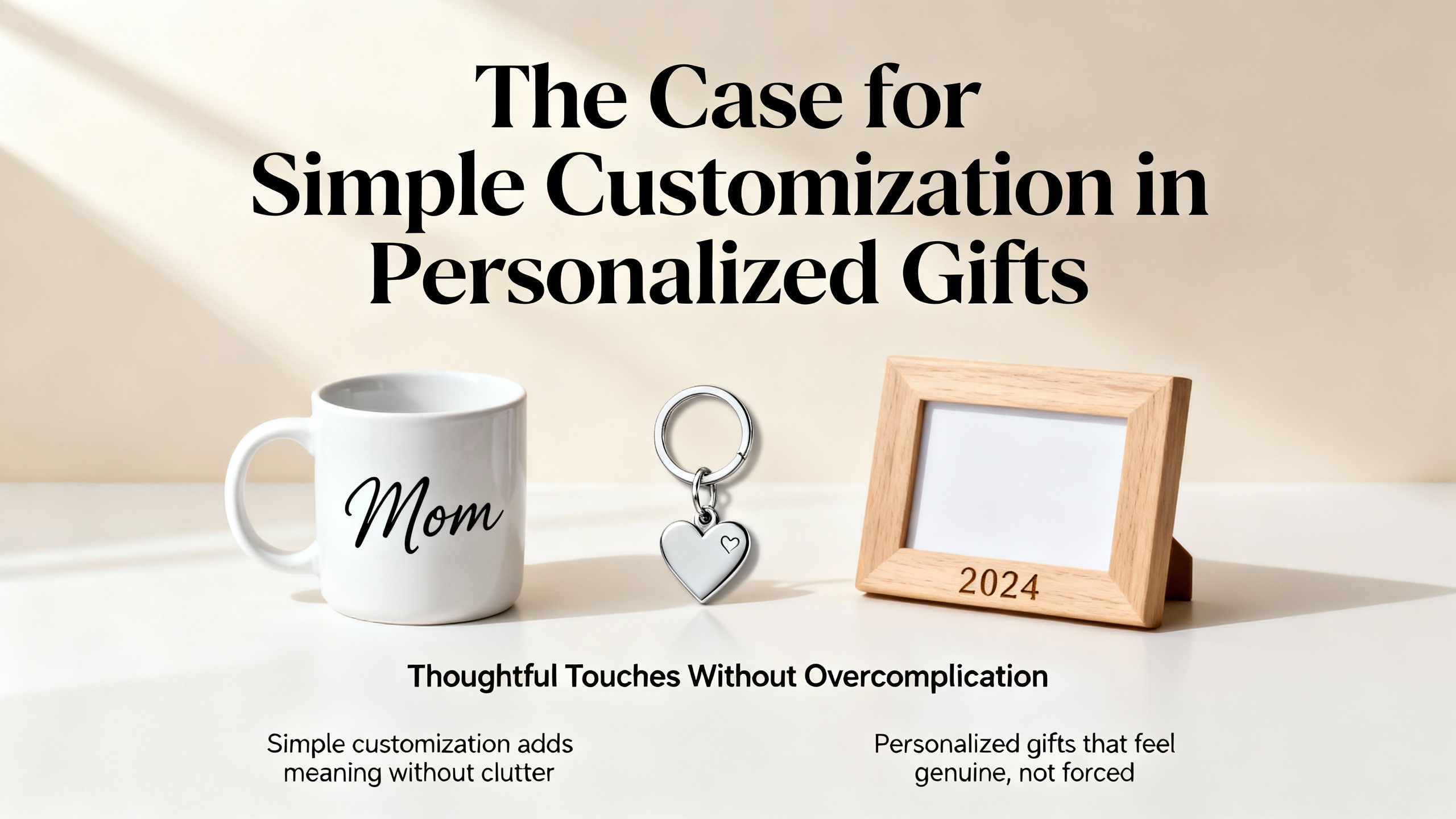
The Case for Simple Customization in Personalized Gifts

Personalized gifts are not a small niche anymore. A 2024 guide from PrintToucan estimates the US personalized gifting market at about $9.69 billion in 2024, projected to reach roughly $14.56 billion by 2030, which implies around 7 percent annual growth. A separate analysis from PrintXpand expects the global personalized gifts industry to rise from about $30.75 billion in 2023 to roughly $53.95 billion by 2032. Those numbers align with what I see in the field: demand is strong and still climbing.

The deeper reason is psychological. Research summarized by Personalise4u cites a University of Bath study showing that personalized gifts create stronger emotional bonds and boost recipients’ self‑esteem, triggering a sense of “vicarious pride.” National Institutes of Health research referenced in the same article connects personalized gifts at milestone events with an increased sense of belonging. In simple terms, when a gift clearly says “I know you,” it lands differently.

Yet in many stores, the actual customization experience is painful. Too many options, confusing interfaces, low‑quality previews, and design results that feel tacky rather than considered. Every extra step in the configurator increases drop‑off. The opportunity is to keep the emotional upside of personalization while stripping out friction.

Simple customization is about that balance: enough control for the customer to feel involved, enough guardrails so every outcome looks good, and enough operational discipline that you can produce and ship profitably.
Scaling a print on demand business with simple design

What “Simple Customization” Really Means

When I walk founders through their product pages, I look at simplicity on two levels: the customer journey and the production reality.

For the customer: guided, low‑friction creativity

Simple customization for a shopper rarely looks like a blank canvas with unlimited tools. Successful brands tend to do three things.

They start from a strong base product that already feels desirable on its own. Articles from Canva Print and 4OVER4 highlight everyday objects such as mugs, notebooks, apparel, coasters, and home décor that become sentimental once you add a name, date, or image.

They provide curated design starting points rather than asking customers to design from scratch. PrintXpand describes product design tools that come with ready artworks, templates, clipart, and font libraries. Platforms like Kickflip and Stockimg.ai emphasize visual configurators and AI‑generated art that non‑designers can quickly adapt to their needs.

They keep the number of decisions reasonable. Personalise4u and 4OVER4 both stress that the most appreciated gifts match the recipient’s personality and context, not the most over‑engineered set of options. Name, date, short message, and a small set of layout or color choices are often enough.

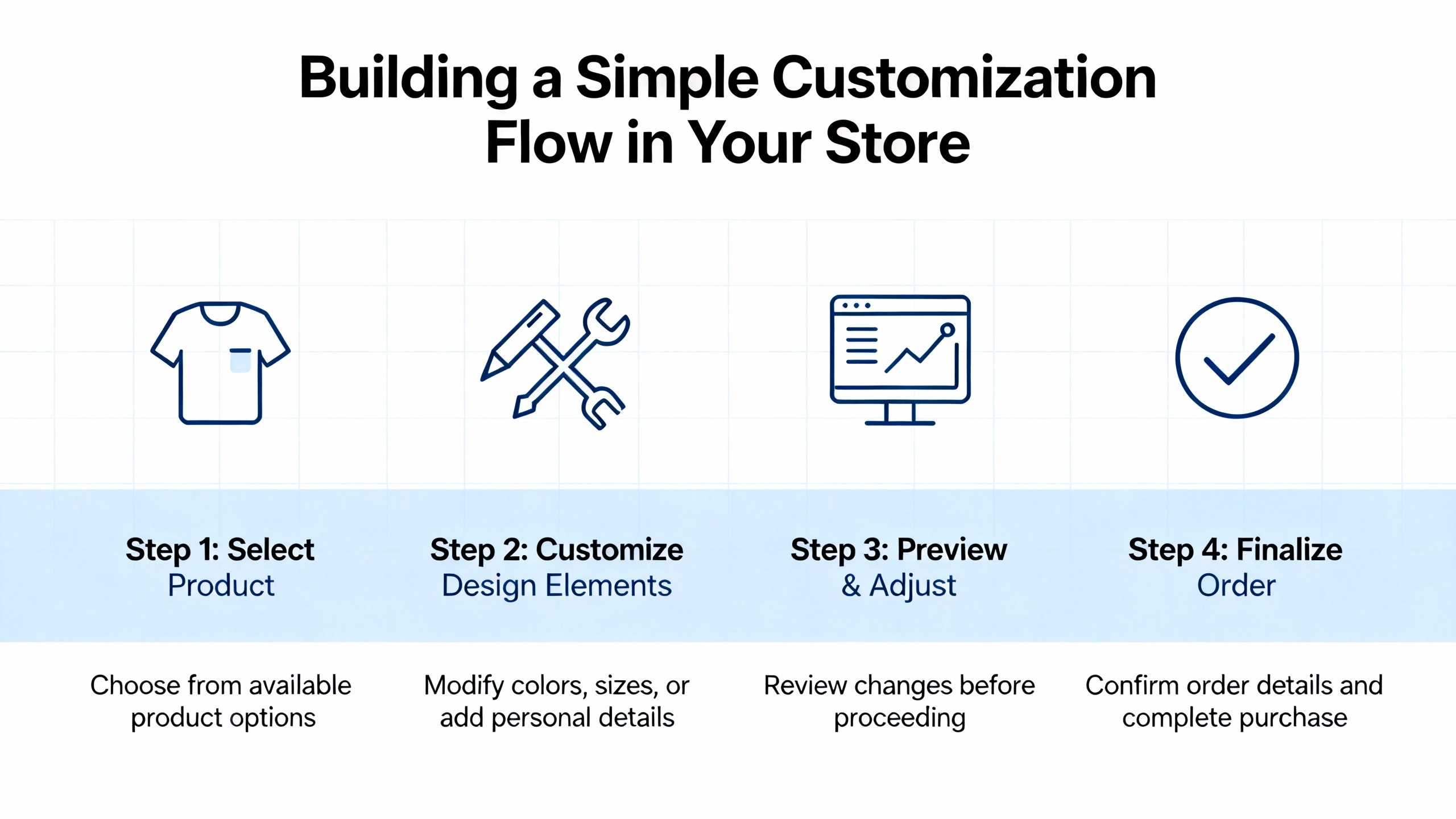
From the shopper’s perspective, an ideal flow might be: choose product type, pick a design style, type in a name or message, upload a photo if needed, see a clear preview, confirm, and pay. Every extra field beyond that needs a justification grounded in conversion or margin.

For your operations: controlled variability

On the back end, simple customization means you have defined limits on what can change and what cannot. Shift4Shop’s guidance on personalized products is blunt: unlimited customization makes production unmanageable, inflates costs, and complicates returns. The platform recommends narrowing to a clear niche and setting realistic limits per item.

In practice, this typically means you standardize blanks and techniques and only personalize surface data, such as text, image placement, and colors inside predefined zones. PrintXpand’s web‑to‑print tools and PrintToucan’s templates illustrate this approach: powerful rendering, but always within guardrails you set.

A useful mental check as you design options is to ask, for each choice you expose, exactly how it affects printing files, production steps, packing, and support. If the answer is vague or expensive, remove or reduce that option until you can express the impact clearly.

Technologies That Enable Effortless Custom Gifts

You do not need an in‑house factory to run a sophisticated personalized‑gifts brand. However, you do need a basic understanding of the printing and fabrication methods your partners use so you can design products and promises that match reality.

Mug and drinkware printing in plain language

A 2025 piece from the University of Arizona’s housing division on advanced mug printing equipment explains how three main techniques dominate custom mugs: sublimation, UV printing, and ceramic printing. Each has distinct strengths.

Sublimation uses heat to transfer dye from special paper into a polymer coating on the mug, creating full‑color, photo‑realistic images that are effectively part of the surface. PrintToucan notes that sublimation makes personalized mugs extremely durable and fade‑resistant for daily use, which is why photo mugs remain bestsellers.

UV printing deposits liquid ink on the surface and cures it instantly with ultraviolet light. According to the Arizona report, this method produces high‑definition, fade‑resistant prints and works well for outdoor or high‑exposure situations, such as travel tumblers or items that spend time in the sun.

Ceramic printing blends specialized ceramic inks with kiln firing to literally fuse the design into the mug’s glaze. The same report notes that the result is permanent, dishwasher‑safe, and highly resistant to heat, ideal for premium pieces where longevity is a selling point.

You can think of them side by side like this:

Technique

Key strengths

Typical best use cases

Sublimation

Vibrant color, photo quality, cost‑effective for small runs

Personalized photo mugs, everyday coffee or tea drinkware

UV printing

Fade resistance, instant curing, detail on varied surfaces

Tumblers, outdoor mugs, promotional items with detailed logos

Ceramic printing

Extreme durability, dishwasher and high‑heat safe

High‑end mugs, corporate gifts, items marketed as heirlooms

As an e‑commerce founder, you rarely own these machines, but you do choose partners and techniques. The Arizona article recommends selecting method and equipment based on desired visual outcome, durability requirements such as outdoor versus indoor use, and cost. That maps directly to your positioning: everyday casual gifts can lean on sublimation, while high‑ticket corporate sets may justify ceramic.

Apparel, décor, and lifestyle products

PrintToucan’s market guide points out that custom apparel accounts for over a third of the US personalized gifts market, with trends emphasizing digital printing, embroidery, and CAD/CAM. Personalized T‑shirts, hats, and hoodies become “walking advertisements,” either for individuals or brands.

Global Asia Printings similarly highlights apparel and lifestyle gifts, from custom drinkware and office essentials to eco‑friendly items and tech gadgets. Their emphasis is on practical items that recipients use daily, which naturally keep your brand visible.

Canva Print and 4OVER4 add another layer: photo books, canvas prints, blankets, and wall art that turn memories into décor. Urban Sketch Course demonstrates how hand‑drawn sketches can be scanned and printed on canvas, bookmarks, calendars, tote bags, pillows, and mugs, often via sublimation for fabric or ceramic items.

Together, the picture is clear. With a single, well‑integrated print‑on‑demand partner, you can sell a coherent line of personalized apparel, décor, and drinkware that all share a similar design language and customization flow.

3D printing for high‑impact one‑offs

For many brands, 3D printing is a second phase, not the starting point, but it is worth understanding if you want to introduce highly differentiated premium items.

Womp’s 2025 guide on custom 3D‑printed gifts shows how 3D printing merges personal thoughtfulness with modern manufacturing. It describes custom home décor, organizers, gaming accessories, and holiday items, and explains that by hollowing large pieces you can reduce material costs by up to about 50 percent while maintaining a high‑end look.

Design constraints matter more here than in flat printing. Womp cautions about respecting minimum wall thickness around 1.2 millimeters, roughly 0.05 inch, staying within size limits, and avoiding fragile overhangs. Those constraints mean you should prefer simple forms with personalized surface features such as names, dates, or symbols, instead of extremely complex custom geometry for each buyer.

SwiftShape’s overview of its LX30 desktop fabrication machine combines laser engraving, CNC carving, and 3D printing in one unit, presented as a way for hobbyists to produce professional‑quality gifts at home. Even if you never touch hardware, the examples help you imagine product lines: engraved tumblers, jewelry boxes, cutting boards, map art, and 3D‑printed puzzles, all customized via text or simple design choices rather than full custom CAD.

For dropshipping founders, the right way to use 3D printing initially is usually through a specialized fulfillment partner. Offer a small set of hero products, keep personalization to text, colors, or modular elements, and rely on well‑documented design rules to keep defect rates low.

Designing Gifts That Feel Premium, Not Cheesy

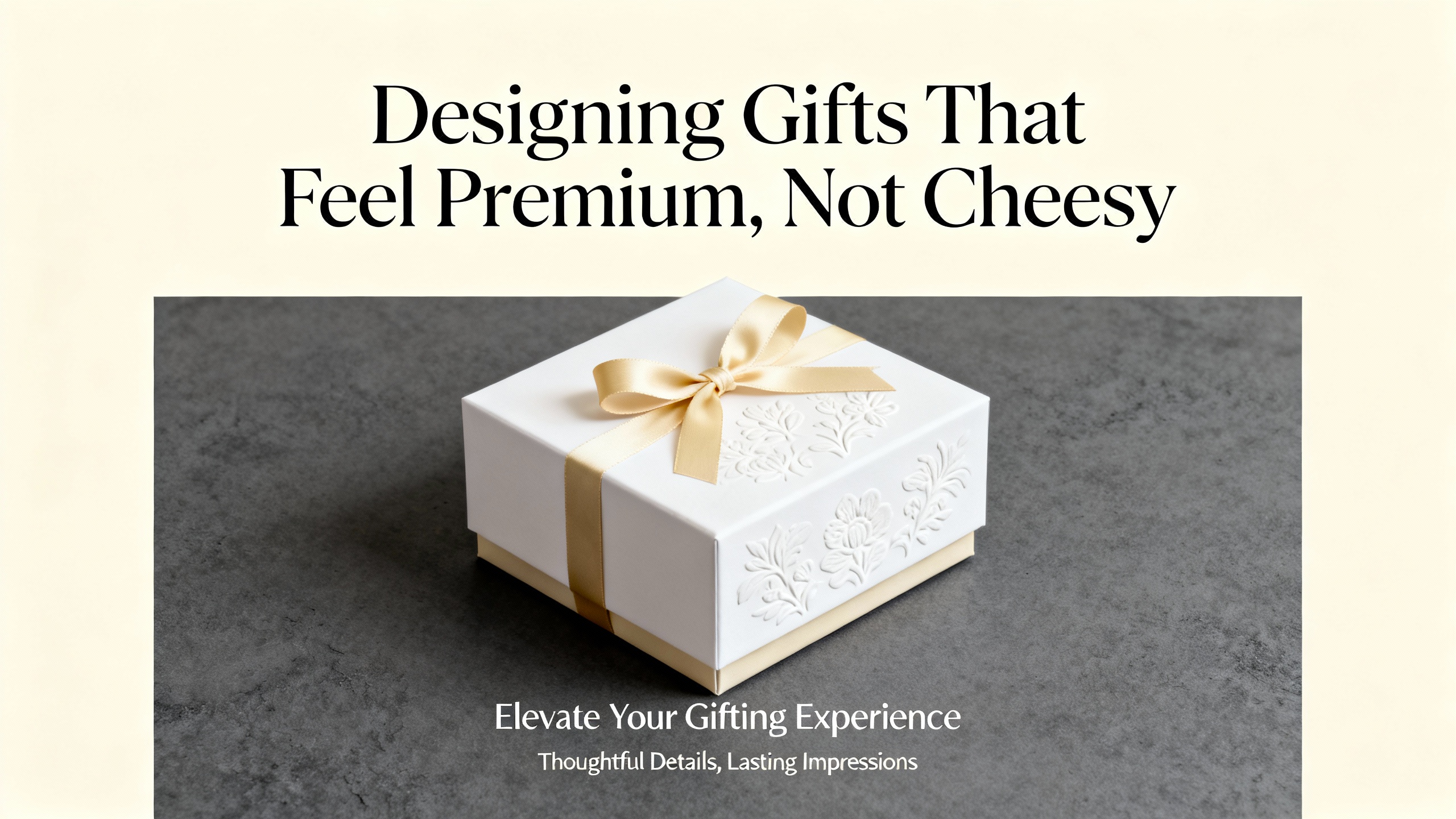
Many early‑stage merchants assume more customization equals more perceived value. Often the opposite is true. InkedJoy’s design guidance on avoiding cheesy personalization underscores a principle I continually reinforce with founders: subtlety and placement matter at least as much as the message itself.

Large, central graphics or huge names across the chest of a shirt are more likely to look unprofessional or overwhelming. InkedJoy shows that smaller design elements, used sparingly at the sleeve, pocket area, or a corner of an accessory, look more intentional and modern. A small custom illustration tied to the recipient’s interests can have far more impact than a generic full‑coverage design.

Personalise4u and 4OVER4 extend this idea beyond aesthetics into etiquette. They emphasize matching the depth of personalization to the relationship. For close relationships, highly specific references, coordinates of important places, and detailed photo books may be welcome. For professional contexts, subtle initials on quality stationery, discreet branding, or refined homeware tends to feel appropriate and respectful.

EHL’s corporate gifting research reinforces that in B2B settings, effective gifts are elegant, relevant, and meaningful rather than loud. They suggest refined office accessories, gourmet boxes, or cultural experiences, often with subtle logos or names, as better signals of seriousness and respect than highly flashy designs.

From a founder’s standpoint, you can encode these principles in your templates. Constrain text size, place logos in tasteful locations, and leave negative space. Make the default preview look premium so customers are less likely to “destroy” the design by accident.
Profitable personalized gift business model

Building a Simple Customization Flow in Your Store

Turning these principles into revenue means designing your e‑commerce stack around them. Several of the sources in your research notes explore different parts of that stack, from storefront to configurator to production.

Start with a focused product lineup

Shift4Shop’s playbook on personalized gifts urges entrepreneurs to pick a clear niche and avoid trying to personalize everything at once. Global Asia Printings, PrintToucan, and 4OVER4 all converge on similar core categories: drinkware, office essentials, tech accessories, apparel, and a few home décor staples.

As a mentor, I usually advise new stores to launch with no more than three to five product categories and two or three SKUs per category, all of which share the same printing technique. For example, you might start with sublimation mugs, tumblers, and coasters, or with digital‑printed apparel only. This keeps operations straightforward while you learn what sells and how customers actually use your customization tools.

Tahoe Gifting Co’s “create your own” gift boxes show another approach: a curated catalog of artisan products plus optional personalization such as engraved glassware or embossed journals. You could mirror that with a few base products and one simple personalization step per item.

Design the experience from idea to preview

On the front end, you need two layers: a storefront and a customization engine.

PrintXpand and Shift4Shop both outline core storefront requirements. You choose an e‑commerce platform such as Shopify, Magento, or Shift4Shop itself, and ensure basics like secure payment, carts, wishlists, clear product descriptions, and strong imagery are all in place. Shift4Shop notes that text fields for names, file upload options for images, and integrations with product designers are essential for personalization.

For the customization engine, there are several patterns in your research.

PrintXpand’s product design tool offers ready artworks, a font library, live pricing, and 3D preview, plus mobile personalization. Kickflip is described as a visual, no‑code configurator brands can plug into their Shopify stores to build product customizers without hiring developers. Stockimg.ai and Canva focus on enabling creative assets through AI and templates, making it easier for non‑designers to generate art, cards, and mockups that can be printed on products.

The pattern here is that the more you pre‑design, the easier it becomes for customers to personalize. Quick start points might include holiday‑themed mug layouts, office gift sets with matching notebook and mug designs, or sports‑inspired controller skins similar to those described by Cinch Gaming.

Live pricing, as highlighted by PrintXpand, keeps trust high. When a customer sees the price adjust immediately as they add more complex elements, there are fewer surprises at checkout and fewer abandoned carts.

Keep production and returns under control

Shift4Shop warns that personalized products are hard to resell, so returns policies are necessarily stricter. Many sellers accept returns only for damaged or defective items, not for buyer’s remorse on custom designs. They also recommend slightly higher pricing to offset inevitable reprints, misprints, or shipping issues.

To avoid over‑promising, Shift4Shop advises clearly communicating production and delivery times on product pages and during checkout. Personalized gifts are made‑to‑order; customers expecting same‑day shipping will be disappointed unless you explicitly set expectations.

On the tooling side, PrintXpand emphasizes that a web‑to‑print storefront plus integrated design tool can reduce errors by giving customers realistic previews and structured options. Womp’s advice on testing 3D prints on a small scale before full production mirrors good practice across methods: test templates and workflows internally, then scale the winners.

Finally, think about data and privacy. Walgreens’ material on personalized experiences in its photo gifts area highlights the importance of respecting consumer data rights, offering opt‑outs, and being transparent about how data such as uploaded images and personalization preferences are used. Even as a small merchant, you should treat customer photos and messages as sensitive assets and choose partners that do the same.
Ecommerce customization best practices for dropshipping

Pros and Cons of Simple Customization for On‑Demand Brands

Simple customization is not just a design choice; it shapes your economics. It is helpful to see the trade‑offs clearly.

Aspect

Advantages of simple customization

Potential drawbacks and risks

Conversion and UX

Fewer steps, clearer previews, lower cognitive load, higher completion rates

Some customers may wish for deeper control or more eccentric options

Operational complexity

Easier batching, standardized print files, faster training for staff or partners

Less flexibility to accept unusual requests or one‑off high‑margin jobs

Quality and aesthetics

Guardrails prevent tacky or unreadable designs, more consistent brand look

Templates must be updated regularly to avoid feeling generic

Pricing and margins

Easier cost modeling and live pricing, simpler bundles and promotions

You may need to justify premium prices without “infinite” customization

Brand positioning

Clear, cohesive identity across SKUs, easier storytelling and marketing

Harder to market as “we can do absolutely anything”

In my experience, for on‑demand and dropshipping businesses, the upside of simplicity almost always outweighs the downsides, especially in the first three years. You can always create a “concierge” or “white‑glove” tier later for complex projects once you have stable cash flow.

Practical Playbooks: Three Simple Custom Gift Models

To make this concrete, consider three business models that map closely to your research notes and that I see working well in practice.

Personalized drinkware and desk essentials

The first model pairs custom drinkware with office essentials. Drawing from PrintToucan, Global Asia Printings, and the Arizona mug‑printing guide, you can build a collection around mugs, tumblers, bottles, notebooks, pens, and mousepads. Printing techniques might be sublimation for mugs and UV or laser engraving for metal bottles and pens.

Customization is minimal but meaningful: names, initials, roles, short quotes, and perhaps one of several pre‑designed motifs. Corporate buyers can create welcome kits or festive sets with matching designs, while consumers buy single pieces as gifts.

Because these products are practical and used daily, they deliver ongoing brand impressions; Global Asia Printings describes them as “silent marketing,” sitting on desks, in kitchens, and on commutes. Simplicity in the configurator keeps ordering easy even for busy HR teams or small businesses ordering in batches.

AI‑assisted art and photo‑based gifts

The second model leverages AI design and photo tools. Stockimg.ai explains how non‑designers can generate illustrations, avatars, and mockups by writing specific prompts, and Canva Print emphasizes turning photos into books, collages, and printed gifts. Urban Sketch Course shows how original art can be repurposed into prints, cards, and fabric‑based products.

An entrepreneur can combine these tools into a workflow where customers choose between uploading their own photo, using an AI‑generated illustration tailored to a prompt, or selecting a pre‑designed template. Personalization then focuses on names, dates, and short messages overlaid on that artwork.

Because Stockimg.ai and similar tools allow fine control over style and subject, you can build themed collections: pets, favorite cities, hobbies, or abstract patterns. PrintToucan notes that consumers describe the best personalized gifts as combining thoughtfulness, uniqueness, and convenience; an AI‑assisted flow delivers exactly that when done with care.

Thoughtful corporate and event gifting

The third model focuses on curated corporate and event gifts with light personalization. EHL’s corporate gifting research and Tahoe Gifting Co’s “create your own” tool provide a blueprint: mix gourmet food, artisan home goods, and a small number of engraved or printed items, topped with handwritten‑style notes.

Here, customization is subtle. Employee names on notebooks, dates on glassware, logos on boxes, and personalized messages in cards often suffice. Personalise4u’s guidance on etiquette suggests that this level of personalization is appropriate for professional relationships without overstepping boundaries.

For your operations, this model tends to revolve around kitting and packaging. Pressbooks’ discussion of custom tissue paper and eco‑friendly wrapping, along with Zingy Gifts’ emphasis on creative packaging and hand‑drawn tags, show how presentation turns a set of items into a cohesive, premium experience.

This model often works best with on‑demand or low‑minimum partners for engraved and printed items and with local or regional suppliers for food and décor, supported by a web‑to‑print storefront like those described by PrintXpand or Shift4Shop.

Short FAQ on Simple Customization

How many customization options should I offer on each product?

Most successful brands in this space, including those highlighted by PrintToucan, Global Asia Printings, and PrintXpand, concentrate on a small number of levers: usually the recipient’s name or initials, a short message, a date, and sometimes a photo. In mentoring sessions, I generally suggest starting with no more than three required fields and one optional upload. You can always add more variants later once you see where customers are actually asking for flexibility.

How do I keep designs from looking cheap if customers control the text?

You control the frame, even when customers control the words. InkedJoy’s advice is to keep fonts modern and legible, limit text length in templates, and place personalization in smaller, intentional areas such as a corner, cuff, or engraving plate. If you design previews with generous negative space and avoid allowing oversized text, even last‑minute messages tend to look considered.

Is it worth adding complex 3D or handmade options early on?

Womp and SwiftShape both show exciting possibilities for 3D‑printed and fabricated gifts, and Zingy Gifts and Jenna Rainey demonstrate the power of handmade work. However, these routes require more skill, quality control, and time. For most on‑demand e‑commerce founders, it makes sense to start with flat printing and engraving through reliable partners. Once your core store is profitable and stable, you can test limited‑edition 3D or handmade lines where higher prices justify the extra complexity.

Closing Thoughts

Simple customization is not a compromise; it is a strategic choice. When you align clean templates, disciplined production methods, and psychologically smart personalization, you create gifts that feel effortless for the buyer, emotionally rich for the recipient, and financially healthy for your business. As you plan your next product cycle, challenge yourself to design one hero personalized product that embodies these principles, then let real customer behavior guide your next iteration.

References

  1. https://dev.housing.arizona.edu/mug-printing-equipment
  2. https://hospitalityinsights.ehl.edu/how-to-choose-corporate-gifts
  3. https://pressbooks.cuny.edu/printing/chapter/creative-ways-to-use-gift-packaging-tissue-paper/
  4. https://personalise4u.net/blogs/journal/how-to-personalize-gifts-creative-ideas?srsltid=AfmBOor6xkoaMNrX8uDCM_ohrEYJx5xxWKnoND_BNGmsd4lZVC2r0AjK
  5. https://www.personalcreations.com/?srsltid=AfmBOorA8AcF4NfWcXgjfIFGaal61HHxtvBk3OtwAzIfOa7UpcA2peyd
  6. https://www.thingsremembered.com/
  7. https://smart.dhgate.com/creative-and-affordable-ways-to-make-personalized-gifts-without-breaking-the-bank/
  8. https://gokickflip.com/blog/custom-gifts-ideas
  9. https://inkedjoy.com/blog/personalize-gifts-without-being-cheesy-tips
  10. https://jennarainey.com/handmade-gifts/

Like the article

0
Personalized Products, Simple Customization: Effortless Custom Gift Design

Personalized Products, Simple Customization: Effortless Custom Gift Design

Personalization has moved from “nice to have” to core expectation in the gifting economy. As a mentor to dozens of print‑on‑demand and dropshipping founders, I have watched the most profitable brands win not by offering the most complex configurators, but by delivering simple, effortless customization that feels premium and emotionally smart.

In other words, your customer should feel like they designed something meaningful, while your backend remains clean, repeatable, and profitable.

This article unpacks what “simple customization” really means, the technologies that make it possible, and how to design experiences that look professional instead of cheesy. The focus is practical: how to build an on‑demand personalized product line that customers love and your operations can sustain.

The Case for Simple Customization in Personalized Gifts

Personalized gifts are not a small niche anymore. A 2024 guide from PrintToucan estimates the US personalized gifting market at about $9.69 billion in 2024, projected to reach roughly $14.56 billion by 2030, which implies around 7 percent annual growth. A separate analysis from PrintXpand expects the global personalized gifts industry to rise from about $30.75 billion in 2023 to roughly $53.95 billion by 2032. Those numbers align with what I see in the field: demand is strong and still climbing.

The deeper reason is psychological. Research summarized by Personalise4u cites a University of Bath study showing that personalized gifts create stronger emotional bonds and boost recipients’ self‑esteem, triggering a sense of “vicarious pride.” National Institutes of Health research referenced in the same article connects personalized gifts at milestone events with an increased sense of belonging. In simple terms, when a gift clearly says “I know you,” it lands differently.

Yet in many stores, the actual customization experience is painful. Too many options, confusing interfaces, low‑quality previews, and design results that feel tacky rather than considered. Every extra step in the configurator increases drop‑off. The opportunity is to keep the emotional upside of personalization while stripping out friction.

Simple customization is about that balance: enough control for the customer to feel involved, enough guardrails so every outcome looks good, and enough operational discipline that you can produce and ship profitably.

Scaling a print on demand business with simple design

What “Simple Customization” Really Means

When I walk founders through their product pages, I look at simplicity on two levels: the customer journey and the production reality.

For the customer: guided, low‑friction creativity

Simple customization for a shopper rarely looks like a blank canvas with unlimited tools. Successful brands tend to do three things.

They start from a strong base product that already feels desirable on its own. Articles from Canva Print and 4OVER4 highlight everyday objects such as mugs, notebooks, apparel, coasters, and home décor that become sentimental once you add a name, date, or image.

They provide curated design starting points rather than asking customers to design from scratch. PrintXpand describes product design tools that come with ready artworks, templates, clipart, and font libraries. Platforms like Kickflip and Stockimg.ai emphasize visual configurators and AI‑generated art that non‑designers can quickly adapt to their needs.

They keep the number of decisions reasonable. Personalise4u and 4OVER4 both stress that the most appreciated gifts match the recipient’s personality and context, not the most over‑engineered set of options. Name, date, short message, and a small set of layout or color choices are often enough.

From the shopper’s perspective, an ideal flow might be: choose product type, pick a design style, type in a name or message, upload a photo if needed, see a clear preview, confirm, and pay. Every extra field beyond that needs a justification grounded in conversion or margin.

For your operations: controlled variability

On the back end, simple customization means you have defined limits on what can change and what cannot. Shift4Shop’s guidance on personalized products is blunt: unlimited customization makes production unmanageable, inflates costs, and complicates returns. The platform recommends narrowing to a clear niche and setting realistic limits per item.

In practice, this typically means you standardize blanks and techniques and only personalize surface data, such as text, image placement, and colors inside predefined zones. PrintXpand’s web‑to‑print tools and PrintToucan’s templates illustrate this approach: powerful rendering, but always within guardrails you set.

A useful mental check as you design options is to ask, for each choice you expose, exactly how it affects printing files, production steps, packing, and support. If the answer is vague or expensive, remove or reduce that option until you can express the impact clearly.

Technologies That Enable Effortless Custom Gifts

You do not need an in‑house factory to run a sophisticated personalized‑gifts brand. However, you do need a basic understanding of the printing and fabrication methods your partners use so you can design products and promises that match reality.

Mug and drinkware printing in plain language

A 2025 piece from the University of Arizona’s housing division on advanced mug printing equipment explains how three main techniques dominate custom mugs: sublimation, UV printing, and ceramic printing. Each has distinct strengths.

Sublimation uses heat to transfer dye from special paper into a polymer coating on the mug, creating full‑color, photo‑realistic images that are effectively part of the surface. PrintToucan notes that sublimation makes personalized mugs extremely durable and fade‑resistant for daily use, which is why photo mugs remain bestsellers.

UV printing deposits liquid ink on the surface and cures it instantly with ultraviolet light. According to the Arizona report, this method produces high‑definition, fade‑resistant prints and works well for outdoor or high‑exposure situations, such as travel tumblers or items that spend time in the sun.

Ceramic printing blends specialized ceramic inks with kiln firing to literally fuse the design into the mug’s glaze. The same report notes that the result is permanent, dishwasher‑safe, and highly resistant to heat, ideal for premium pieces where longevity is a selling point.

You can think of them side by side like this:

Technique

Key strengths

Typical best use cases

Sublimation

Vibrant color, photo quality, cost‑effective for small runs

Personalized photo mugs, everyday coffee or tea drinkware

UV printing

Fade resistance, instant curing, detail on varied surfaces

Tumblers, outdoor mugs, promotional items with detailed logos

Ceramic printing

Extreme durability, dishwasher and high‑heat safe

High‑end mugs, corporate gifts, items marketed as heirlooms

As an e‑commerce founder, you rarely own these machines, but you do choose partners and techniques. The Arizona article recommends selecting method and equipment based on desired visual outcome, durability requirements such as outdoor versus indoor use, and cost. That maps directly to your positioning: everyday casual gifts can lean on sublimation, while high‑ticket corporate sets may justify ceramic.

Apparel, décor, and lifestyle products

PrintToucan’s market guide points out that custom apparel accounts for over a third of the US personalized gifts market, with trends emphasizing digital printing, embroidery, and CAD/CAM. Personalized T‑shirts, hats, and hoodies become “walking advertisements,” either for individuals or brands.

Global Asia Printings similarly highlights apparel and lifestyle gifts, from custom drinkware and office essentials to eco‑friendly items and tech gadgets. Their emphasis is on practical items that recipients use daily, which naturally keep your brand visible.

Canva Print and 4OVER4 add another layer: photo books, canvas prints, blankets, and wall art that turn memories into décor. Urban Sketch Course demonstrates how hand‑drawn sketches can be scanned and printed on canvas, bookmarks, calendars, tote bags, pillows, and mugs, often via sublimation for fabric or ceramic items.

Together, the picture is clear. With a single, well‑integrated print‑on‑demand partner, you can sell a coherent line of personalized apparel, décor, and drinkware that all share a similar design language and customization flow.

3D printing for high‑impact one‑offs

For many brands, 3D printing is a second phase, not the starting point, but it is worth understanding if you want to introduce highly differentiated premium items.

Womp’s 2025 guide on custom 3D‑printed gifts shows how 3D printing merges personal thoughtfulness with modern manufacturing. It describes custom home décor, organizers, gaming accessories, and holiday items, and explains that by hollowing large pieces you can reduce material costs by up to about 50 percent while maintaining a high‑end look.

Design constraints matter more here than in flat printing. Womp cautions about respecting minimum wall thickness around 1.2 millimeters, roughly 0.05 inch, staying within size limits, and avoiding fragile overhangs. Those constraints mean you should prefer simple forms with personalized surface features such as names, dates, or symbols, instead of extremely complex custom geometry for each buyer.

SwiftShape’s overview of its LX30 desktop fabrication machine combines laser engraving, CNC carving, and 3D printing in one unit, presented as a way for hobbyists to produce professional‑quality gifts at home. Even if you never touch hardware, the examples help you imagine product lines: engraved tumblers, jewelry boxes, cutting boards, map art, and 3D‑printed puzzles, all customized via text or simple design choices rather than full custom CAD.

For dropshipping founders, the right way to use 3D printing initially is usually through a specialized fulfillment partner. Offer a small set of hero products, keep personalization to text, colors, or modular elements, and rely on well‑documented design rules to keep defect rates low.

Designing Gifts That Feel Premium, Not Cheesy

Many early‑stage merchants assume more customization equals more perceived value. Often the opposite is true. InkedJoy’s design guidance on avoiding cheesy personalization underscores a principle I continually reinforce with founders: subtlety and placement matter at least as much as the message itself.

Large, central graphics or huge names across the chest of a shirt are more likely to look unprofessional or overwhelming. InkedJoy shows that smaller design elements, used sparingly at the sleeve, pocket area, or a corner of an accessory, look more intentional and modern. A small custom illustration tied to the recipient’s interests can have far more impact than a generic full‑coverage design.

Personalise4u and 4OVER4 extend this idea beyond aesthetics into etiquette. They emphasize matching the depth of personalization to the relationship. For close relationships, highly specific references, coordinates of important places, and detailed photo books may be welcome. For professional contexts, subtle initials on quality stationery, discreet branding, or refined homeware tends to feel appropriate and respectful.

EHL’s corporate gifting research reinforces that in B2B settings, effective gifts are elegant, relevant, and meaningful rather than loud. They suggest refined office accessories, gourmet boxes, or cultural experiences, often with subtle logos or names, as better signals of seriousness and respect than highly flashy designs.

From a founder’s standpoint, you can encode these principles in your templates. Constrain text size, place logos in tasteful locations, and leave negative space. Make the default preview look premium so customers are less likely to “destroy” the design by accident.

Profitable personalized gift business model

Building a Simple Customization Flow in Your Store

Turning these principles into revenue means designing your e‑commerce stack around them. Several of the sources in your research notes explore different parts of that stack, from storefront to configurator to production.

Start with a focused product lineup

Shift4Shop’s playbook on personalized gifts urges entrepreneurs to pick a clear niche and avoid trying to personalize everything at once. Global Asia Printings, PrintToucan, and 4OVER4 all converge on similar core categories: drinkware, office essentials, tech accessories, apparel, and a few home décor staples.

As a mentor, I usually advise new stores to launch with no more than three to five product categories and two or three SKUs per category, all of which share the same printing technique. For example, you might start with sublimation mugs, tumblers, and coasters, or with digital‑printed apparel only. This keeps operations straightforward while you learn what sells and how customers actually use your customization tools.

Tahoe Gifting Co’s “create your own” gift boxes show another approach: a curated catalog of artisan products plus optional personalization such as engraved glassware or embossed journals. You could mirror that with a few base products and one simple personalization step per item.

Design the experience from idea to preview

On the front end, you need two layers: a storefront and a customization engine.

PrintXpand and Shift4Shop both outline core storefront requirements. You choose an e‑commerce platform such as Shopify, Magento, or Shift4Shop itself, and ensure basics like secure payment, carts, wishlists, clear product descriptions, and strong imagery are all in place. Shift4Shop notes that text fields for names, file upload options for images, and integrations with product designers are essential for personalization.

For the customization engine, there are several patterns in your research.

PrintXpand’s product design tool offers ready artworks, a font library, live pricing, and 3D preview, plus mobile personalization. Kickflip is described as a visual, no‑code configurator brands can plug into their Shopify stores to build product customizers without hiring developers. Stockimg.ai and Canva focus on enabling creative assets through AI and templates, making it easier for non‑designers to generate art, cards, and mockups that can be printed on products.

The pattern here is that the more you pre‑design, the easier it becomes for customers to personalize. Quick start points might include holiday‑themed mug layouts, office gift sets with matching notebook and mug designs, or sports‑inspired controller skins similar to those described by Cinch Gaming.

Live pricing, as highlighted by PrintXpand, keeps trust high. When a customer sees the price adjust immediately as they add more complex elements, there are fewer surprises at checkout and fewer abandoned carts.

Keep production and returns under control

Shift4Shop warns that personalized products are hard to resell, so returns policies are necessarily stricter. Many sellers accept returns only for damaged or defective items, not for buyer’s remorse on custom designs. They also recommend slightly higher pricing to offset inevitable reprints, misprints, or shipping issues.

To avoid over‑promising, Shift4Shop advises clearly communicating production and delivery times on product pages and during checkout. Personalized gifts are made‑to‑order; customers expecting same‑day shipping will be disappointed unless you explicitly set expectations.

On the tooling side, PrintXpand emphasizes that a web‑to‑print storefront plus integrated design tool can reduce errors by giving customers realistic previews and structured options. Womp’s advice on testing 3D prints on a small scale before full production mirrors good practice across methods: test templates and workflows internally, then scale the winners.

Finally, think about data and privacy. Walgreens’ material on personalized experiences in its photo gifts area highlights the importance of respecting consumer data rights, offering opt‑outs, and being transparent about how data such as uploaded images and personalization preferences are used. Even as a small merchant, you should treat customer photos and messages as sensitive assets and choose partners that do the same.

Ecommerce customization best practices for dropshipping

Pros and Cons of Simple Customization for On‑Demand Brands

Simple customization is not just a design choice; it shapes your economics. It is helpful to see the trade‑offs clearly.

Aspect

Advantages of simple customization

Potential drawbacks and risks

Conversion and UX

Fewer steps, clearer previews, lower cognitive load, higher completion rates

Some customers may wish for deeper control or more eccentric options

Operational complexity

Easier batching, standardized print files, faster training for staff or partners

Less flexibility to accept unusual requests or one‑off high‑margin jobs

Quality and aesthetics

Guardrails prevent tacky or unreadable designs, more consistent brand look

Templates must be updated regularly to avoid feeling generic

Pricing and margins

Easier cost modeling and live pricing, simpler bundles and promotions

You may need to justify premium prices without “infinite” customization

Brand positioning

Clear, cohesive identity across SKUs, easier storytelling and marketing

Harder to market as “we can do absolutely anything”

In my experience, for on‑demand and dropshipping businesses, the upside of simplicity almost always outweighs the downsides, especially in the first three years. You can always create a “concierge” or “white‑glove” tier later for complex projects once you have stable cash flow.

Practical Playbooks: Three Simple Custom Gift Models

To make this concrete, consider three business models that map closely to your research notes and that I see working well in practice.

Personalized drinkware and desk essentials

The first model pairs custom drinkware with office essentials. Drawing from PrintToucan, Global Asia Printings, and the Arizona mug‑printing guide, you can build a collection around mugs, tumblers, bottles, notebooks, pens, and mousepads. Printing techniques might be sublimation for mugs and UV or laser engraving for metal bottles and pens.

Customization is minimal but meaningful: names, initials, roles, short quotes, and perhaps one of several pre‑designed motifs. Corporate buyers can create welcome kits or festive sets with matching designs, while consumers buy single pieces as gifts.

Because these products are practical and used daily, they deliver ongoing brand impressions; Global Asia Printings describes them as “silent marketing,” sitting on desks, in kitchens, and on commutes. Simplicity in the configurator keeps ordering easy even for busy HR teams or small businesses ordering in batches.

AI‑assisted art and photo‑based gifts

The second model leverages AI design and photo tools. Stockimg.ai explains how non‑designers can generate illustrations, avatars, and mockups by writing specific prompts, and Canva Print emphasizes turning photos into books, collages, and printed gifts. Urban Sketch Course shows how original art can be repurposed into prints, cards, and fabric‑based products.

An entrepreneur can combine these tools into a workflow where customers choose between uploading their own photo, using an AI‑generated illustration tailored to a prompt, or selecting a pre‑designed template. Personalization then focuses on names, dates, and short messages overlaid on that artwork.

Because Stockimg.ai and similar tools allow fine control over style and subject, you can build themed collections: pets, favorite cities, hobbies, or abstract patterns. PrintToucan notes that consumers describe the best personalized gifts as combining thoughtfulness, uniqueness, and convenience; an AI‑assisted flow delivers exactly that when done with care.

Thoughtful corporate and event gifting

The third model focuses on curated corporate and event gifts with light personalization. EHL’s corporate gifting research and Tahoe Gifting Co’s “create your own” tool provide a blueprint: mix gourmet food, artisan home goods, and a small number of engraved or printed items, topped with handwritten‑style notes.

Here, customization is subtle. Employee names on notebooks, dates on glassware, logos on boxes, and personalized messages in cards often suffice. Personalise4u’s guidance on etiquette suggests that this level of personalization is appropriate for professional relationships without overstepping boundaries.

For your operations, this model tends to revolve around kitting and packaging. Pressbooks’ discussion of custom tissue paper and eco‑friendly wrapping, along with Zingy Gifts’ emphasis on creative packaging and hand‑drawn tags, show how presentation turns a set of items into a cohesive, premium experience.

This model often works best with on‑demand or low‑minimum partners for engraved and printed items and with local or regional suppliers for food and décor, supported by a web‑to‑print storefront like those described by PrintXpand or Shift4Shop.

Short FAQ on Simple Customization

How many customization options should I offer on each product?

Most successful brands in this space, including those highlighted by PrintToucan, Global Asia Printings, and PrintXpand, concentrate on a small number of levers: usually the recipient’s name or initials, a short message, a date, and sometimes a photo. In mentoring sessions, I generally suggest starting with no more than three required fields and one optional upload. You can always add more variants later once you see where customers are actually asking for flexibility.

How do I keep designs from looking cheap if customers control the text?

You control the frame, even when customers control the words. InkedJoy’s advice is to keep fonts modern and legible, limit text length in templates, and place personalization in smaller, intentional areas such as a corner, cuff, or engraving plate. If you design previews with generous negative space and avoid allowing oversized text, even last‑minute messages tend to look considered.

Is it worth adding complex 3D or handmade options early on?

Womp and SwiftShape both show exciting possibilities for 3D‑printed and fabricated gifts, and Zingy Gifts and Jenna Rainey demonstrate the power of handmade work. However, these routes require more skill, quality control, and time. For most on‑demand e‑commerce founders, it makes sense to start with flat printing and engraving through reliable partners. Once your core store is profitable and stable, you can test limited‑edition 3D or handmade lines where higher prices justify the extra complexity.

Closing Thoughts

Simple customization is not a compromise; it is a strategic choice. When you align clean templates, disciplined production methods, and psychologically smart personalization, you create gifts that feel effortless for the buyer, emotionally rich for the recipient, and financially healthy for your business. As you plan your next product cycle, challenge yourself to design one hero personalized product that embodies these principles, then let real customer behavior guide your next iteration.

References

  1. https://dev.housing.arizona.edu/mug-printing-equipment
  2. https://hospitalityinsights.ehl.edu/how-to-choose-corporate-gifts
  3. https://pressbooks.cuny.edu/printing/chapter/creative-ways-to-use-gift-packaging-tissue-paper/
  4. https://personalise4u.net/blogs/journal/how-to-personalize-gifts-creative-ideas?srsltid=AfmBOor6xkoaMNrX8uDCM_ohrEYJx5xxWKnoND_BNGmsd4lZVC2r0AjK
  5. https://www.personalcreations.com/?srsltid=AfmBOorA8AcF4NfWcXgjfIFGaal61HHxtvBk3OtwAzIfOa7UpcA2peyd
  6. https://www.thingsremembered.com/
  7. https://smart.dhgate.com/creative-and-affordable-ways-to-make-personalized-gifts-without-breaking-the-bank/
  8. https://gokickflip.com/blog/custom-gifts-ideas
  9. https://inkedjoy.com/blog/personalize-gifts-without-being-cheesy-tips
  10. https://jennarainey.com/handmade-gifts/
Like the article

0