


Personalized Gifts with Proof Approval: How Smart Merchants Let Customers Review Custom Designs Before Production

Personalized Gifts with Proof Approval: How Smart Merchants Let Customers Review Custom Designs Before Production

Jan 3, 2026 by Iris POD e-Commerce 101

Personalized gifts have moved from novelty to expectation. Whether someone is ordering a custom mug with a inside joke, a canvas celebrating a graduation, or a branded gift box for clients, they assume the final product will match the story in their head. As a mentor to founders in on-demand printing and dropshipping, I see the same pattern over and over: the emotion is in the personalization, and the risk is in the execution. A single typo, misplaced photo, or misunderstood brief can turn an otherwise perfect gift into a support ticket.

That is where proof approval comes in. Instead of “print whatever they typed,” you introduce a simple but powerful checkpoint: the customer sees and confirms a visual proof of the design before you hit “go” on production. Done well, this protects margins, reduces disputes, and makes you the kind of brand people trust for high-stakes occasions and corporate campaigns.

In this article, I will unpack what proof approval is, how it connects to corporate gifting and compliance, and how to design a proof flow that works in a fast-paced on-demand printing operation without killing your turnaround time.

Why Personalized Gifts Create Both Opportunity and Risk

Personalization is not just a trend; it is the backbone of modern gifting. Gift specialists like PrintToucan describe personalized gifts as everyday objects customized with photos, names, dates, or messages so they become story-rich keepsakes rather than generic items. Printing providers like 4OVER4 highlight how simple products such as wine labels, cutting boards, or electronics cases become long-lasting keepsakes once you add names, dates, designs, or photos.

Editorial guides from outlets such as CNN Underscored, TODAY.com, and Wirecutter consistently curate dozens of personalized gift ideas each year. They feature everything from monogrammed tote bags and custom phone cases to embroidered aprons, engraved chef’s knives, and sneakers decorated with initials and bespoke colors. Across those guides, a few themes repeat: personalization makes gifts feel one-of-a-kind, showcases the recipient’s personality, and dramatically reduces the chance that the gift is regifted or forgotten.

Thoughtful Presence, a brand focused on custom gifts, frames the core value clearly: personalization turns ordinary objects into emotionally significant keepsakes that tell a unique story and show that the giver “truly sees” the recipient. Personalized gifts are recommended for birthdays, anniversaries, weddings, graduations, baby showers, sympathy moments, and “just because” gestures. In other words, they show up at exactly the moments where disappointment is most painful and word-of-mouth is most powerful.

That emotional weight is good news and bad news for your print-on-demand store. When everything goes right, the impact is huge. When something goes wrong in the design, spelling, or layout, it is not just a defective product; it is a spoiled milestone. That is why proof approval is no longer a “nice to have” for serious personalized-gift businesses.

What “Proof Approval” Really Means in an On-Demand Workflow

In a personalized gift business, proof approval is the process of showing the customer a visual representation of the final design and getting explicit confirmation before you start production. It can be as simple as an automatically generated mockup in the cart or as structured as a formal proof document that a corporate client signs off in writing.

Clothes2Order, which advises on starting a personalized gift business, stresses the importance of designing an order workflow that collects customization details accurately and defines clear production and shipping times. They specifically call out the value of offering visual proofs or mockups when appropriate. Swagify, a corporate gifting provider, notes that teams should plan around design proofing, production lead times, and shipping windows so customized items arrive before key events. Those are exactly the moving parts your proof system needs to handle.

A practical proof approval process usually follows a pattern. The customer chooses a base product, such as a blanket, mug, or piece of apparel, and enters their personalization details: names, dates, quotes, or photos. Your system then generates a proof, which might be a realistic product mockup or a flat design layout. The customer reviews the proof, requests changes if needed, and eventually approves it. Only once that approval is captured do you send the job to print or embroidery.

In many on-demand printing setups, the online designer itself functions as a real-time proof. Providers like 4OVER4 describe user-friendly online design tools that let shoppers add monograms, artwork, logos, and personalized text so they can achieve a polished, professional look even if they are not designers. That live preview, paired with an explicit “I approve this design” step, is often enough for smaller retail orders. For corporate, bulk, or high-value gifts, merchants usually add a more formal review stage.

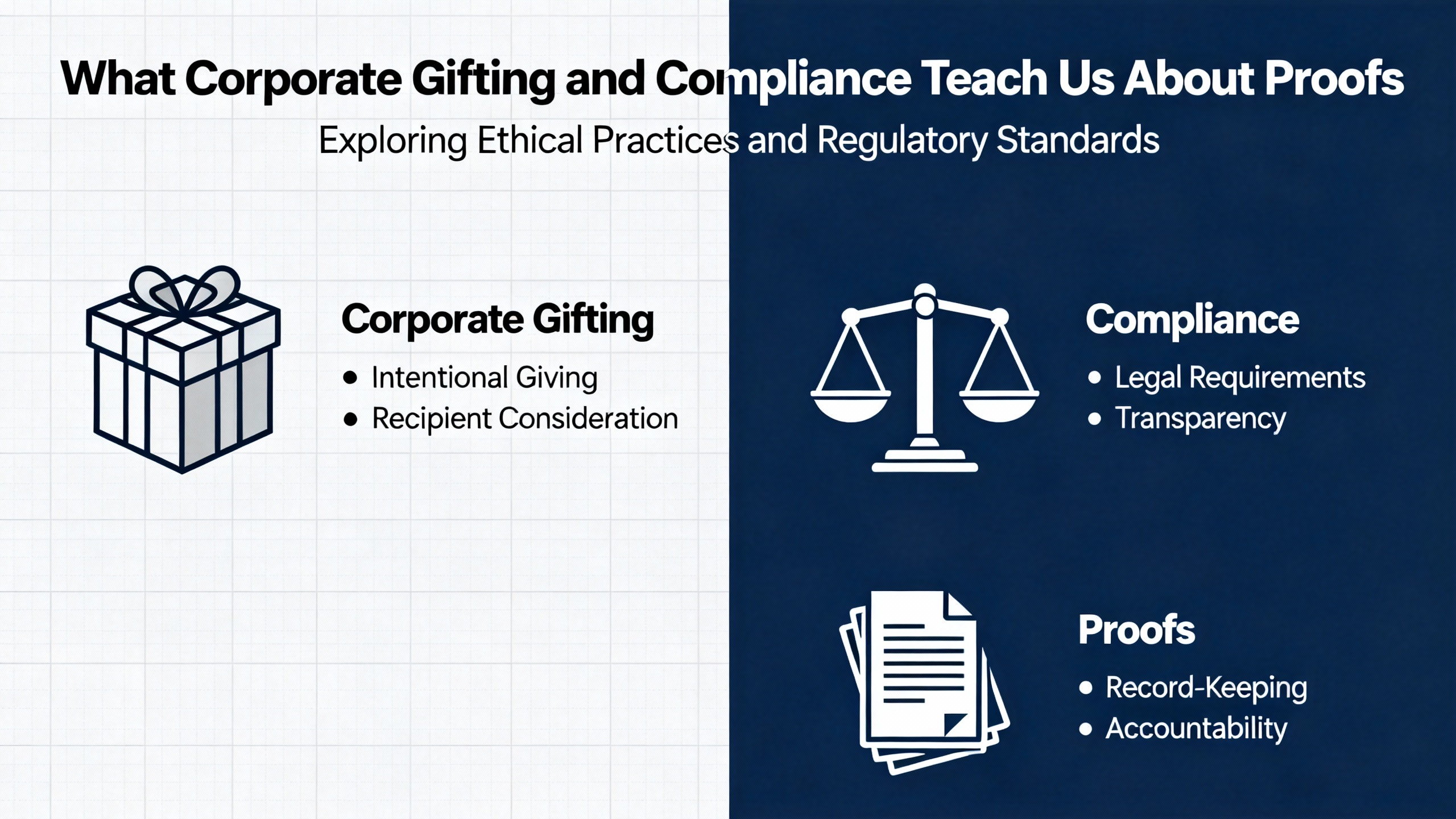
What Corporate Gifting and Compliance Teach Us About Proofs

If you serve corporate clients or want to, it is worth looking at how mature gifting platforms handle approvals and compliance.

CorporateGift.com describes structured approval flows where requesters answer specific questions before a gift is approved. Typical forms ask who the gift is for, whether the recipient is an employee or a client, and the desired send date. Admins can mark responses as mandatory or optional, create as many questions as needed, and centralize all required information in one place. This reduces back-and-forth messages, speeds approvals, and creates an auditable trail of gift decisions.

Double The Donation, which focuses on corporate gift-giving laws, explains that internal policies are designed to prevent bribery, favoritism, and conflicts of interest. They recommend defining who may give and receive gifts, what types are appropriate, when they may be given, and how much can be spent. They also point out that, for U.S. tax purposes, businesses generally can deduct up to $25 of the value of a gift per recipient per tax year, excluding certain entertainment expenses. Their guidance includes tracking each gift’s value, date, recipient, and purpose, and maintaining this information in a centralized system. They also suggest a gift acceptance policy to govern incoming gifts.

The numbers they cite are telling. Research they reference shows that 57% of employees and 52% of consumers are more likely to be loyal to companies that give gifts, and 81% of employees say they work harder when they feel appreciated. Corporate gifting is not just politeness; it is part of engagement, retention, and brand strategy.

Giftsenda, a corporate gifting platform, reinforces how important personalization is in this context. They report that ninety-six percent of digital marketers say personalization advances customer relationships and that recipients respond more than five times as often to personalized gifts compared with standard email campaigns. Their platform supports gift item sourcing, personalized messaging based on account-based marketing research, branded merchandise, and free-choice gifting links where recipients pick a gift from a curated selection.

Taken together, these sources show why proof approval matters so much for corporate and bulk orders. Corporate teams need to know what is going out in their name, stay within their own policies and tax constraints, and prove they followed their internal rules. A structured proof process, with the right questions and records, makes your business much easier to work with.
custom design review for print on demand

Designing a Proof Approval Flow That Fits Your Store

In practice, proof approval is not a single feature; it is a series of design decisions. You need to decide when to require proofs, what information to collect, how to generate proofs, and how to track approvals. The right answer is different for a small Etsy-style shop and a scaling corporate gifting operation, but the building blocks are similar.

Decide When Proofs Are Required

Not every order needs the same level of oversight. A simple custom mug with one line of text and a low price might not justify a manual proof, while a large canvas wall art piece for a corporate lobby definitely does. Some retailers prefer to reserve proofs for orders above a certain value, designs that include customer-uploaded photos, or products where alignment and color are critical.

You can think in terms of three basic models.

Proof model

Speed for customer

Risk of design errors

Typical use cases

No proof

Fastest

Highest

Low-value, repeat designs, simple text personalization

Optional proof

Moderate

Medium

Retail photo gifts, small batches, repeat customers

Mandatory proof

Slowest

Lowest

Corporate orders, bulk runs, complex layouts

Retailers highlighted by CNN Underscored and TODAY.com often deal with one-off consumer gifts, where shoppers already see a preview in the online designer but may not have a formal approval step. Corporate-focused providers like Swagify and Giftsenda lean toward more structured flows with clear proofing and signoff, because the stakes and volumes are higher. As a founder, your job is to position each product and customer segment into the right model instead of treating everything the same.

Capture the Right Information Up Front

Good proofs start with good inputs. CorporateGift.com emphasizes using structured questions, multiple field types, and mandatory fields to make sure that approvers have everything they need. That same thinking applies to your product pages and order forms.

For personalized gifts, you want to collect details such as names, dates, messages, and special characters, but you also want contextual information. Asking about the occasion, the recipient’s relationship to the buyer, and the desired send date can all change design decisions. Corporate clients may also need fields for department, internal cost center, or campaign name so that they can reconcile gifts with budgets later.

Double The Donation’s recommendation to track gift value, date, recipient, and purpose can be built into your backend fields even if the customer never sees them. When a corporate buyer asks for a export that fits their internal reporting, you will already be ready.

Instead of free-text chaos, think in terms that CorporateGift.com suggests: text boxes for engraving lines, multiple-choice options for layout styles, date pickers for event dates, and file uploads for photos or logos. Clear field labels and examples reduce mistakes that later show up on proofs.

Generate Clear, Realistic Proofs

A proof only works if the customer understands what they are looking at. Printing providers like 4OVER4 and brands like PrintToucan showcase the value of easy online design tools that make it simple for customers to add photos, names, and designs while seeing a polished result. That is essentially proof generation in real time.

For more complex or high-value items, you may prefer to generate proofs behind the scenes. A designer or automated system lays out the artwork based on the customer’s inputs, then you send a static image or PDF proof for review. In corporate gifting, Swagify notes the importance of planning time for design proofing before production, especially for curated gift boxes or branded merchandise sets.

Whatever method you use, clarity matters. The proof should show the correct product variant, illustrate scale and placement as accurately as possible, and make any limitations obvious. If text will be small, if a photo is low resolution, or if colors may print slightly differently, the proof is your chance to highlight those realities and prevent disappointment. It is better to have a revision or two at this stage than a remade order later.

Set Expectations on Timelines and Revisions

Even the most beautiful proof loses value if it blows your shipping promise. Multiple sources emphasize planning ahead for personalized gifts. Sam’s Engraving & Gifts suggests ordering customized gifts at least one to two weeks in advance because engraving and personalization take extra time. PrintToucan highlights fast three-day U.S. shipping on some items but still encourages thoughtful selection. Editorial guides from CNN Underscored and TODAY.com tell readers to start shopping early because custom items often require longer production and shipping times, especially around holidays.

For your operation, the key is to turn those general warnings into specific service levels. Decide how long it will take you to generate a proof after an order is placed, how many rounds of changes you will allow, and what happens if a customer does not respond. For example, you may state that proofs are sent within one business day, orders ship within a set number of days after approval, and unattended proofs are either auto-approved or cancelled after a clear deadline.

Swagify points out that companies should account for design proofing, production lead times, seasonal bottlenecks, and shipping windows so gifts arrive before key events. Building these buffers into your internal calendar—and communicating them on product pages and in post-purchase emails—turns proof approval from a delay into a predictable part of the service.

Keep an Audit Trail

CorporateGift.com highlights that centralizing responses and approvals reduces errors and creates an auditable trail of decisions. Double The Donation recommends structured gift reporting with clear responsibility for maintaining records. Giftsenda encourages senders to ask questions such as who the intended recipient is, what the purpose of the gift is, and what message will accompany it before signing off on a campaign.

Your proof approval process should follow the same philosophy. Store each proof version, the date it was sent, the approver’s identity, and the timestamp of their approval. If there is ever a dispute, your team can pull up exactly what was approved. For corporate customers, this record can be shared with their legal or compliance teams as needed, making your company a safer partner.

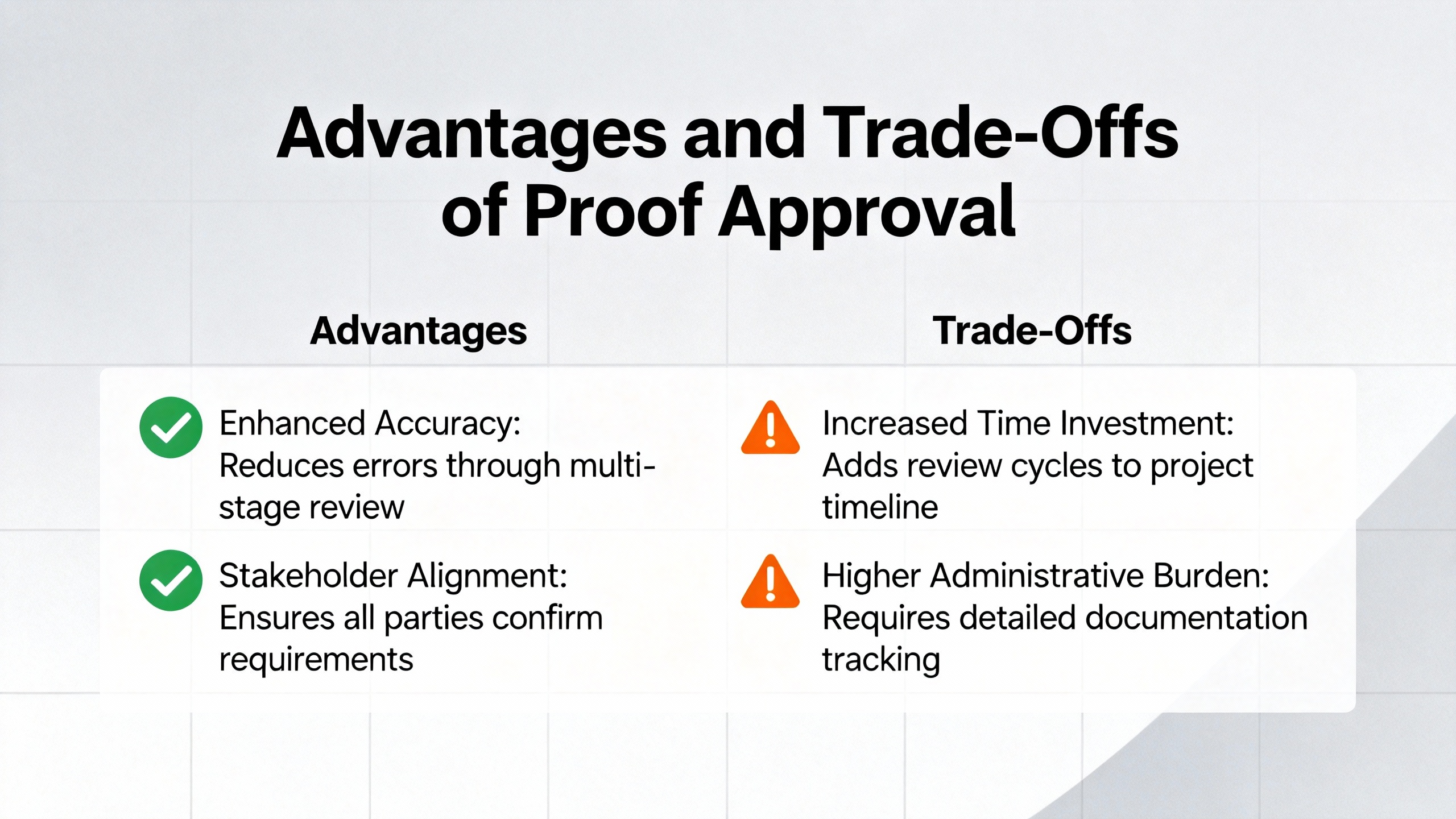
Advantages and Trade-Offs of Proof Approval

From a founder’s perspective, proof approval has clear upsides and real costs. Understanding both helps you design a system that supports growth instead of slowing it.

On the advantage side, proofs dramatically reduce avoidable errors. Many mistakes in personalized gifts are simple: a name spelled incorrectly, a date entered wrong, or a message that wraps strangely when applied to the actual product. A clear proof surfaces these issues before printing. That translates into fewer reprints, lower material waste, and less time spent in support resolving “this is not what I expected” situations.

Proofs also support a premium brand position. High-quality providers like 4OVER4 and Uncommon Goods emphasize polished finishes, unique designs, and careful curation. Platforms like Uncommon Goods even highlight ethical material choices and generous return policies to build trust. When you pair that kind of positioning with a robust proof process, customers rightly feel that you are taking their story seriously, not churning out commodity products.

For corporate clients, proofing is almost non-negotiable. Double The Donation’s guidance on gift policies and IRS rules, combined with CorporateGift.com’s focus on approval flows, illustrates how much structure sits behind a “simple” corporate gift. Proofs become part of their internal control system. They may need to show that a gift complied with price limits, excluded certain categories, and reflected appropriate branding. When you can support that, you move from vendor to strategic partner.

The trade-offs are real, though. Every additional step in the journey can reduce conversion. Some retail buyers just want to click, buy, and get their gift quickly. If they have to wait for a proof and remember to approve it, they may get frustrated or miss a deadline. Your team also needs capacity to generate and manage proofs, especially if many of them are manual.

There is also a subtle risk of over-personalization in formal contexts. Giftsenda and Swagify both caution that effective corporate gifts should balance relevance and professionalism. A witty, personal design might be perfect for an entertainment client and inappropriate for a bank director. When you present proofs, your team sometimes needs to guide customers toward designs that fit the recipient’s role and industry norms, not just the buyer’s sense of humor.

The answer is not to abandon proofs but to deploy them intentionally. Make them standard where the stakes are high and optional where speed matters more, and always communicate the value they add.
proof approval workflow for ecommerce

Serving Corporate, Bulk, and Regulated Gifting Needs

If you already serve individual consumers, corporate and bulk gifting can look like “more of the same but larger.” In practice, the requirements are different enough that you should treat this as a separate product line with its own proof and approval workflow.

CorporateGift.com’s approach to approval questions is a useful template. For corporate orders, your intake should capture who the gifts are for, whether they are employees or clients, the send date, and any specific policy constraints. Double The Donation’s policy template suggests defining unacceptable gift types, price limits by category, and required processes for recording or refusing gifts. You can reflect this by offering curated corporate collections that avoid risky categories and by clearly displaying per-recipient pricing so buyers can stay within thresholds such as the $25 per-person deduction limit.

Corporate gifting platforms like Giftsenda and Swagify add more layers. They personalize messages based on account research, support free-choice gifting where recipients pick from a curated selection, and manage branded merchandise and logistics across multiple countries. While you may not replicate their entire stack, you can borrow principles. For example, create proof templates that show both the product and the personalized note, so approvers can sign off on the full experience. Offer itemized bills and reporting exports that match the fields they need for internal records.

In sectors with stricter rules, such as finance or healthcare, a structured, documented proof process can be the difference between being approved as a vendor and being rejected. Present your proof approval and record-keeping as part of your value proposition in B2B sales conversations.

Technology Choices for Proof Approval and Personalization

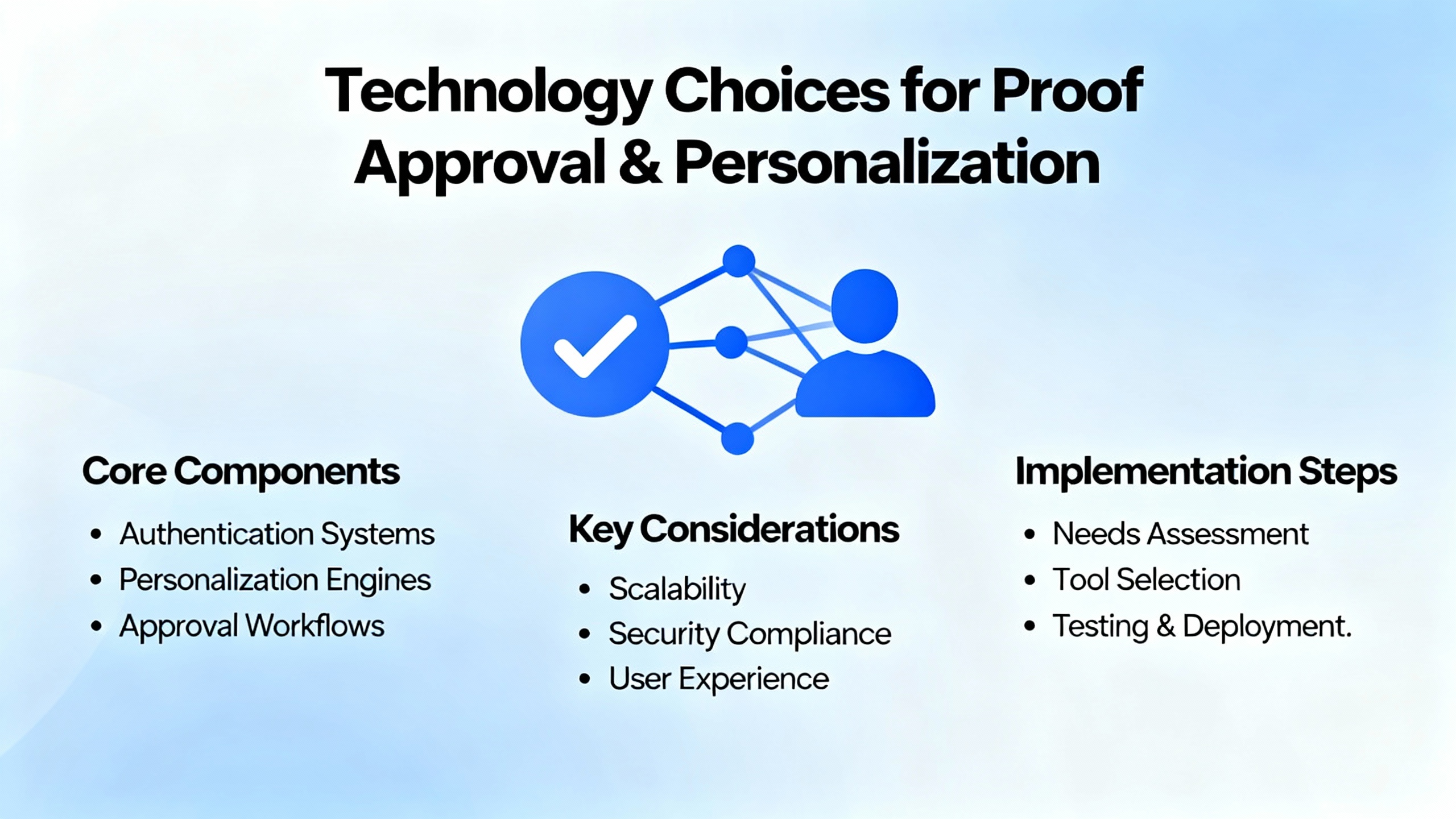
The technology you choose should match your stage and strategy. The research notes highlight a range of models, from small personalized-gift businesses to large platforms.

At the simplest level, many shops start with manual proofs. A designer mocks up the product in a design tool, exports an image, and sends it by email for approval. This approach is resource-intensive but flexible. It is best suited to low volume, high-ticket items where each order justifies hands-on attention.

As you grow, you will likely move toward semi-automated or fully automated proof generation. Print-on-demand companies like PrintToucan emphasize easy online design tools for canvas prints, posters, apparel, blankets, mugs, and pet supplies. 4OVER4 promotes an online designer that lets users add monograms, artwork, logos, and personalized text with a professional result. Those tools not only help customers create designs but effectively generate live proofs that can be captured with an approval checkbox at checkout.

For corporate campaigns, platforms such as Giftsenda and Swagify add higher-level capabilities, including gift sourcing, curated catalogs of thousands of gifts, personalized messaging based on account research, and free-choice gift links where recipients choose from a themed collection. While you may use them as fulfillment partners rather than building everything yourself, it is important to understand how their proof and approval features work so you can integrate smoothly.

Marketplaces like Etsy and specialty retailers such as Mark & Graham and Uncommon Goods show that personalization can command premium pricing, especially when paired with strong branding and curated assortments. Personalized gifts on Etsy often occupy higher price tiers and are sometimes heavily discounted, while Mark & Graham’s “gifts by occasion” collections help shoppers quickly find monogrammed and personalized items by event or holiday. If you integrate proofs into a similar curated, premium experience, it becomes easier to defend your margins.
customer design confirmation system

Measuring Whether Proof Approval Is Working

Proof approval is not just a policy choice; it is a lever in your unit economics. Swagify suggests measuring post-gifting outcomes such as recipient feedback and observed usage to refine future choices. You can adopt the same mindset for your proof process.

Track how often customers request changes at the proof stage and what types of issues drive those revisions. If you notice recurring problems with certain fonts, layouts, or product photos, improve your templates and product-page guidance. Monitor remake rates and support tickets related to personalization errors before and after implementing proofs. Even without publishing specific percentages, you will see whether the trend is moving in the right direction.

There is a balance to maintain between speed and certainty. Watch how long orders stay in “awaiting proof approval” status. If many customers stall there, consider shortening deadlines, sending clearer reminders, or simplifying your proof interface. For optional proofs, compare conversion rates and customer satisfaction scores between orders with and without proofs. That information will help you tune your defaults by product type and customer segment.

Marketing outcomes also matter. Double The Donation’s data on loyalty and effort, combined with Giftsenda’s findings about personalization lifting response rates, makes it clear that thoughtful, personalized gifting is worth investing in. When customers see that you offer proof approval, highlight that in your product descriptions and ads as a mark of quality and care. Over time, you can evaluate whether that positioning increases repeat purchases and organic referrals.

Brief FAQ on Proof Approval for Personalized Gifts

Do I need proof approval for every personalized order?

Not necessarily. For low-value, low-complexity items, especially when customers see an accurate preview in a reliable online designer, you may rely on automated checks. Proof approval becomes more important as order value, design complexity, or corporate compliance requirements increase. Many successful merchants reserve formal proofs for photo-heavy designs, bulk runs, or B2B orders while keeping simpler consumer products fast and streamlined.

Who should approve proofs for corporate orders?

Ideally, someone who understands both the brand and the internal gift policy. CorporateGift.com’s guidance on approval flows and Double The Donation’s policy recommendations both imply that the approver should be able to assess compliance, not just aesthetics. Encourage your corporate clients to designate an internal point person, and make it easy for them to forward proofs for internal review if needed.

How do I handle tight deadlines and unresponsive customers?

The key is to set clear rules before purchase. Use product pages and order confirmations to explain how long proof creation takes, how many revisions are included, and what happens if a customer does not respond. Swagify’s emphasis on planning around proofing and shipping windows is a good reminder that you should give yourself enough buffer. Where deadlines are firm, such as holidays or events, consider offering rush options with shorter proof windows and preconfigured designs that reduce back-and-forth.

As personalized gifting continues to evolve, proof approval is emerging as a quiet competitive advantage. It is not glamorous, but it is exactly the kind of operational discipline that separates hobby shops from durable brands. When you combine thoughtful, occasion-appropriate personalization with a smart proof process that respects timelines and compliance, you not only protect your margins—you become the partner people trust with the moments that matter most.

References

  1. https://www.personalcreations.com/?srsltid=AfmBOoqf-naRcCOcQaaMd0OobLOwBJFqcmR04uB_R7SrkQK4dP1ZRTQl
  2. https://www.personalizationmall.com/Personalized-Gifts-for-Women-s19.store?srsltid=AfmBOor8bzw4Cmf61XrObmTwG_JC0IBNkSALHD6CnNbOng5Xmg5F5ieS
  3. https://www.thingsremembered.com/
  4. https://classiclegacy.com/custom-personalized-gift-guidelines-create-luxury-gifts/
  5. https://doublethedonation.com/corporate-gift-giving-laws/
  6. https://www.today.com/shop/best-personalized-gifts-t199126
  7. https://www.4over4.com/content-hub/stories/personalized-gifts-idea-that-will-make-their-special-day?srsltid=AfmBOopnTlgb0DgZWyR0wW7gll8T645tdFKGgBTtSAYtfwiqQd__ORYv
  8. https://www.chococraft.in/blogs/corporate-gifts/custom-gifts-for-employees-process?srsltid=AfmBOoohyiY7st2PB2aUvkmfWSJPtbnBDfA5St415Q5KdqBPSy5Md-LG
  9. https://www.clothes2order.com/blog/how-to-start-your-own-personalised-gift-business/
  10. https://www.cnn.com/cnn-underscored/gifts/personalized-gifts

Like the article

0
Personalized Gifts with Proof Approval: How Smart Merchants Let Customers Review Custom Designs Before Production

Personalized Gifts with Proof Approval: How Smart Merchants Let Customers Review Custom Designs Before Production

Personalized gifts have moved from novelty to expectation. Whether someone is ordering a custom mug with a inside joke, a canvas celebrating a graduation, or a branded gift box for clients, they assume the final product will match the story in their head. As a mentor to founders in on-demand printing and dropshipping, I see the same pattern over and over: the emotion is in the personalization, and the risk is in the execution. A single typo, misplaced photo, or misunderstood brief can turn an otherwise perfect gift into a support ticket.

That is where proof approval comes in. Instead of “print whatever they typed,” you introduce a simple but powerful checkpoint: the customer sees and confirms a visual proof of the design before you hit “go” on production. Done well, this protects margins, reduces disputes, and makes you the kind of brand people trust for high-stakes occasions and corporate campaigns.

In this article, I will unpack what proof approval is, how it connects to corporate gifting and compliance, and how to design a proof flow that works in a fast-paced on-demand printing operation without killing your turnaround time.

Why Personalized Gifts Create Both Opportunity and Risk

Personalization is not just a trend; it is the backbone of modern gifting. Gift specialists like PrintToucan describe personalized gifts as everyday objects customized with photos, names, dates, or messages so they become story-rich keepsakes rather than generic items. Printing providers like 4OVER4 highlight how simple products such as wine labels, cutting boards, or electronics cases become long-lasting keepsakes once you add names, dates, designs, or photos.

Editorial guides from outlets such as CNN Underscored, TODAY.com, and Wirecutter consistently curate dozens of personalized gift ideas each year. They feature everything from monogrammed tote bags and custom phone cases to embroidered aprons, engraved chef’s knives, and sneakers decorated with initials and bespoke colors. Across those guides, a few themes repeat: personalization makes gifts feel one-of-a-kind, showcases the recipient’s personality, and dramatically reduces the chance that the gift is regifted or forgotten.

Thoughtful Presence, a brand focused on custom gifts, frames the core value clearly: personalization turns ordinary objects into emotionally significant keepsakes that tell a unique story and show that the giver “truly sees” the recipient. Personalized gifts are recommended for birthdays, anniversaries, weddings, graduations, baby showers, sympathy moments, and “just because” gestures. In other words, they show up at exactly the moments where disappointment is most painful and word-of-mouth is most powerful.

That emotional weight is good news and bad news for your print-on-demand store. When everything goes right, the impact is huge. When something goes wrong in the design, spelling, or layout, it is not just a defective product; it is a spoiled milestone. That is why proof approval is no longer a “nice to have” for serious personalized-gift businesses.

What “Proof Approval” Really Means in an On-Demand Workflow

In a personalized gift business, proof approval is the process of showing the customer a visual representation of the final design and getting explicit confirmation before you start production. It can be as simple as an automatically generated mockup in the cart or as structured as a formal proof document that a corporate client signs off in writing.

Clothes2Order, which advises on starting a personalized gift business, stresses the importance of designing an order workflow that collects customization details accurately and defines clear production and shipping times. They specifically call out the value of offering visual proofs or mockups when appropriate. Swagify, a corporate gifting provider, notes that teams should plan around design proofing, production lead times, and shipping windows so customized items arrive before key events. Those are exactly the moving parts your proof system needs to handle.

A practical proof approval process usually follows a pattern. The customer chooses a base product, such as a blanket, mug, or piece of apparel, and enters their personalization details: names, dates, quotes, or photos. Your system then generates a proof, which might be a realistic product mockup or a flat design layout. The customer reviews the proof, requests changes if needed, and eventually approves it. Only once that approval is captured do you send the job to print or embroidery.

In many on-demand printing setups, the online designer itself functions as a real-time proof. Providers like 4OVER4 describe user-friendly online design tools that let shoppers add monograms, artwork, logos, and personalized text so they can achieve a polished, professional look even if they are not designers. That live preview, paired with an explicit “I approve this design” step, is often enough for smaller retail orders. For corporate, bulk, or high-value gifts, merchants usually add a more formal review stage.

What Corporate Gifting and Compliance Teach Us About Proofs

If you serve corporate clients or want to, it is worth looking at how mature gifting platforms handle approvals and compliance.

CorporateGift.com describes structured approval flows where requesters answer specific questions before a gift is approved. Typical forms ask who the gift is for, whether the recipient is an employee or a client, and the desired send date. Admins can mark responses as mandatory or optional, create as many questions as needed, and centralize all required information in one place. This reduces back-and-forth messages, speeds approvals, and creates an auditable trail of gift decisions.

Double The Donation, which focuses on corporate gift-giving laws, explains that internal policies are designed to prevent bribery, favoritism, and conflicts of interest. They recommend defining who may give and receive gifts, what types are appropriate, when they may be given, and how much can be spent. They also point out that, for U.S. tax purposes, businesses generally can deduct up to $25 of the value of a gift per recipient per tax year, excluding certain entertainment expenses. Their guidance includes tracking each gift’s value, date, recipient, and purpose, and maintaining this information in a centralized system. They also suggest a gift acceptance policy to govern incoming gifts.

The numbers they cite are telling. Research they reference shows that 57% of employees and 52% of consumers are more likely to be loyal to companies that give gifts, and 81% of employees say they work harder when they feel appreciated. Corporate gifting is not just politeness; it is part of engagement, retention, and brand strategy.

Giftsenda, a corporate gifting platform, reinforces how important personalization is in this context. They report that ninety-six percent of digital marketers say personalization advances customer relationships and that recipients respond more than five times as often to personalized gifts compared with standard email campaigns. Their platform supports gift item sourcing, personalized messaging based on account-based marketing research, branded merchandise, and free-choice gifting links where recipients pick a gift from a curated selection.

Taken together, these sources show why proof approval matters so much for corporate and bulk orders. Corporate teams need to know what is going out in their name, stay within their own policies and tax constraints, and prove they followed their internal rules. A structured proof process, with the right questions and records, makes your business much easier to work with.

custom design review for print on demand

Designing a Proof Approval Flow That Fits Your Store

In practice, proof approval is not a single feature; it is a series of design decisions. You need to decide when to require proofs, what information to collect, how to generate proofs, and how to track approvals. The right answer is different for a small Etsy-style shop and a scaling corporate gifting operation, but the building blocks are similar.

Decide When Proofs Are Required

Not every order needs the same level of oversight. A simple custom mug with one line of text and a low price might not justify a manual proof, while a large canvas wall art piece for a corporate lobby definitely does. Some retailers prefer to reserve proofs for orders above a certain value, designs that include customer-uploaded photos, or products where alignment and color are critical.

You can think in terms of three basic models.

Proof model

Speed for customer

Risk of design errors

Typical use cases

No proof

Fastest

Highest

Low-value, repeat designs, simple text personalization

Optional proof

Moderate

Medium

Retail photo gifts, small batches, repeat customers

Mandatory proof

Slowest

Lowest

Corporate orders, bulk runs, complex layouts

Retailers highlighted by CNN Underscored and TODAY.com often deal with one-off consumer gifts, where shoppers already see a preview in the online designer but may not have a formal approval step. Corporate-focused providers like Swagify and Giftsenda lean toward more structured flows with clear proofing and signoff, because the stakes and volumes are higher. As a founder, your job is to position each product and customer segment into the right model instead of treating everything the same.

Capture the Right Information Up Front

Good proofs start with good inputs. CorporateGift.com emphasizes using structured questions, multiple field types, and mandatory fields to make sure that approvers have everything they need. That same thinking applies to your product pages and order forms.

For personalized gifts, you want to collect details such as names, dates, messages, and special characters, but you also want contextual information. Asking about the occasion, the recipient’s relationship to the buyer, and the desired send date can all change design decisions. Corporate clients may also need fields for department, internal cost center, or campaign name so that they can reconcile gifts with budgets later.

Double The Donation’s recommendation to track gift value, date, recipient, and purpose can be built into your backend fields even if the customer never sees them. When a corporate buyer asks for a export that fits their internal reporting, you will already be ready.

Instead of free-text chaos, think in terms that CorporateGift.com suggests: text boxes for engraving lines, multiple-choice options for layout styles, date pickers for event dates, and file uploads for photos or logos. Clear field labels and examples reduce mistakes that later show up on proofs.

Generate Clear, Realistic Proofs

A proof only works if the customer understands what they are looking at. Printing providers like 4OVER4 and brands like PrintToucan showcase the value of easy online design tools that make it simple for customers to add photos, names, and designs while seeing a polished result. That is essentially proof generation in real time.

For more complex or high-value items, you may prefer to generate proofs behind the scenes. A designer or automated system lays out the artwork based on the customer’s inputs, then you send a static image or PDF proof for review. In corporate gifting, Swagify notes the importance of planning time for design proofing before production, especially for curated gift boxes or branded merchandise sets.

Whatever method you use, clarity matters. The proof should show the correct product variant, illustrate scale and placement as accurately as possible, and make any limitations obvious. If text will be small, if a photo is low resolution, or if colors may print slightly differently, the proof is your chance to highlight those realities and prevent disappointment. It is better to have a revision or two at this stage than a remade order later.

Set Expectations on Timelines and Revisions

Even the most beautiful proof loses value if it blows your shipping promise. Multiple sources emphasize planning ahead for personalized gifts. Sam’s Engraving & Gifts suggests ordering customized gifts at least one to two weeks in advance because engraving and personalization take extra time. PrintToucan highlights fast three-day U.S. shipping on some items but still encourages thoughtful selection. Editorial guides from CNN Underscored and TODAY.com tell readers to start shopping early because custom items often require longer production and shipping times, especially around holidays.

For your operation, the key is to turn those general warnings into specific service levels. Decide how long it will take you to generate a proof after an order is placed, how many rounds of changes you will allow, and what happens if a customer does not respond. For example, you may state that proofs are sent within one business day, orders ship within a set number of days after approval, and unattended proofs are either auto-approved or cancelled after a clear deadline.

Swagify points out that companies should account for design proofing, production lead times, seasonal bottlenecks, and shipping windows so gifts arrive before key events. Building these buffers into your internal calendar—and communicating them on product pages and in post-purchase emails—turns proof approval from a delay into a predictable part of the service.

Keep an Audit Trail

CorporateGift.com highlights that centralizing responses and approvals reduces errors and creates an auditable trail of decisions. Double The Donation recommends structured gift reporting with clear responsibility for maintaining records. Giftsenda encourages senders to ask questions such as who the intended recipient is, what the purpose of the gift is, and what message will accompany it before signing off on a campaign.

Your proof approval process should follow the same philosophy. Store each proof version, the date it was sent, the approver’s identity, and the timestamp of their approval. If there is ever a dispute, your team can pull up exactly what was approved. For corporate customers, this record can be shared with their legal or compliance teams as needed, making your company a safer partner.

Advantages and Trade-Offs of Proof Approval

From a founder’s perspective, proof approval has clear upsides and real costs. Understanding both helps you design a system that supports growth instead of slowing it.

On the advantage side, proofs dramatically reduce avoidable errors. Many mistakes in personalized gifts are simple: a name spelled incorrectly, a date entered wrong, or a message that wraps strangely when applied to the actual product. A clear proof surfaces these issues before printing. That translates into fewer reprints, lower material waste, and less time spent in support resolving “this is not what I expected” situations.

Proofs also support a premium brand position. High-quality providers like 4OVER4 and Uncommon Goods emphasize polished finishes, unique designs, and careful curation. Platforms like Uncommon Goods even highlight ethical material choices and generous return policies to build trust. When you pair that kind of positioning with a robust proof process, customers rightly feel that you are taking their story seriously, not churning out commodity products.

For corporate clients, proofing is almost non-negotiable. Double The Donation’s guidance on gift policies and IRS rules, combined with CorporateGift.com’s focus on approval flows, illustrates how much structure sits behind a “simple” corporate gift. Proofs become part of their internal control system. They may need to show that a gift complied with price limits, excluded certain categories, and reflected appropriate branding. When you can support that, you move from vendor to strategic partner.

The trade-offs are real, though. Every additional step in the journey can reduce conversion. Some retail buyers just want to click, buy, and get their gift quickly. If they have to wait for a proof and remember to approve it, they may get frustrated or miss a deadline. Your team also needs capacity to generate and manage proofs, especially if many of them are manual.

There is also a subtle risk of over-personalization in formal contexts. Giftsenda and Swagify both caution that effective corporate gifts should balance relevance and professionalism. A witty, personal design might be perfect for an entertainment client and inappropriate for a bank director. When you present proofs, your team sometimes needs to guide customers toward designs that fit the recipient’s role and industry norms, not just the buyer’s sense of humor.

The answer is not to abandon proofs but to deploy them intentionally. Make them standard where the stakes are high and optional where speed matters more, and always communicate the value they add.

proof approval workflow for ecommerce

Serving Corporate, Bulk, and Regulated Gifting Needs

If you already serve individual consumers, corporate and bulk gifting can look like “more of the same but larger.” In practice, the requirements are different enough that you should treat this as a separate product line with its own proof and approval workflow.

CorporateGift.com’s approach to approval questions is a useful template. For corporate orders, your intake should capture who the gifts are for, whether they are employees or clients, the send date, and any specific policy constraints. Double The Donation’s policy template suggests defining unacceptable gift types, price limits by category, and required processes for recording or refusing gifts. You can reflect this by offering curated corporate collections that avoid risky categories and by clearly displaying per-recipient pricing so buyers can stay within thresholds such as the $25 per-person deduction limit.

Corporate gifting platforms like Giftsenda and Swagify add more layers. They personalize messages based on account research, support free-choice gifting where recipients pick from a curated selection, and manage branded merchandise and logistics across multiple countries. While you may not replicate their entire stack, you can borrow principles. For example, create proof templates that show both the product and the personalized note, so approvers can sign off on the full experience. Offer itemized bills and reporting exports that match the fields they need for internal records.

In sectors with stricter rules, such as finance or healthcare, a structured, documented proof process can be the difference between being approved as a vendor and being rejected. Present your proof approval and record-keeping as part of your value proposition in B2B sales conversations.

Technology Choices for Proof Approval and Personalization

The technology you choose should match your stage and strategy. The research notes highlight a range of models, from small personalized-gift businesses to large platforms.

At the simplest level, many shops start with manual proofs. A designer mocks up the product in a design tool, exports an image, and sends it by email for approval. This approach is resource-intensive but flexible. It is best suited to low volume, high-ticket items where each order justifies hands-on attention.

As you grow, you will likely move toward semi-automated or fully automated proof generation. Print-on-demand companies like PrintToucan emphasize easy online design tools for canvas prints, posters, apparel, blankets, mugs, and pet supplies. 4OVER4 promotes an online designer that lets users add monograms, artwork, logos, and personalized text with a professional result. Those tools not only help customers create designs but effectively generate live proofs that can be captured with an approval checkbox at checkout.

For corporate campaigns, platforms such as Giftsenda and Swagify add higher-level capabilities, including gift sourcing, curated catalogs of thousands of gifts, personalized messaging based on account research, and free-choice gift links where recipients choose from a themed collection. While you may use them as fulfillment partners rather than building everything yourself, it is important to understand how their proof and approval features work so you can integrate smoothly.

Marketplaces like Etsy and specialty retailers such as Mark & Graham and Uncommon Goods show that personalization can command premium pricing, especially when paired with strong branding and curated assortments. Personalized gifts on Etsy often occupy higher price tiers and are sometimes heavily discounted, while Mark & Graham’s “gifts by occasion” collections help shoppers quickly find monogrammed and personalized items by event or holiday. If you integrate proofs into a similar curated, premium experience, it becomes easier to defend your margins.

customer design confirmation system

Measuring Whether Proof Approval Is Working

Proof approval is not just a policy choice; it is a lever in your unit economics. Swagify suggests measuring post-gifting outcomes such as recipient feedback and observed usage to refine future choices. You can adopt the same mindset for your proof process.

Track how often customers request changes at the proof stage and what types of issues drive those revisions. If you notice recurring problems with certain fonts, layouts, or product photos, improve your templates and product-page guidance. Monitor remake rates and support tickets related to personalization errors before and after implementing proofs. Even without publishing specific percentages, you will see whether the trend is moving in the right direction.

There is a balance to maintain between speed and certainty. Watch how long orders stay in “awaiting proof approval” status. If many customers stall there, consider shortening deadlines, sending clearer reminders, or simplifying your proof interface. For optional proofs, compare conversion rates and customer satisfaction scores between orders with and without proofs. That information will help you tune your defaults by product type and customer segment.

Marketing outcomes also matter. Double The Donation’s data on loyalty and effort, combined with Giftsenda’s findings about personalization lifting response rates, makes it clear that thoughtful, personalized gifting is worth investing in. When customers see that you offer proof approval, highlight that in your product descriptions and ads as a mark of quality and care. Over time, you can evaluate whether that positioning increases repeat purchases and organic referrals.

Brief FAQ on Proof Approval for Personalized Gifts

Do I need proof approval for every personalized order?

Not necessarily. For low-value, low-complexity items, especially when customers see an accurate preview in a reliable online designer, you may rely on automated checks. Proof approval becomes more important as order value, design complexity, or corporate compliance requirements increase. Many successful merchants reserve formal proofs for photo-heavy designs, bulk runs, or B2B orders while keeping simpler consumer products fast and streamlined.

Who should approve proofs for corporate orders?

Ideally, someone who understands both the brand and the internal gift policy. CorporateGift.com’s guidance on approval flows and Double The Donation’s policy recommendations both imply that the approver should be able to assess compliance, not just aesthetics. Encourage your corporate clients to designate an internal point person, and make it easy for them to forward proofs for internal review if needed.

How do I handle tight deadlines and unresponsive customers?

The key is to set clear rules before purchase. Use product pages and order confirmations to explain how long proof creation takes, how many revisions are included, and what happens if a customer does not respond. Swagify’s emphasis on planning around proofing and shipping windows is a good reminder that you should give yourself enough buffer. Where deadlines are firm, such as holidays or events, consider offering rush options with shorter proof windows and preconfigured designs that reduce back-and-forth.

As personalized gifting continues to evolve, proof approval is emerging as a quiet competitive advantage. It is not glamorous, but it is exactly the kind of operational discipline that separates hobby shops from durable brands. When you combine thoughtful, occasion-appropriate personalization with a smart proof process that respects timelines and compliance, you not only protect your margins—you become the partner people trust with the moments that matter most.

References

  1. https://www.personalcreations.com/?srsltid=AfmBOoqf-naRcCOcQaaMd0OobLOwBJFqcmR04uB_R7SrkQK4dP1ZRTQl
  2. https://www.personalizationmall.com/Personalized-Gifts-for-Women-s19.store?srsltid=AfmBOor8bzw4Cmf61XrObmTwG_JC0IBNkSALHD6CnNbOng5Xmg5F5ieS
  3. https://www.thingsremembered.com/
  4. https://classiclegacy.com/custom-personalized-gift-guidelines-create-luxury-gifts/
  5. https://doublethedonation.com/corporate-gift-giving-laws/
  6. https://www.today.com/shop/best-personalized-gifts-t199126
  7. https://www.4over4.com/content-hub/stories/personalized-gifts-idea-that-will-make-their-special-day?srsltid=AfmBOopnTlgb0DgZWyR0wW7gll8T645tdFKGgBTtSAYtfwiqQd__ORYv
  8. https://www.chococraft.in/blogs/corporate-gifts/custom-gifts-for-employees-process?srsltid=AfmBOoohyiY7st2PB2aUvkmfWSJPtbnBDfA5St415Q5KdqBPSy5Md-LG
  9. https://www.clothes2order.com/blog/how-to-start-your-own-personalised-gift-business/
  10. https://www.cnn.com/cnn-underscored/gifts/personalized-gifts
Like the article

0