
Custom Gifts Online Design Tools: Create Personalized Items Easily
As a mentor to many print-on-demand and dropshipping founders, I see the same pattern every year. The stores that win in the custom gift space are not the ones with the biggest catalog; they are the ones that make it incredibly easy for customers to design something personal, see it instantly, and trust that what arrives will look just as promised. The modern online design tool is at the center of that experience.
In this article, we will unpack how custom gift design tools work, what features actually move the needle, and how to combine AI, web-to-print technology, and print-on-demand fulfillment to build a scalable, profitable personalized gift business.
Why Custom Gift Design Tools Matter Now
The broader gift market is not just large; it is evolving toward personalization and technology-enabled experiences. Research summarized by GiftList shows the global gift retail market growing from about $495.2 billion in 2023 to roughly $619.8 billion by 2028. Within that, immersive AR and VR shopping for gifts is projected to reach around $15.1 billion by 2030. This is a signal: customers increasingly expect interactive, digital-first gift journeys.
On the personalization side, research cited by WP Configurator draws on McKinsey & Company and Boston Consulting Group. Companies that excel at personalization can generate up to 40% more revenue from personalization-related activities than average competitors, while around four-fifths of consumers expect brands to offer personalized experiences. The same WP Configurator article notes studies suggesting customized products can increase conversion rates by up to 50%, because customers feel more connected to items they helped design.
Corporate gifting tells the same story. Coresight Research, referenced by Giftsenda, projects the U.S. corporate gifting market will rise from $258 billion in 2022 to $312 billion in 2025, driven by remote work, employee recognition, and relationship-based sales. Corporate gifting platforms such as Sendoso, Alyce by Sendoso, Giftsenda, Loop & Tie, and others exist largely to deliver more relevant and personalized experiences at scale, with analytics attached.
In other words, the demand is there. Your competitive advantage comes from combining that demand with a frictionless online design tool that lets everyday shoppers create something that feels one-of-one.
What Is an Online Custom Gift Design Tool?
At its core, a custom gift design tool is software embedded in your e-commerce store that allows customers to personalize products in real time. WP Configurator describes this as the ability to upload photos, add text, tweak colors, position logos, and instantly preview the result on gadgets and gifts such as phone cases, headphones, chargers, mugs, or full gift sets. This is often called a product customization tool or web-to-print configurator.
Platforms like Customily go a step further. They not only power personalization on the storefront, but also generate print-ready files automatically and integrate with print-on-demand providers. That means each time a customer finishes a design, your operations team (or your POD partner) receives a clean file ready to produce, without manual artwork preparation.
PrintXpand’s discussion of personalized gift software for web-to-print stores reinforces the same idea from another angle. Their featured solution emphasizes a simple, enjoyable customization experience for items ranging from business cards and banners to mobile covers, canvases, mugs, T-shirts, and neon signs. Customers select a product, personalize it visually, approve the design, and the system routes the order for production and fast delivery.
In practical terms, a modern design tool sits between your shoppers’ creativity and your print or embroidery pipeline and makes that entire journey feel seamless.
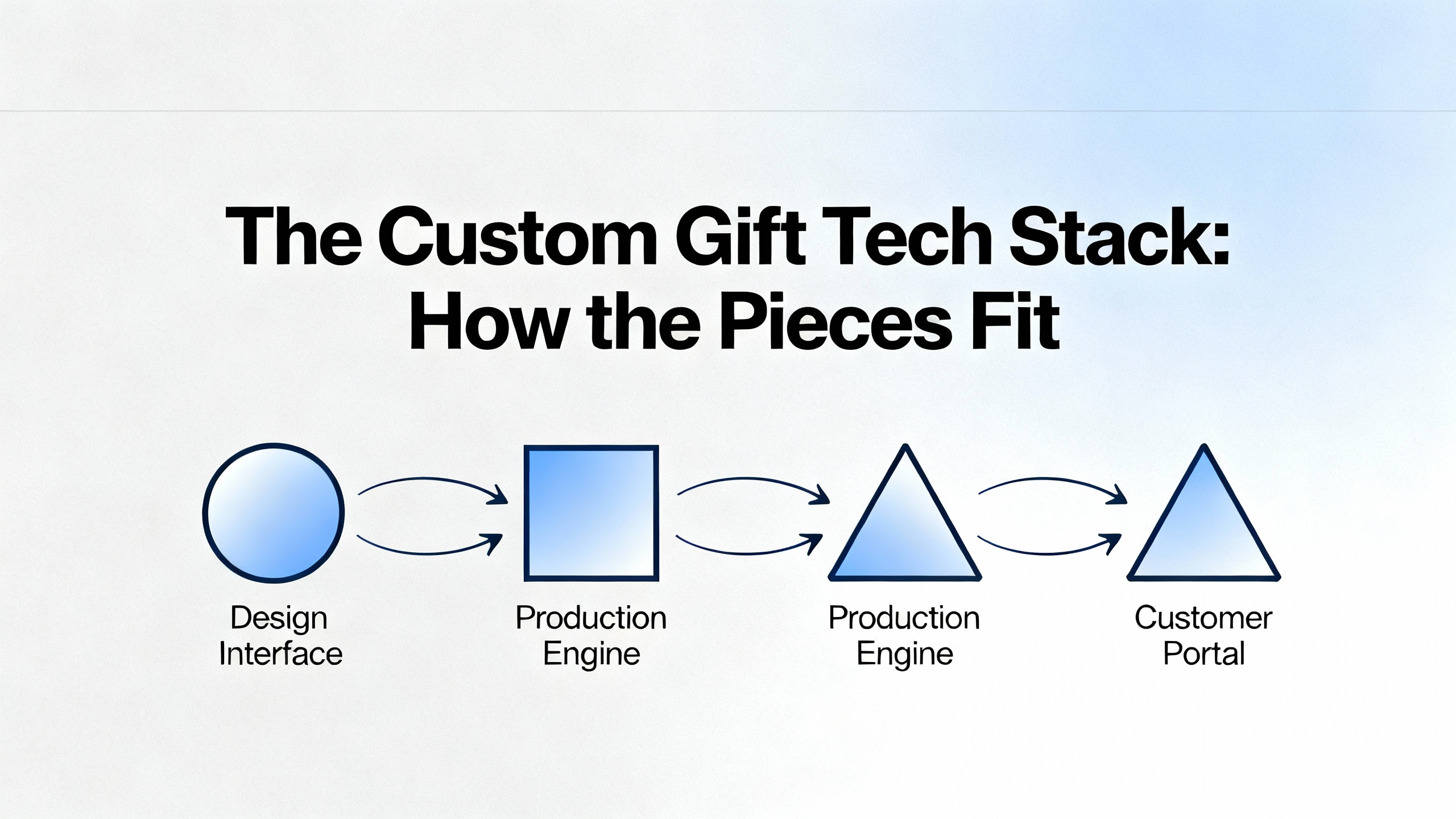
The Custom Gift Tech Stack: How the Pieces Fit
Most successful personalized gift businesses do not rely on a single tool. Instead, they assemble a small, focused stack of technologies that work together.
Here is a simple way to think about the main layers, based on the tools described in the research.
Layer in the stack | What it does | Example platforms from the research | Typical use case |
|---|---|---|---|
Storefront product customizer | Lets customers personalize products with text, images, colors, and real-time previews, often with dynamic pricing. | WP Configurator, Customily, PrintXpand’s gift design tool | Powering on-site customization for mugs, apparel, gadgets, home décor, and gift sets. |
AI design and content generator | Creates artwork, layouts, or design ideas using AI, often from text prompts. | Stockimg.ai, Canva, Adobe Express, Midjourney (as referenced by Stockimg.ai) | Quickly generating on-brand graphics, illustrations, avatars, or card designs without hiring a designer. |
Print-on-demand and production backend | Produces and ships the customized products on demand. | Printify, Gelato, various POD providers connected to Customily | Handling physical production and shipping without holding inventory, often via distributed local facilities. |
Gifting and analytics layer | Manages gifting workflows, campaign triggers, and performance tracking. | Alyce by Sendoso, Sendoso, Giftsenda, Loop & Tie | Running corporate gifting or loyalty campaigns and tying gifting activity to engagement, pipeline, and revenue. |
When these layers are aligned, a customer can discover a gift idea, personalize it beautifully, and have it produced and delivered with minimal friction, while you capture data at every step.
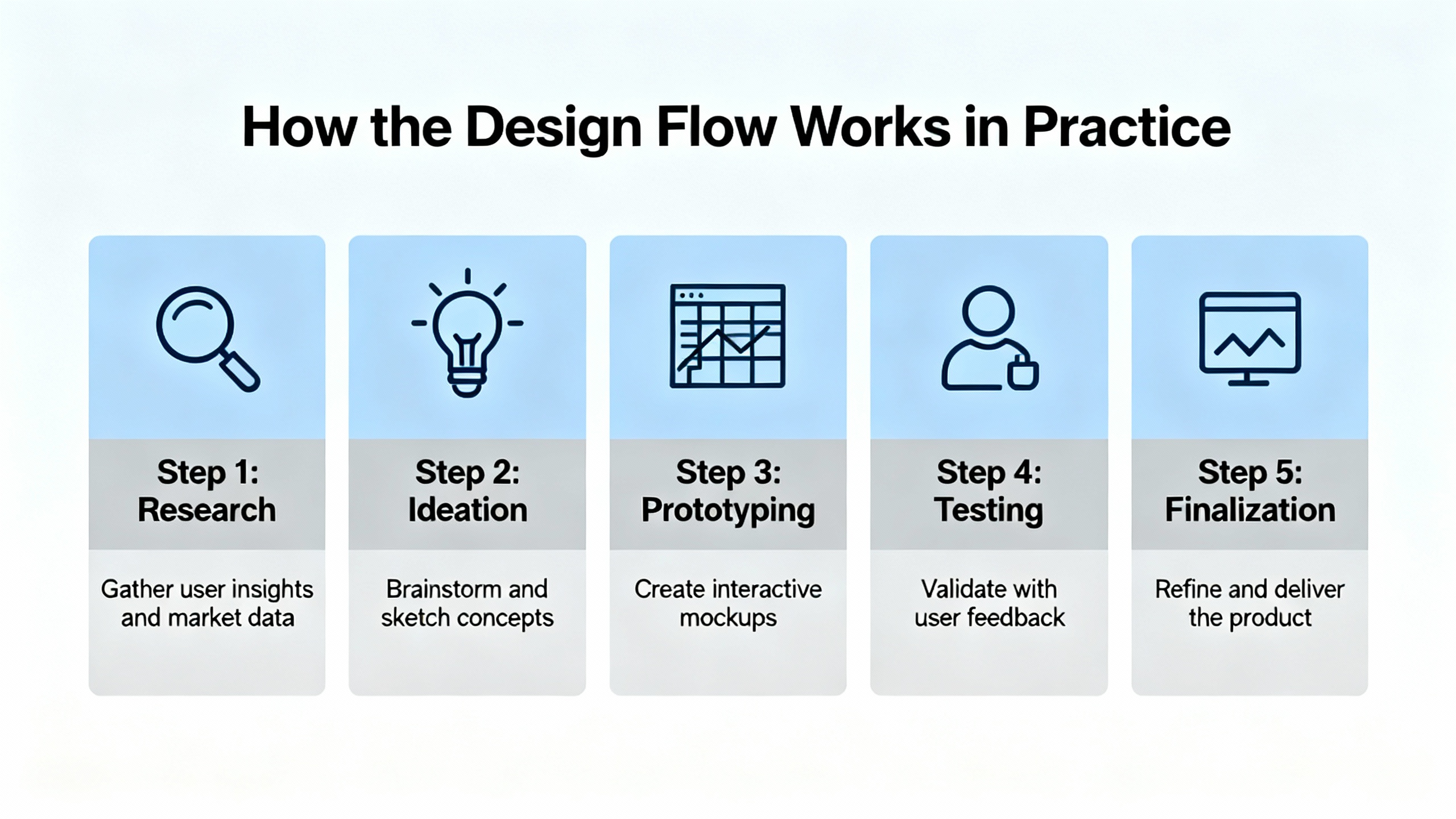
How the Design Flow Works in Practice
Let us walk through how this looks from an entrepreneur’s perspective, combining insights from WP Configurator, Customily, Stockimg.ai, Printify, WTPBiz, Canva, Snapfish, and other sources.
Step 1 – Choose Your Product Catalog and Niche
Start by clarifying what you actually want to sell. The Prize Possessions article on personalized gifts shows how specialized you can be: they focus on engraved awards and gifts for golf, corporate events, yachting, scholastic achievements, and similar niches, with precision engraving on glass and other materials. That kind of specialization makes it easier to design a focused customization experience and marketing strategy.
Photo-centric platforms like Shutterfly and Snapfish illustrate another angle. Their strengths lie in products where personal photos and messages carry the emotional weight: mugs, blankets, puzzles, photo books, cards, wall art, and calendars. Canva’s personalized gifts offering similarly centers on everyday items such as notebooks, coasters, mugs, hoodies, T-shirts, tumblers, and tote bags that become keepsakes once you add custom designs.
As an entrepreneur, you might anchor your catalog in a few high-velocity categories such as apparel, drinkware, and home décor, then add more specialized lines such as pet products, corporate awards, or event gifts as you learn what your audience responds to.
Step 2 – Let Customers Design in Real Time
This is where your online design tool carries the most weight. WP Configurator emphasizes the value of real-time, live previews where shoppers can see their design updates instantly in a 2D view, and even via AR for certain products. The tool supports practically unlimited variations of colors, materials, finishes, and engraving options, without sacrificing performance. Dynamic pricing updates totals as customers add premium options such as engraving, upgraded packaging, or higher-end materials, which not only improves transparency but often increases average order value.
From a user experience standpoint, features like step-by-step customization flows, saved drafts, and responsive design across desktop, tablet, and cell phones are not nice-to-haves; they are conversion levers. Customers want to experiment and then come back to a design later, especially for higher-stakes gifts like wedding sets or corporate awards. In my work with founders, I repeatedly see significant drop-off on stores that offer customization but no clear preview or price feedback.
Step 3 – Generate Artwork with AI, Even If You Are Not a Designer
Many founders delay launching because they think they need a full-time designer. The Stockimg.ai article shows how AI design tools have changed that equation. Tools such as Stockimg.ai, Canva, Midjourney, and Adobe Express allow you to create illustrations, avatars, art pieces, and cards tailored to your products with only a descriptive prompt.
Stockimg.ai recommends being specific in prompts about subject, style, text, and background. For example, instead of writing “cute dog mug,” you might ask for “a playful illustration of a golden retriever wearing a birthday hat, with confetti in the background and the phrase ‘Party Animal’ in bold script.” The tool can then generate multiple variations you can refine.
The same platform highlights categories like Illustrations, Avatars, Art, Cards, and Mockups, each aligned with different product types such as mugs, T-shirts, phone cases, wall art, and printed cards. Mockups help you visualize how a design will look on a product before you add it to your store. The article also emphasizes exporting in high-resolution formats so prints look crisp, which is critical for physical products.
One important note from Stockimg.ai is licensing. Many AI tools allow both personal and commercial use of generated designs, but you must verify and comply with each platform’s specific terms. As a mentor, I advise founders to treat licensing as seriously as they treat payment processing or tax compliance.
Step 4 – Connect the Design Tool to Production and Fulfillment
Once customers can create beautiful designs, you must ensure those designs can be made and shipped reliably.
Customily’s positioning as a product personalization platform is instructive. The platform automatically generates print-ready files and integrates with print-on-demand providers. That means your workflow can look like this: a customer personalizes a mug, Customily produces a print-ready file, and your POD partner prints and ships it without your team manually touching the artwork.
Printify’s content on launching a personalized gift business underscores the beginner-friendly path. You sign up, choose products from its catalog, connect your store, and start selling, with Printify handling production and shipping. A related guide about embroidery explains the concept of digitizing embroidery designs, meaning converting artwork into stitch-ready digital files that embroidery machines can interpret, which parallels the print-ready automation that Customily offers.
Gelato’s personalized gifts content further illustrates global-scale fulfillment. While the snippet in the research is brief, Gelato frames itself as making custom product production and delivery simple and borderless, processing millions of print jobs each year via distributed teams and facilities, and offering local production information via a product catalog. For founders, that kind of infrastructure allows you to offer local or regional production, which can shorten shipping times and reduce costs.
WTPBiz reminds us that even with POD, you must understand printing methods. They describe techniques suited for bulk T-shirt printing, where prints are durable and uniform but production is slower, digital photo printing for high-quality, full-color mugs, and a sewing-machine-based decorative method that creates a unique, regal look with very low risk of the design coming off. Many entrepreneurs eventually blend in local vendors and specialized printers, negotiating cost per product and per design to balance quality and margin.
Step 5 – Track What Works with Gifting Analytics
If you serve corporate buyers or run your own gifting campaigns for lead generation and retention, adding a gifting analytics layer can be extremely powerful.
Alyce by Sendoso highlights how visibility into gifting performance changes behavior. Its reporting allows teams to see when individual gifts are viewed, accepted, or exchanged, and to coordinate follow-up outreach accordingly. Impact dashboards connect gifting activity to pipeline creation, deal acceleration, and closed-won revenue. You also get insight into which gift types and use cases perform best and which reps or teams use gifting effectively.
Sendoso’s broader positioning, including AI-enhanced personalization via SmartSend after acquiring Alyce, shows where this is heading. Corporate gifting platforms increasingly combine AI suggestions, global warehouses, eGift catalogs, and CRM integration so that gifting becomes a programmable component of sales and marketing.
For a smaller personalized gift brand, you may not need enterprise-level tools on day one. However, it is wise to design your store and design experience so you can later plug into these platforms or at least track campaign performance via UTM tags, coupon codes, or marketing automation.
Why Personalization and Design Tools Pay Off
From a business perspective, the investment in a solid design tool and personalization stack should not be viewed as a cosmetic upgrade; it is a revenue and retention driver.
The WP Configurator article, citing industry research, notes that customized products can increase conversion rates by up to 50%. This is intuitive when you consider that customers are more committed to items they have actively designed, especially for sentimental occasions.
McKinsey & Company’s personalization research, referenced in the same article, finds that companies that lead in personalization can derive up to 40% more revenue from personalization-related activities than average players. Boston Consulting Group’s survey of 23,000 consumers reports that roughly 80% expect personalized experiences and value the increased perceived value, enjoyment, and convenience that personalization brings.
GiftList’s coverage of AI gift generators adds another dimension: 95% of surveyed consumers feel AI helps them discover better gifts, and 90% value tailored recommendations. The article also highlights projected growth in AR and VR shopping, suggesting that visual, interactive experiences will increasingly become table stakes.
On the corporate side, Coresight Research’s projections on corporate gifting, summarized by Giftsenda, underscore sustained growth fueled by remote and hybrid work, ongoing recognition, and inclusion initiatives. Decision-makers are comfortable allocating budget to thoughtful, trackable gifts; your ability to integrate a polished custom design experience into that ecosystem directly affects your share of that spend.
To consolidate these numbers and their implications, consider the following summary.
Insight | Source mentioned in the research | Implication for your custom gift business |
|---|---|---|
Customized products may increase conversion rates by up to 50%. | WP Configurator summarizing industry research | Investing in a robust design tool and thoughtful product personalization can be one of the most effective conversion levers on your site. |
Companies leading in personalization can see up to 40% more revenue from personalization activities. | McKinsey & Company, via WP Configurator | Treat personalization as a core growth strategy, not an add-on feature. |
About 80% of consumers expect personalized experiences. | Boston Consulting Group, via WP Configurator | Customers increasingly see personalization as a baseline expectation, especially for gifts. |
Gift retail is projected to grow from about $495.2 billion in 2023 to around $619.8 billion by 2028. | GiftList citing market projections | The overall pie is growing; differentiation will come from better experiences, not just more SKUs. |
AR and VR gift shopping could reach about $15.1 billion by 2030. | GiftList citing AR and VR market forecasts | Interactive, visual design and preview experiences are aligned with where shopper behavior is headed. |
Corporate gifting is expected to grow from $258 billion in 2022 to $312 billion in 2025. | Coresight Research, via Giftsenda | There is sustained demand for personalized, trackable gifts in B2B; having a scalable design and fulfillment setup positions you to serve this segment. |
The pattern is consistent across sources: personalization and interactive design are moving from novelty to necessity.
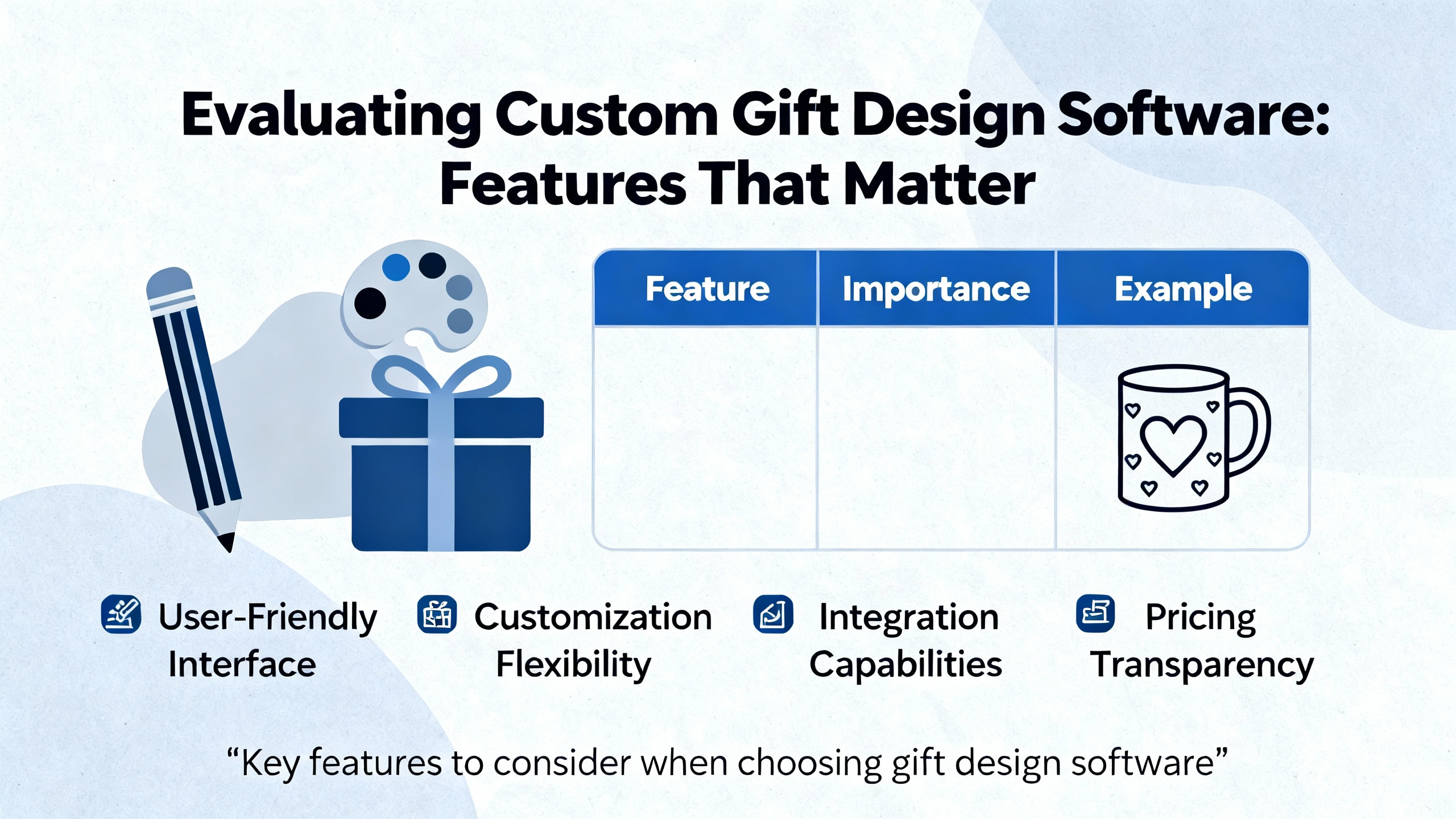
Evaluating Custom Gift Design Software: Features That Matter
Founders often ask which specific features they should prioritize when selecting a design tool. Drawing from WP Configurator, Customily, WTPBiz, and related research, you can group the criteria into three main buckets.
Customer Experience and Conversion Features
First, focus on the experience that your customers will have while designing gifts.
WP Configurator advocates for real-time previews that reflect color changes, text edits, and image uploads instantly. This reduces uncertainty and the fear of “will it really look like this,” which is a major cause of cart abandonment for personalized products. A clear, guided interface that leads shoppers through steps and allows them to save drafts also supports longer consideration cycles for higher-value gifts.
WTPBiz stresses the importance of intuitive navigation, attractive UX and UI, and a feature-rich library that includes fonts, clip art, images, and flexible object handling. When customers have enough creative tools at their fingertips, they are more likely to feel proud of the result, which not only drives conversion but also word-of-mouth.
Mobile responsiveness is non-negotiable. Many shoppers now browse and buy from their cell phones; if your configurator feels cramped or slow on smaller screens, you will lose them before they reach the checkout.
Operational and Scaling Capabilities
Second, evaluate how well the tool plugs into your operations and supports growth.
Customily’s ability to generate print-ready files and integrate with multiple print-on-demand providers stands out here. Automation of production files reduces errors, lowers artwork labor costs, and speeds fulfillment. Tools that support multiple e-commerce platforms and marketplaces, as WTPBiz suggests, allow you to expand beyond a single storefront without re-architecting your design experience.
WP Configurator highlights dynamic pricing as an operational feature as well as a UX enhancement. When the price updates immediately as customers add engraving, upgrade materials, or select premium packaging, you both manage expectations and encourage higher-value configurations.
Scalable tools also support corporate and bulk use cases. WP Configurator notes that branded templates, batch customizations, and sophisticated pricing rules allow you to serve teams, events, and corporate gifting programs economically. Customily’s multi-channel focus similarly targets merchants who need to scale personalization across different platforms.
Privacy, Cookies, and Compliance
Finally, do not overlook data and privacy. GiftDesign’s privacy preference center offers a helpful framework for thinking about cookies in a personalization-heavy environment.
They categorize cookies into strictly necessary, functional or personalization, and advertising or targeting. Strictly necessary cookies support core functions such as login, privacy preferences, and form fills, and cannot be switched off without breaking the site. Functional and personalization cookies enable enhanced features and customized experiences, sometimes set by third-party providers. Advertising cookies allow ad partners to build an interest profile and serve relevant ads.
From a practical standpoint, your design tool and store must respect consent choices. If a user declines certain cookie categories, some personalized features may need to degrade gracefully. As an e-commerce mentor, I recommend aligning your design and analytics stack with clear consent management from day one, rather than retrofitting it later under pressure.
Pros and Trade-Offs of Online Design Tools
Any serious investment has trade-offs. The research allows us to outline the main benefits and challenges without resorting to hype.
On the shopper side, the main advantages are emotional connection, creative expression, and higher confidence in the outcome. Buyers can incorporate names, dates, inside jokes, or special messages, as Stockimg.ai recommends, and see their design on realistic mockups. Photo platforms such as Canva and Snapfish make it easy to turn shared moments into physical keepsakes. The downside is that more choices and steps can overwhelm less tech-savvy users if the interface is not carefully designed.
For entrepreneurs and store owners, design tools unlock higher average order value, stronger differentiation, and in many cases, better conversion. Tools such as Customily and WP Configurator decrease operational friction by generating print-ready files and integrating directly with WooCommerce or other e-commerce platforms. However, these systems introduce complexity. You need to manage templates, assets, print specifications, and sometimes custom code. Poorly implemented tools can slow down your site and create support headaches.
Corporate gifting teams benefit from deeper personalization at scale, with platforms like Alyce by Sendoso and Sendoso providing engagement and revenue analytics. At the same time, articles on Xoxoday and other enterprise platforms acknowledge that breadth brings complexity and learning curves. Setup can be time-consuming, and less technical teams may find the abundance of options overwhelming without clear internal ownership.
The key is to design a stack that matches your stage and ambition rather than chasing every possible feature.
Practical Implementation Roadmap for Founders
The WTPBiz article on web-to-print gift businesses offers a pragmatic roadmap that aligns well with what I advise founders to do in their first year.
Clarify Your Business Plan and Budget
Before you sign up for tools, define your budget and plan. WTPBiz emphasizes that a detailed gift business plan helps you understand how investment flows, cut wasteful spending, identify which product verticals deserve more investment, and set realistic quarterly targets. It also makes you more credible when approaching investors or lenders.
In this planning phase, decide how much you can allocate to your e-commerce platform, design tool, AI artwork tools, initial marketing, and contingency. Underestimating marketing spend is one of the most common mistakes I see.
Handle Legal and Administrative Setup
WTPBiz underscores that starting a customized gift company involves paperwork. You must register your business, obtain required licenses, and set up logistics and vendor management. Because your business is online-first, reliable and timely delivery is crucial. Build relationships with shipping providers and, if you are not fully POD-based, with local suppliers and printers.
Creating clear agreements with printing vendors about methods, costs per product and design, and turnaround times will help you avoid tense conversations during peak seasons.
Choose Your E-Commerce Platform and Design Tool
Once the legal foundations are in place, choose your e-commerce platform and define essential features. The WTPBiz guide suggests selecting an appropriate platform, finalizing must-have features, and identifying a development partner if you are not technical.
At this stage, evaluate design tools like WP Configurator, Customily, or PrintXpand’s software based on the criteria discussed earlier: UX quality, print-ready file generation, platform compatibility, multilingual support, library features, and 3D or AR preview capabilities. Prioritize tools that integrate tightly with your chosen e-commerce platform and with your POD or print partners.
Build Your Supply and Production Network
After your eStore and design tool are set up, connect with suppliers. WTPBiz recommends contacting multiple suppliers for the products you want to offer and securing deals that reflect your consumers’ requirements. This might include blank apparel, drinkware, home décor blanks, pet products, or award items, depending on your niche.
You should also decide which printing methods to use for each product category. Use bulk-friendly, durable methods for staple products like T-shirts, high-resolution digital methods for photo-heavy products like mugs, and stitched decoration for items where a more premium, long-lasting aesthetic matters. When you partner with external printers, ask about supported methods and their pricing for your specific products and volumes.
Design and Execute Your Marketing Strategy
Finally, build demand. WTPBiz outlines several marketing channels: search engine optimization for long-term ranking gains, pay-per-click advertising for immediate visibility, influencer marketing to reach Gen Z and millennials, social media campaigns, collaborations with other eStores, and more.
SEO can take six to eight months to show results, so pair it with faster channels early on. Influencer marketing and social media can be especially powerful in the personalized gift space because they showcase real, customized products in context. Remember that your online design tool is not just a backend feature; it is a story you can tell in your marketing. Show prospective customers how easy and fun it is to create something unique.
Forward-Looking Trends: Where Custom Gift Design Is Heading
Looking ahead, several trends from the research suggest where custom gift design tools are moving.
First, AI will not simply suggest products; it will increasingly generate complete gift experiences. The GiftList article on AI gift generators highlights tools that build recipient profiles, track occasions, and integrate with wish lists. Combined with AI design engines like Stockimg.ai, this means you can move from “What should I buy?” to “Let us co-create a design and gift journey tailored to this person’s interests.”
Second, immersive visualization will deepen. WP Configurator already offers AR views for gadgets, and GiftList’s market projections for AR and VR shopping indicate that customers will expect to see products in their own environment or on their own avatar before buying. That has direct implications for how you structure your design tool and asset pipeline.
Third, values-based gifting will continue to grow. Platforms like Loop & Tie emphasize sustainable and small-business-friendly collections, with environmental impact metrics such as trees planted and carbon sequestered. As you build your catalog and design library, consider how you can highlight sustainability, local sourcing, or charitable impact in ways that resonate with your audience.
Finally, corporate and consumer worlds will keep converging. The same person who designs a playful custom mug for a friend on your store may later receive a carefully personalized gift box from their employer or a vendor via a platform like Sendoso or Snappy. The quality of your design tool, production, and unboxing experience influences how your brand is remembered in both contexts.
Short FAQ on Custom Gift Design Tools
Do I need professional design skills to launch a custom gift business with an online design tool? Based on the tools discussed in the research, you do not. AI-powered design platforms such as Stockimg.ai, Canva, and Adobe Express allow non-designers to generate high-quality, customizable artwork using structured prompts and templates. Storefront customizers like WP Configurator, Customily, and PrintXpand’s gift software then let your customers personalize those designs further with their own text, photos, and colors. Your main responsibilities are curating good templates, understanding your audience, and enforcing quality standards by exporting and printing at appropriate resolutions.
Should I build my own design tool from scratch or use an existing platform? For nearly all early-stage founders I mentor, using proven tools is the better path. WP Configurator and Customily have already solved complex problems such as real-time previews, dynamic pricing, print-ready file generation, and multi-platform compatibility. Building all of that from scratch is expensive, slow, and risky, especially when you also need to handle operations, customer service, and marketing. Once your brand reaches significant scale and has very specific requirements, you can reassess whether custom development makes sense.
How can I avoid overwhelming customers with too many customization options? The research suggests focusing on guided experiences rather than infinite choice. WP Configurator’s step-by-step customizer, WTPBiz’s emphasis on intuitive UX, and Stockimg.ai’s recommendation to use specific prompts all point in the same direction: structure creativity. Offer curated styles, a limited but meaningful set of fonts and colors, and contextual suggestions rather than every possible parameter at once. Test your flows on real users and watch where they hesitate or abandon; then simplify.
As you think about your next move in the personalized gift space, remember that your goal is not just to add a design widget to your site. Your goal is to build an interactive studio where customers, AI, and your operations work together to create objects that feel deeply personal yet are produced and delivered with professional reliability. If you design that ecosystem thoughtfully, the tools highlighted by Printify, WP Configurator, Customily, Stockimg.ai, and others can give even a lean, home-based business the capabilities once reserved for large, established brands.
References
- https://www.customily.com/
- https://www.forever.com/artisan?srsltid=AfmBOoqMDXPmgA2uZKBVyJiDdZ0Q1RAqWdbNf3JNWs5SClJ2EW83WJuA
- https://www.gelato.com/personalized-gifts
- https://www.kudoboard.com/
- https://www.loopandtie.com/
- https://www.personalcreations.com/?srsltid=AfmBOor6KM4kB3R2vpR_hS04RsSPJbcou6LpDS5_NaFIlUOUJIxuLKwB
- https://poe.com/GiftDesign
- https://www.snapfish.com/home
- https://www.alyce.com/product/
- https://b2bsaasreviews.com/top-gifting-platforms/