


Cheaper Alternatives to Vistaprint: Affordable Personalized Products

Cheaper Alternatives to Vistaprint: Affordable Personalized Products

Dec 25, 2025 by Iris POD e-Commerce 101

Vistaprint is often the first name small businesses think of when they need business cards, flyers, or branded swag. It earned that position by giving entrepreneurs a simple way to design and order professional-looking print without driving to a local shop.

But if you are serious about margins, personalization, and e-commerce in 2025 and beyond, Vistaprint is no longer your only, or even your cheapest, option.

From mentoring founders who run everything from local service businesses to multi-store Shopify brands, I see the same pattern: teams stay with Vistaprint out of habit, even when better-priced and more flexible alternatives are available. This article will walk you through those alternatives, when they actually save you money, and how to transition without sacrificing brand quality.

Step One: Understand What You Are Really Buying

Before comparing vendors, clarify your use case. In practice, entrepreneurs are usually buying one of two things.

The first is marketing and operational print for your own organization. That includes business cards, flyers, booklets, catalogs, banners, door hangers, notepads, and similar materials. An online printing service in this context is simply a website where you choose a base product, upload or create a design, pay online, and receive printed items by shipping, instead of visiting a local print shop. VistaPrint, PrintingCenterUSA, GotPrint, UPrinting, and MOO all sit in this category.

The second is personalized products you sell to customers. That includes apparel, home décor, drinkware, accessories, and promotional items printed with your designs and shipped per order. Here you are not just buying print; you are buying a fulfillment engine. Print-on-demand companies such as Printful, Printify, CustomCat, Gooten, Gelato, Merchize, and marketplace platforms like Redbubble or Zazzle take the order from your online store, print the item only after purchase, then pack and ship it under your brand. Shopify and other guides define print-on-demand in exactly these terms: no inventory, production only after the customer orders.

Once you categorize your needs as “my own collateral” versus “products I sell,” the comparison with Vistaprint becomes clearer. For some categories it remains a good value; for others, it is comfortably beaten on price or total cost of ownership.

Best online printing services vs Vistaprint

Where Vistaprint Shines – And Where It Gets Pricey

According to Vistaprint’s own guidance, its online printing services are built to help small businesses create consistent, professional marketing by reusing designs across multiple products. A hub article from Vista positions the company as one of the oldest online printers, active since the mid‑1990s, with a very broad catalog across marketing materials, stationery, apparel, gifts, and home décor. It pairs that with website tools, logo and branding support through services like VistaCreate and 99designs, free PDF proofs, sample kits, and a reprint or refund guarantee.

That bundle is powerful if you want a single environment for design, branding, and basic marketing print. The tradeoff is that Vistaprint is not always the lowest-cost producer for specific printed pieces, especially multi-page work such as booklets.

A comparison by PrintingCenterUSA looked at a standard eight-page, full-color booklet order on gloss stock. The test used 100 copies for a short run and 1,000 copies for a bulk run. The results are instructive.

Provider (PrintingCenterUSA comparison)

Example focus

Approx. price per booklet, 100 copies

Approx. price per booklet, 1,000 copies

PrintingCenterUSA

Online booklets, calendars, catalogs specialist

About $1.42

About $0.48

GotPrint

Budget online commercial printer

About $2.50

About $0.69

PrintRunner

General online commercial printer

About $3.57

About $0.64

Office Depot / OfficeMax

Big-box office retailer with online ordering

About $3.99

About $3.35

VistaPrint

Small-business hub with broad promo catalog

About $4.09

Not listed in the 1,000-unit comparison

UPrinting

Custom shapes, stocks, and coatings specialist

About $4.15

About $0.74

The same article notes that PrintingCenterUSA does not sell promotional items such as shirts, stickers, or pens, while VistaPrint and UPrinting do. So the message is not that VistaPrint is “bad,” but that for specific products like booklets it is clearly not the cheapest. As soon as your marketing mix includes catalogs, booklets, or similar multi-page pieces, separating vendors by product category can cut your per-unit cost by more than half.

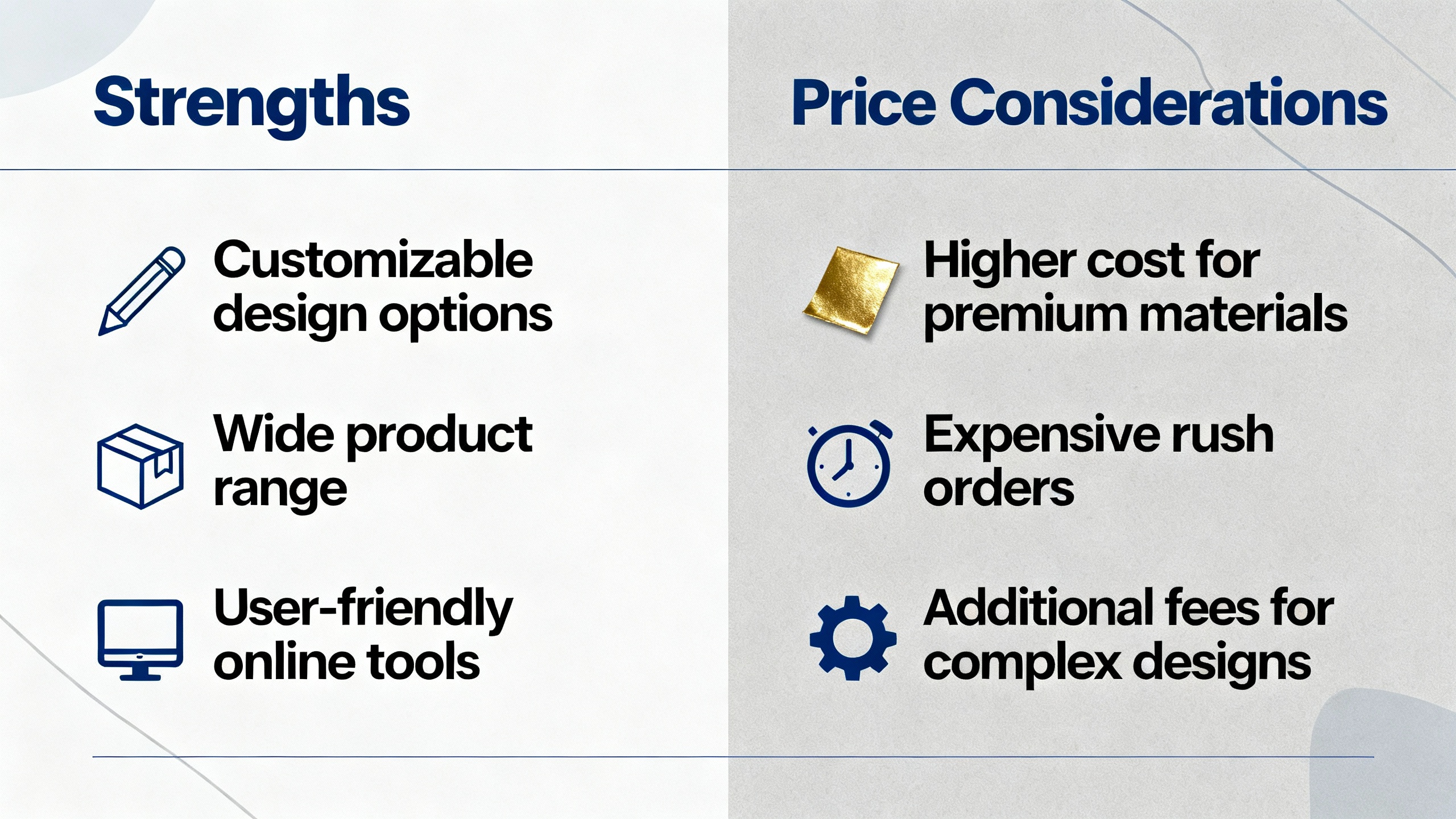
The takeaway for a cost-conscious entrepreneur is simple. Keep Vistaprint in your toolkit for convenience and breadth of catalog if you value the all-in-one small-business hub. But do not assume its prices are competitive across every product and quantity band.
Affordable Vistaprint competitors for marketing materials

Cheaper Online Printing Alternatives For Your Marketing Materials

Once you are willing to split your spend by product type, you can often beat Vistaprint on unit cost without giving up quality. Several providers from the PrintingCenterUSA comparison and related research are especially useful.

PrintingCenterUSA for Booklets, Catalogs, and Calendars

PrintingCenterUSA positions itself as a leading online printer focused on quality and low prices for more than forty products, including booklets, calendars, catalogs, brochures, books, art and photo prints, posters, and cards. In the booklet pricing tests just discussed, it sat at roughly $1.42 per booklet on a 100‑unit order and about $0.48 per booklet at 1,000 units, the lowest among the compared providers.

From a practical standpoint, PrintingCenterUSA behaves like a specialized engine for longer-form collateral. It uses digital presses for flexible short runs and offers online design tools and downloadable templates so you can keep design work in-house. The same comparison notes that it supports flexible quantities from 10 up to around 50,000 units, with proofing by PDF and optional hard-copy proofs. That flexibility, combined with bulk pricing, is where the cost advantage over a generalist like Vistaprint appears.

If you currently order catalogs, lookbooks, or product guides from Vistaprint at quantities in the hundreds or thousands, it is worth running the same quote through PrintingCenterUSA. The gap reflected in the published tests is large enough that even after accounting for design time and shipping you are likely to see meaningful savings.

GotPrint and UPrinting for Budget-Friendly Variety and Custom Work

GotPrint and UPrinting are also highlighted as capable alternatives, particularly when you need more control over substrates and finishing than Vistaprint typically emphasizes.

GotPrint is described as a family-run service known for very low, transparent pricing. The comparison points out that it avoids hidden fees such as automatic charges for printing on the back of business cards, offers many paper and coating options, and provides free PDF proofs with optional paid hard-copy proofs. Its economy shipping is slower, with production plus delivery often taking a couple of weeks, but for non-rush jobs that tradeoff often makes sense. If you are sensitive to nickel-and-dime add-ons, GotPrint’s approach can be a welcome change.

UPrinting sits in a midrange pricing tier but emphasizes deep customization. It supports custom die-cut shapes and fully custom products with open-ended size, shape, and material choices, backed by a 33‑point quality check. It offers free PDF proofs, sample kits, and hard-copy proofs, but does not bundle professional design services. That makes it a good fit for teams that already use design software and want more creative control without stepping into agency-level budgets.

Between PrintingCenterUSA for long-form pieces, GotPrint for rock-bottom prices on standard items, and UPrinting for bespoke shapes and materials, you have a strong trio of alternatives that can undercut or out-innovate Vistaprint in many marketing-print scenarios.

When a Local Shop Beats Online Prices

It is easy to forget local options once you move most purchasing online, yet for certain products a nearby shop can still be the cheapest intelligent choice.

Midwest Custom Print, a Chicago-based printer, illustrates why. Its guide for entrepreneurs argues that business cards, flyers, brochures, banners, memo pads, stickers, car magnets, bookmarks, and door hangers can all be very affordable when produced locally using efficient print-on-demand workflows. They highlight turnaround times around three to five business days, with some jobs shipped within twenty-four hours, and stress thorough pre-print inspection to prevent costly reprints.

The economics can work in your favor because there is no long-distance shipping and you can optimize the design once, then reuse it across multiple runs as your needs change. If your business is concentrated in a specific region, particularly for items like car magnets or door hangers that are inherently local in their impact, a well-run neighborhood printer can quietly be your cheapest Vista alternative.
Low cost business card printing options

Why Vistaprint Is Weak For Print-On-Demand E‑Commerce

Everything discussed so far assumes you are printing for your own use. The picture changes when you are selling personalized products to customers.

An Elevate guide to print-on-demand tools describes Vistaprint’s strengths in business-related products such as branded packaging, stationery, and marketing materials, and praises its intuitive design tools and budget-friendly pricing for offline branding. However, it explicitly notes that Vistaprint offers limited direct integrations with e-commerce platforms such as Shopify or WooCommerce and does not operate as a fully automated print-on-demand backend.

That matters. If you run an online store, you want orders to flow directly from your storefront into your production and fulfillment systems. In the print-on-demand world, leading providers such as Printful, Printify, Gooten, CustomCat, Gelato, and others are built from the ground up for this model. They integrate with Shopify, Etsy, Amazon-like marketplaces, and other platforms so that when a customer orders a hoodie, poster, or mug, the item is printed on demand and shipped without manual intervention.

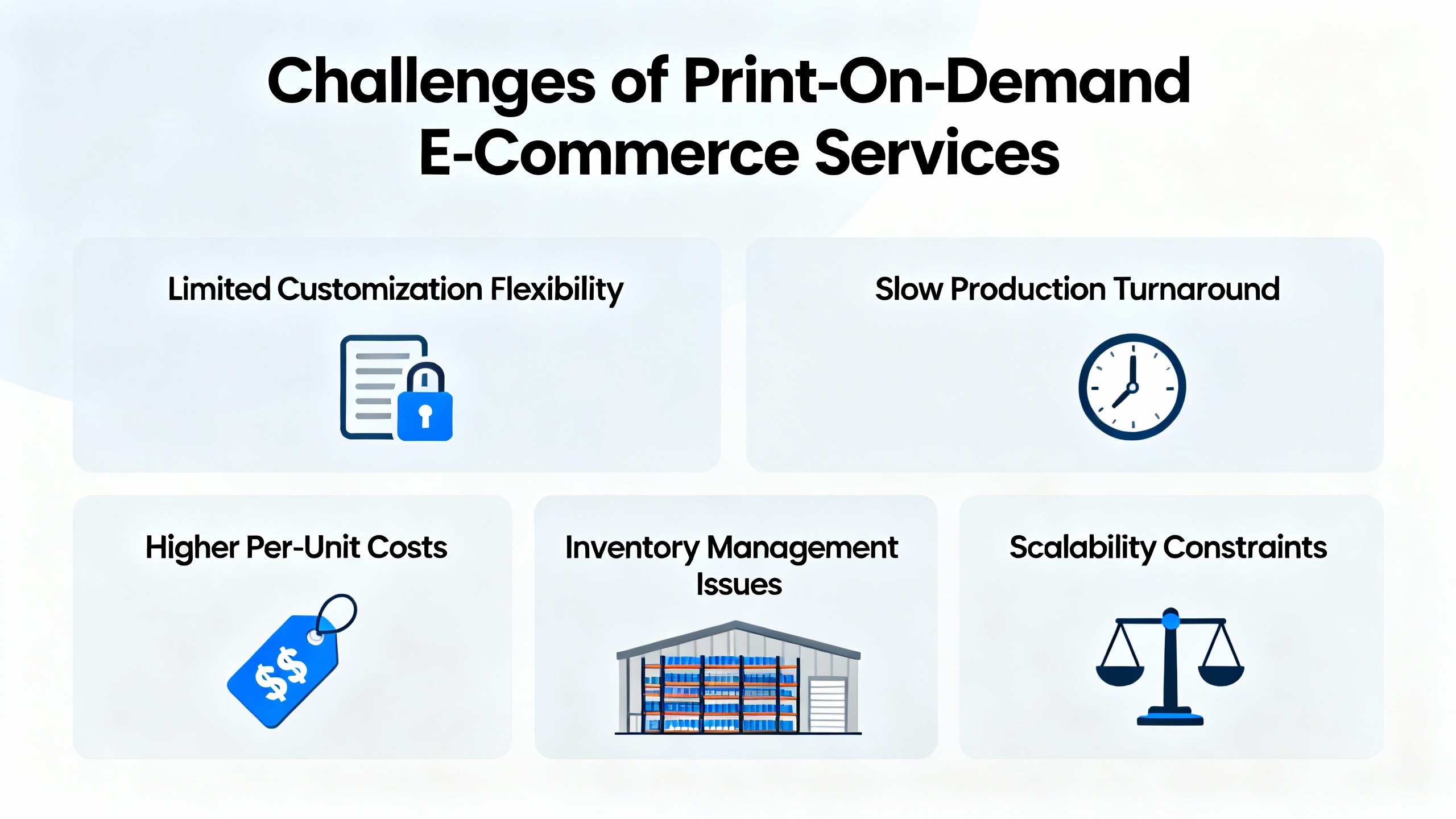
In other words, while Vistaprint can certainly print promotional items you resell or give away, it is not your best lever for building a scalable merchandising or print-on-demand business. The alternatives below are usually cheaper in terms of total risk and operational cost, even when their per-unit prices are similar.
Vistaprint alternatives for print on demand products

Print-On-Demand Platforms That Drive Better Economics Than Vistaprint

Printify and CustomCat for Margin-Focused Sellers

Printify has grown quickly into a major name in print-on-demand fulfillment. A detailed practitioner review by Michael Essek and multiple guides describe its distinctive model: it does not do any printing in-house. Instead, it connects you to a network of more than one hundred forty independent print providers worldwide and acts as the central middleman for order routing and management.

The Printful blog notes that Printify’s catalog now exceeds 1,300 products, spanning clothing, home decor, accessories, and more. Elevate’s comparison highlights that Printify supports direct-to-garment, sublimation, and embroidery among other methods and integrates with Shopify, WooCommerce, Etsy, eBay, and similar platforms. Both Elevate and Essek mention a paid Premium plan that, depending on the source, sits around the mid‑twenties to high‑twenties per month and can provide roughly twenty percent discounts or save several dollars per shirt, making it attractive for margin-focused and scaling sellers.

From a cost standpoint, Printify embodies flexibility. You can select specific providers for each product based on price, location, and quality. Essek points out that some providers such as Monster Digital and SwiftPOD often achieve production times around one to two days in non-peak periods, which is competitive with any POD provider, and that overall quality among recommended partners is strong. The tradeoff is that quality can vary across providers and you must test and curate your supplier list. For sellers willing to do that work, the combination of competitive base prices and Premium-discounted rates often beats buying pre-printed inventory from a service like Vistaprint and holding stock.

CustomCat offers a different angle on the same problem. According to Elevate and other research, it carries more than five hundred products across apparel, activewear, pet accessories, drinkware, and home decor, and uses direct-to-garment, sublimation, and embroidery with private-label options. It integrates with Shopify, WooCommerce, and Etsy, and offers competitive per-item pricing.

Crucially, CustomCat runs a Pro Plan with a monthly fee that can deliver discounts of up to around forty percent on products, making it especially cost-effective for high-volume sellers. For a brand that has validated demand and is moving real volume, this structure can make your print cost per unit materially lower than buying generic promotional items from Vistaprint and trying to resell them.

Printful for Premium Brands and Controlled Quality

Printful is often described as the global leader in print-on-demand. EComposer’s 2025 overview notes that it was founded in 2013, has delivered more than one hundred twelve million items, and operates fulfillment centers in North America, Europe, and Australia, with additional partner facilities in places like Canada and Australia. The same source reports that its catalog now includes more than four hundred forty customizable items.

Printful’s strengths are consistent quality and branding control. Multiple sources highlight its support for advanced methods such as direct-to-garment, cut-and-sew, sublimation, and embroidery, along with custom branding options like inside labels, packing inserts, and branded packing slips. Shopify’s review adds that Printful offers built-in mockup tools, logo services, and even marketing videos, and that it typically fulfills orders in two to five business days, with many orders ready in under three days. It notes a 4.8 out of 5 rating from more than two thousand four hundred Shopify reviews.

From a cost perspective, both Elevate and WTPBIZ recognize that Printful’s base prices tend to be higher than some rivals. However, Printful operates on a pure pay-as-you-go model with no subscription, offers discounts of around twenty percent on sample orders and up to fifty-five percent on certain bulk orders, and can handle warehousing and complex branding tasks. That combination makes it a strong fit for brands that position themselves at a premium price point. Compared to Vistaprint, where you would need to pre-order inventory and handle fulfillment yourself, Printful lets you avoid unsold stock while still commanding higher price points that absorb the base cost.

Gooten, Gelato, and Other Global Networks

Gooten sits somewhere between Printify’s aggregator model and Printful’s emphasis on quality. Different sources describe its catalog as ranging from more than one hundred fifty to more than five hundred customizable products, spanning apparel, home decor, accessories, wall art, and lifestyle items. EComposer notes that Gooten uses a global network of manufacturing partners and emphasizes automation and reliability, while Elevate points out that it charges no subscription fees, uses competitive wholesale pricing, and offers flat-rate shipping to simplify cost control. Shopify adds that it is a certified app partner with more than two hundred products and typical production times around three to four business days, though reviews mention occasional difficulty reaching support.

Gelato, profiled by Shopify and Printful’s competitive overviews, connects merchants to more than one hundred local print partners across about thirty countries and can deliver some orders in as little as seventy-two hours. Originally built around paper goods, it now offers wall art, home decor, stationery, tote bags, and apparel printed on multiple areas. A shipping and delivery calculator and a focus on sustainable, localized production help keep shipping costs under control, particularly for international orders. Shopify cites more than five hundred seventy-five reviews with an average around 4.8 out of 5.

These platforms are not necessarily “cheaper per unit” than every Vistaprint product. Instead, they are often cheaper in total when you factor in no inventory, lower international shipping, and reduced operational overhead. That is why WTPBIZ estimates the global print-on-demand market will exceed ten billion dollars between 2025 and 2026: the model aligns costs with revenue in a way bulk printing simply cannot.

Printing Methods That Quietly Decide Your Cost Structure

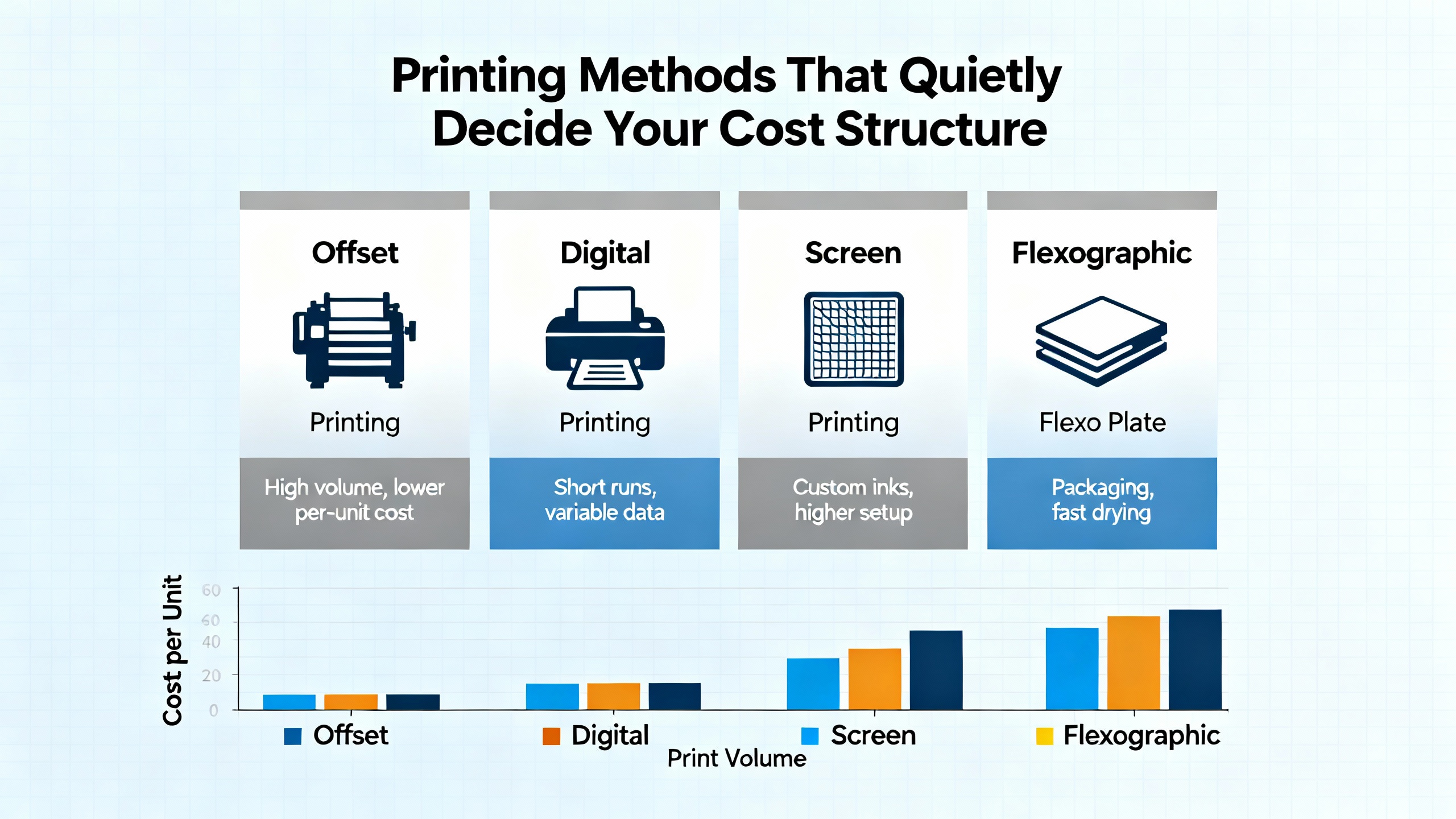
Regardless of vendor, your choice of printing method heavily influences your actual costs. Research from Hola Custom Boxes and Printful’s own overview of bulk printing methods makes this clear.

Digital printing, including direct-to-garment and inkjet-based approaches, applies ink directly to the substrate without plates or screens. It delivers precise color, high resolution, and supports complex or frequently changing designs with minimal setup. That makes it cost-efficient for short runs, personalization, and print-on-demand workflows, which is why POD platforms favor it for apparel, labels, and marketing collateral.

Offset printing uses plates and a rubber blanket to transfer ink and becomes very economical at scale. PrintingCenterUSA’s booklet tests illustrate this effect: once you reach a thousand copies, the per-unit cost can drop below fifty cents for a full-color booklet. However, offset requires more setup and is not efficient for constantly changing or very small batches.

Flexographic printing uses flexible plates on cylinders and excels at printing on a wide range of packaging materials. It is valuable for large-volume standardized packaging but tends to be less competitive for short, multi-color runs because of setup complexity and material costs.

Screen printing is ideal for large runs of simple, bold designs, such as thousands of shirts or promotional plastics. It produces durable, vibrant prints but requires separate screens for each color. That makes it most cost-effective when you anticipate steady volume on a limited set of designs.

Sublimation embeds dyes into polyester fibers, enabling all-over prints on jerseys, performance wear, mugs, and similar products. It yields vivid colors that will not crack or peel and adds no extra texture. The limitation is that it works only on light synthetic materials and is ineffective on cotton or dark garments.

Other methods, such as thermal printing for labels or engraving and embossing for premium packaging, have their own cost and positioning profiles. Thermal printing can be up to several times faster than offset on narrow applications like labels with relatively low energy consumption, while engraving and embossing create luxury effects at higher per-unit cost.

The strategic implication is straightforward. When you get quotes, do not compare vendors only on the finished price; ask which method they are using and whether a different method or quantity band would alter the economics. Digital methods often win for short, personalized runs, while offset, flexo, or screen take over as you scale.
Cost comparison of online printing companies 2025

How To Transition Away From A Vistaprint-Only Strategy

For many founders, the best path is not to abandon Vistaprint outright but to design a more deliberate mix of suppliers.

Start by exporting your last twelve months of print purchases or scanning your last few stacks of bills and physically laying out what you bought. Group items into categories such as multi-page print (booklets, catalogs, calendars), simple marketing collateral (business cards, flyers, door hangers, posters), labels and stickers, promotional products, and merchandise you resell.

Next, map each category to one or two specialists. For long-form pieces, use PublishingCenterUSA-style providers that have demonstrated lower per-unit costs at scale. For simple marketing print where transparency and minimal add-ons matter, fold in budget services like GotPrint. For unique shapes, coatings, or substrate needs, experiment with UPrinting. For labels and stickers, consider Avery’s WePrint service, which emphasizes professional digital printing, a broad range of materials, fast turnaround without extra charges for setup plates or dies, and a one hundred percent satisfaction guarantee.

For promotional products and gifts used in outreach and recognition, Walmart Business Print and 4imprint offer credible alternatives. Walmart Business Print positions its promotional products as practical items such as drinkware, journals, magnets, calendars, towels, keychains, and desk mats, backed by an online design tool, fast-turnaround options, and bulk pricing. 4imprint focuses on being a turnkey provider that can handle packaging, fulfillment, and mailing, saving marketing teams time and operational cost even if the per-item price is not the absolute lowest.

For merchandise you sell, move your experiments and initial runs to print-on-demand partners such as Printify, CustomCat, Printful, Gooten, or Gelato instead of pre-ordering from Vistaprint. Multiple sources, including Printify and Printful’s own content, strongly recommend ordering samples from shortlisted POD companies to evaluate print quality, color accuracy, material feel, sizing, and packaging before fully committing. That small investment protects you from negative customer experiences while you hunt for the right balance of quality and cost.

While you test, pay attention to more than just unit price. Forbes Advisor’s analysis of print-on-demand companies stresses factors like fulfillment speed, ease of use, and e-commerce integrations alongside price. Mindful Design Consulting likewise emphasizes that quality, reliability, and integration with your existing systems often matter more than marginally cheaper quotes. A slightly higher base price from a provider that integrates directly with Shopify or your order management system may be cheaper overall once you factor in saved staff time and fewer mistakes.

Finally, do not hesitate to run a multi-supplier strategy. Printify’s own blog and Printful’s competitive guides point out that many successful sellers use more than one POD company to access a wider catalog, better pricing on specific products, and regional fulfillment centers that shorten delivery times. The same logic applies on the marketing-print side: there is no need to force one vendor to be everything when different providers are clearly better at different jobs.

Pros And Cons Of Moving Beyond Vistaprint

On the positive side, shifting from a single Vistaprint dependency to a portfolio of providers can dramatically reduce your cost on certain items. The booklet comparison shows more than a two-thirds reduction in per-unit cost when moving from Vistaprint-level pricing to a specialist like PrintingCenterUSA at volume. Print-on-demand platforms let you transform fixed inventory costs into variable costs aligned with actual sales, something traditional Vistaprint orders cannot offer. Many alternatives also offer deeper branding options, such as inside labels, custom packaging, and premium finishes, which can justify higher retail pricing.

On the downside, a multi-provider setup is more complex to manage. You must track different file specifications, proofing workflows, turnaround definitions, and return policies. Aggregator-style POD platforms such as Printify and Gooten add another layer of complexity because quality can vary by print partner; you must place sample orders, monitor performance, and occasionally switch suppliers. Consistency of color and material across vendors also requires a little more attention to detail.

For most serious entrepreneurs, the benefits outweigh the drawbacks, provided you approach the transition methodically and lean on the data published by these providers and independent comparisons rather than making assumptions.
Discounted commercial printing services

FAQ

Is Vistaprint always more expensive than the alternatives?

No. Vistaprint positions itself as a budget-friendly small-business hub and can be competitive on many basic items, especially when you factor in its design tools and bundled branding services. However, independent comparisons from sources such as PrintingCenterUSA show that for specific products like full-color booklets, it is significantly more expensive per unit than specialist printers at both short and bulk runs. The only reliable way to know is to compare quotes for your exact specifications rather than assuming the brand you know is the cheapest.

Are print-on-demand companies actually cheaper than ordering from Vistaprint?

Per unit, print-on-demand items from providers such as Printful, Printify, CustomCat, Gooten, or Gelato can be similar in price or slightly higher than bulk orders from an online printer. The real savings come from the business model. Print-on-demand, as described by Shopify, Elevate, Printify, and WTPBIZ, lets you avoid buying inventory upfront, eliminates warehousing, and shifts production costs to the moment of sale. For new or design-heavy product lines where demand is uncertain, that reduction in risk and working capital usually makes POD the cheaper approach in practice compared with pre-printing and stockpiling items from Vistaprint.

Should I use more than one print or POD provider?

In many cases, yes. Research from Printify and other POD guides explicitly recommends using more than one POD company when needed to access a wider catalog, better pricing, and regional fulfillment. On the marketing-print side, comparisons from PrintingCenterUSA and Vista-affiliated content show different providers excel in different areas: some win on booklets, others on custom shapes, others on premium materials. As long as you document your templates and brand standards, a multi-provider strategy can lower your costs and reduce operational risk.

The entrepreneurs who thrive in the next wave of personalized products will treat print vendors the way they treat ad platforms: as tools, not loyalties. If you audit your current Vistaprint spend, map each product type to specialist alternatives, and adopt print-on-demand for anything you sell online, you can reduce cost, free up cash, and still deliver the consistent, professional brand experience your customers expect.

References

  1. https://pmc.ncbi.nlm.nih.gov/articles/PMC9962448/
  2. https://www.4imprint.com/
  3. https://www.gotprint.com/home.html?srsltid=AfmBOopV50jiWMe2fJhSVW0ijDfyzODZW2_0BSHUt8ZBF-lGpUyzlbEs
  4. https://www.printful.com/design-your-own-products
  5. https://www.vistaprint.com/?srsltid=AfmBOor8w9NW_5CVKkW2Cc936I8Om8ena87RME4aOMi6lAq0v-8nSDEX
  6. https://www.avery.com/custom-printing/
  7. https://www.canva.com/print/
  8. https://elevate.store/ultimate-guide/best-print-on-demand-tools
  9. https://holacustomboxes.com/blogs/comparing-the-costs-of-different-custom-packaging-printing-services
  10. https://www.michaelessek.com/print-on-demand-companies/

Like the article

0
Cheaper Alternatives to Vistaprint: Affordable Personalized Products

Cheaper Alternatives to Vistaprint: Affordable Personalized Products

Vistaprint is often the first name small businesses think of when they need business cards, flyers, or branded swag. It earned that position by giving entrepreneurs a simple way to design and order professional-looking print without driving to a local shop.

But if you are serious about margins, personalization, and e-commerce in 2025 and beyond, Vistaprint is no longer your only, or even your cheapest, option.

From mentoring founders who run everything from local service businesses to multi-store Shopify brands, I see the same pattern: teams stay with Vistaprint out of habit, even when better-priced and more flexible alternatives are available. This article will walk you through those alternatives, when they actually save you money, and how to transition without sacrificing brand quality.

Step One: Understand What You Are Really Buying

Before comparing vendors, clarify your use case. In practice, entrepreneurs are usually buying one of two things.

The first is marketing and operational print for your own organization. That includes business cards, flyers, booklets, catalogs, banners, door hangers, notepads, and similar materials. An online printing service in this context is simply a website where you choose a base product, upload or create a design, pay online, and receive printed items by shipping, instead of visiting a local print shop. VistaPrint, PrintingCenterUSA, GotPrint, UPrinting, and MOO all sit in this category.

The second is personalized products you sell to customers. That includes apparel, home décor, drinkware, accessories, and promotional items printed with your designs and shipped per order. Here you are not just buying print; you are buying a fulfillment engine. Print-on-demand companies such as Printful, Printify, CustomCat, Gooten, Gelato, Merchize, and marketplace platforms like Redbubble or Zazzle take the order from your online store, print the item only after purchase, then pack and ship it under your brand. Shopify and other guides define print-on-demand in exactly these terms: no inventory, production only after the customer orders.

Once you categorize your needs as “my own collateral” versus “products I sell,” the comparison with Vistaprint becomes clearer. For some categories it remains a good value; for others, it is comfortably beaten on price or total cost of ownership.

Best online printing services vs Vistaprint

Where Vistaprint Shines – And Where It Gets Pricey

According to Vistaprint’s own guidance, its online printing services are built to help small businesses create consistent, professional marketing by reusing designs across multiple products. A hub article from Vista positions the company as one of the oldest online printers, active since the mid‑1990s, with a very broad catalog across marketing materials, stationery, apparel, gifts, and home décor. It pairs that with website tools, logo and branding support through services like VistaCreate and 99designs, free PDF proofs, sample kits, and a reprint or refund guarantee.

That bundle is powerful if you want a single environment for design, branding, and basic marketing print. The tradeoff is that Vistaprint is not always the lowest-cost producer for specific printed pieces, especially multi-page work such as booklets.

A comparison by PrintingCenterUSA looked at a standard eight-page, full-color booklet order on gloss stock. The test used 100 copies for a short run and 1,000 copies for a bulk run. The results are instructive.

Provider (PrintingCenterUSA comparison)

Example focus

Approx. price per booklet, 100 copies

Approx. price per booklet, 1,000 copies

PrintingCenterUSA

Online booklets, calendars, catalogs specialist

About $1.42

About $0.48

GotPrint

Budget online commercial printer

About $2.50

About $0.69

PrintRunner

General online commercial printer

About $3.57

About $0.64

Office Depot / OfficeMax

Big-box office retailer with online ordering

About $3.99

About $3.35

VistaPrint

Small-business hub with broad promo catalog

About $4.09

Not listed in the 1,000-unit comparison

UPrinting

Custom shapes, stocks, and coatings specialist

About $4.15

About $0.74

The same article notes that PrintingCenterUSA does not sell promotional items such as shirts, stickers, or pens, while VistaPrint and UPrinting do. So the message is not that VistaPrint is “bad,” but that for specific products like booklets it is clearly not the cheapest. As soon as your marketing mix includes catalogs, booklets, or similar multi-page pieces, separating vendors by product category can cut your per-unit cost by more than half.

The takeaway for a cost-conscious entrepreneur is simple. Keep Vistaprint in your toolkit for convenience and breadth of catalog if you value the all-in-one small-business hub. But do not assume its prices are competitive across every product and quantity band.

Affordable Vistaprint competitors for marketing materials

Cheaper Online Printing Alternatives For Your Marketing Materials

Once you are willing to split your spend by product type, you can often beat Vistaprint on unit cost without giving up quality. Several providers from the PrintingCenterUSA comparison and related research are especially useful.

PrintingCenterUSA for Booklets, Catalogs, and Calendars

PrintingCenterUSA positions itself as a leading online printer focused on quality and low prices for more than forty products, including booklets, calendars, catalogs, brochures, books, art and photo prints, posters, and cards. In the booklet pricing tests just discussed, it sat at roughly $1.42 per booklet on a 100‑unit order and about $0.48 per booklet at 1,000 units, the lowest among the compared providers.

From a practical standpoint, PrintingCenterUSA behaves like a specialized engine for longer-form collateral. It uses digital presses for flexible short runs and offers online design tools and downloadable templates so you can keep design work in-house. The same comparison notes that it supports flexible quantities from 10 up to around 50,000 units, with proofing by PDF and optional hard-copy proofs. That flexibility, combined with bulk pricing, is where the cost advantage over a generalist like Vistaprint appears.

If you currently order catalogs, lookbooks, or product guides from Vistaprint at quantities in the hundreds or thousands, it is worth running the same quote through PrintingCenterUSA. The gap reflected in the published tests is large enough that even after accounting for design time and shipping you are likely to see meaningful savings.

GotPrint and UPrinting for Budget-Friendly Variety and Custom Work

GotPrint and UPrinting are also highlighted as capable alternatives, particularly when you need more control over substrates and finishing than Vistaprint typically emphasizes.

GotPrint is described as a family-run service known for very low, transparent pricing. The comparison points out that it avoids hidden fees such as automatic charges for printing on the back of business cards, offers many paper and coating options, and provides free PDF proofs with optional paid hard-copy proofs. Its economy shipping is slower, with production plus delivery often taking a couple of weeks, but for non-rush jobs that tradeoff often makes sense. If you are sensitive to nickel-and-dime add-ons, GotPrint’s approach can be a welcome change.

UPrinting sits in a midrange pricing tier but emphasizes deep customization. It supports custom die-cut shapes and fully custom products with open-ended size, shape, and material choices, backed by a 33‑point quality check. It offers free PDF proofs, sample kits, and hard-copy proofs, but does not bundle professional design services. That makes it a good fit for teams that already use design software and want more creative control without stepping into agency-level budgets.

Between PrintingCenterUSA for long-form pieces, GotPrint for rock-bottom prices on standard items, and UPrinting for bespoke shapes and materials, you have a strong trio of alternatives that can undercut or out-innovate Vistaprint in many marketing-print scenarios.

When a Local Shop Beats Online Prices

It is easy to forget local options once you move most purchasing online, yet for certain products a nearby shop can still be the cheapest intelligent choice.

Midwest Custom Print, a Chicago-based printer, illustrates why. Its guide for entrepreneurs argues that business cards, flyers, brochures, banners, memo pads, stickers, car magnets, bookmarks, and door hangers can all be very affordable when produced locally using efficient print-on-demand workflows. They highlight turnaround times around three to five business days, with some jobs shipped within twenty-four hours, and stress thorough pre-print inspection to prevent costly reprints.

The economics can work in your favor because there is no long-distance shipping and you can optimize the design once, then reuse it across multiple runs as your needs change. If your business is concentrated in a specific region, particularly for items like car magnets or door hangers that are inherently local in their impact, a well-run neighborhood printer can quietly be your cheapest Vista alternative.

Low cost business card printing options

Why Vistaprint Is Weak For Print-On-Demand E‑Commerce

Everything discussed so far assumes you are printing for your own use. The picture changes when you are selling personalized products to customers.

An Elevate guide to print-on-demand tools describes Vistaprint’s strengths in business-related products such as branded packaging, stationery, and marketing materials, and praises its intuitive design tools and budget-friendly pricing for offline branding. However, it explicitly notes that Vistaprint offers limited direct integrations with e-commerce platforms such as Shopify or WooCommerce and does not operate as a fully automated print-on-demand backend.

That matters. If you run an online store, you want orders to flow directly from your storefront into your production and fulfillment systems. In the print-on-demand world, leading providers such as Printful, Printify, Gooten, CustomCat, Gelato, and others are built from the ground up for this model. They integrate with Shopify, Etsy, Amazon-like marketplaces, and other platforms so that when a customer orders a hoodie, poster, or mug, the item is printed on demand and shipped without manual intervention.

In other words, while Vistaprint can certainly print promotional items you resell or give away, it is not your best lever for building a scalable merchandising or print-on-demand business. The alternatives below are usually cheaper in terms of total risk and operational cost, even when their per-unit prices are similar.

Vistaprint alternatives for print on demand products

Print-On-Demand Platforms That Drive Better Economics Than Vistaprint

Printify and CustomCat for Margin-Focused Sellers

Printify has grown quickly into a major name in print-on-demand fulfillment. A detailed practitioner review by Michael Essek and multiple guides describe its distinctive model: it does not do any printing in-house. Instead, it connects you to a network of more than one hundred forty independent print providers worldwide and acts as the central middleman for order routing and management.

The Printful blog notes that Printify’s catalog now exceeds 1,300 products, spanning clothing, home decor, accessories, and more. Elevate’s comparison highlights that Printify supports direct-to-garment, sublimation, and embroidery among other methods and integrates with Shopify, WooCommerce, Etsy, eBay, and similar platforms. Both Elevate and Essek mention a paid Premium plan that, depending on the source, sits around the mid‑twenties to high‑twenties per month and can provide roughly twenty percent discounts or save several dollars per shirt, making it attractive for margin-focused and scaling sellers.

From a cost standpoint, Printify embodies flexibility. You can select specific providers for each product based on price, location, and quality. Essek points out that some providers such as Monster Digital and SwiftPOD often achieve production times around one to two days in non-peak periods, which is competitive with any POD provider, and that overall quality among recommended partners is strong. The tradeoff is that quality can vary across providers and you must test and curate your supplier list. For sellers willing to do that work, the combination of competitive base prices and Premium-discounted rates often beats buying pre-printed inventory from a service like Vistaprint and holding stock.

CustomCat offers a different angle on the same problem. According to Elevate and other research, it carries more than five hundred products across apparel, activewear, pet accessories, drinkware, and home decor, and uses direct-to-garment, sublimation, and embroidery with private-label options. It integrates with Shopify, WooCommerce, and Etsy, and offers competitive per-item pricing.

Crucially, CustomCat runs a Pro Plan with a monthly fee that can deliver discounts of up to around forty percent on products, making it especially cost-effective for high-volume sellers. For a brand that has validated demand and is moving real volume, this structure can make your print cost per unit materially lower than buying generic promotional items from Vistaprint and trying to resell them.

Printful for Premium Brands and Controlled Quality

Printful is often described as the global leader in print-on-demand. EComposer’s 2025 overview notes that it was founded in 2013, has delivered more than one hundred twelve million items, and operates fulfillment centers in North America, Europe, and Australia, with additional partner facilities in places like Canada and Australia. The same source reports that its catalog now includes more than four hundred forty customizable items.

Printful’s strengths are consistent quality and branding control. Multiple sources highlight its support for advanced methods such as direct-to-garment, cut-and-sew, sublimation, and embroidery, along with custom branding options like inside labels, packing inserts, and branded packing slips. Shopify’s review adds that Printful offers built-in mockup tools, logo services, and even marketing videos, and that it typically fulfills orders in two to five business days, with many orders ready in under three days. It notes a 4.8 out of 5 rating from more than two thousand four hundred Shopify reviews.

From a cost perspective, both Elevate and WTPBIZ recognize that Printful’s base prices tend to be higher than some rivals. However, Printful operates on a pure pay-as-you-go model with no subscription, offers discounts of around twenty percent on sample orders and up to fifty-five percent on certain bulk orders, and can handle warehousing and complex branding tasks. That combination makes it a strong fit for brands that position themselves at a premium price point. Compared to Vistaprint, where you would need to pre-order inventory and handle fulfillment yourself, Printful lets you avoid unsold stock while still commanding higher price points that absorb the base cost.

Gooten, Gelato, and Other Global Networks

Gooten sits somewhere between Printify’s aggregator model and Printful’s emphasis on quality. Different sources describe its catalog as ranging from more than one hundred fifty to more than five hundred customizable products, spanning apparel, home decor, accessories, wall art, and lifestyle items. EComposer notes that Gooten uses a global network of manufacturing partners and emphasizes automation and reliability, while Elevate points out that it charges no subscription fees, uses competitive wholesale pricing, and offers flat-rate shipping to simplify cost control. Shopify adds that it is a certified app partner with more than two hundred products and typical production times around three to four business days, though reviews mention occasional difficulty reaching support.

Gelato, profiled by Shopify and Printful’s competitive overviews, connects merchants to more than one hundred local print partners across about thirty countries and can deliver some orders in as little as seventy-two hours. Originally built around paper goods, it now offers wall art, home decor, stationery, tote bags, and apparel printed on multiple areas. A shipping and delivery calculator and a focus on sustainable, localized production help keep shipping costs under control, particularly for international orders. Shopify cites more than five hundred seventy-five reviews with an average around 4.8 out of 5.

These platforms are not necessarily “cheaper per unit” than every Vistaprint product. Instead, they are often cheaper in total when you factor in no inventory, lower international shipping, and reduced operational overhead. That is why WTPBIZ estimates the global print-on-demand market will exceed ten billion dollars between 2025 and 2026: the model aligns costs with revenue in a way bulk printing simply cannot.

Printing Methods That Quietly Decide Your Cost Structure

Regardless of vendor, your choice of printing method heavily influences your actual costs. Research from Hola Custom Boxes and Printful’s own overview of bulk printing methods makes this clear.

Digital printing, including direct-to-garment and inkjet-based approaches, applies ink directly to the substrate without plates or screens. It delivers precise color, high resolution, and supports complex or frequently changing designs with minimal setup. That makes it cost-efficient for short runs, personalization, and print-on-demand workflows, which is why POD platforms favor it for apparel, labels, and marketing collateral.

Offset printing uses plates and a rubber blanket to transfer ink and becomes very economical at scale. PrintingCenterUSA’s booklet tests illustrate this effect: once you reach a thousand copies, the per-unit cost can drop below fifty cents for a full-color booklet. However, offset requires more setup and is not efficient for constantly changing or very small batches.

Flexographic printing uses flexible plates on cylinders and excels at printing on a wide range of packaging materials. It is valuable for large-volume standardized packaging but tends to be less competitive for short, multi-color runs because of setup complexity and material costs.

Screen printing is ideal for large runs of simple, bold designs, such as thousands of shirts or promotional plastics. It produces durable, vibrant prints but requires separate screens for each color. That makes it most cost-effective when you anticipate steady volume on a limited set of designs.

Sublimation embeds dyes into polyester fibers, enabling all-over prints on jerseys, performance wear, mugs, and similar products. It yields vivid colors that will not crack or peel and adds no extra texture. The limitation is that it works only on light synthetic materials and is ineffective on cotton or dark garments.

Other methods, such as thermal printing for labels or engraving and embossing for premium packaging, have their own cost and positioning profiles. Thermal printing can be up to several times faster than offset on narrow applications like labels with relatively low energy consumption, while engraving and embossing create luxury effects at higher per-unit cost.

The strategic implication is straightforward. When you get quotes, do not compare vendors only on the finished price; ask which method they are using and whether a different method or quantity band would alter the economics. Digital methods often win for short, personalized runs, while offset, flexo, or screen take over as you scale.

Cost comparison of online printing companies 2025

How To Transition Away From A Vistaprint-Only Strategy

For many founders, the best path is not to abandon Vistaprint outright but to design a more deliberate mix of suppliers.

Start by exporting your last twelve months of print purchases or scanning your last few stacks of bills and physically laying out what you bought. Group items into categories such as multi-page print (booklets, catalogs, calendars), simple marketing collateral (business cards, flyers, door hangers, posters), labels and stickers, promotional products, and merchandise you resell.

Next, map each category to one or two specialists. For long-form pieces, use PublishingCenterUSA-style providers that have demonstrated lower per-unit costs at scale. For simple marketing print where transparency and minimal add-ons matter, fold in budget services like GotPrint. For unique shapes, coatings, or substrate needs, experiment with UPrinting. For labels and stickers, consider Avery’s WePrint service, which emphasizes professional digital printing, a broad range of materials, fast turnaround without extra charges for setup plates or dies, and a one hundred percent satisfaction guarantee.

For promotional products and gifts used in outreach and recognition, Walmart Business Print and 4imprint offer credible alternatives. Walmart Business Print positions its promotional products as practical items such as drinkware, journals, magnets, calendars, towels, keychains, and desk mats, backed by an online design tool, fast-turnaround options, and bulk pricing. 4imprint focuses on being a turnkey provider that can handle packaging, fulfillment, and mailing, saving marketing teams time and operational cost even if the per-item price is not the absolute lowest.

For merchandise you sell, move your experiments and initial runs to print-on-demand partners such as Printify, CustomCat, Printful, Gooten, or Gelato instead of pre-ordering from Vistaprint. Multiple sources, including Printify and Printful’s own content, strongly recommend ordering samples from shortlisted POD companies to evaluate print quality, color accuracy, material feel, sizing, and packaging before fully committing. That small investment protects you from negative customer experiences while you hunt for the right balance of quality and cost.

While you test, pay attention to more than just unit price. Forbes Advisor’s analysis of print-on-demand companies stresses factors like fulfillment speed, ease of use, and e-commerce integrations alongside price. Mindful Design Consulting likewise emphasizes that quality, reliability, and integration with your existing systems often matter more than marginally cheaper quotes. A slightly higher base price from a provider that integrates directly with Shopify or your order management system may be cheaper overall once you factor in saved staff time and fewer mistakes.

Finally, do not hesitate to run a multi-supplier strategy. Printify’s own blog and Printful’s competitive guides point out that many successful sellers use more than one POD company to access a wider catalog, better pricing on specific products, and regional fulfillment centers that shorten delivery times. The same logic applies on the marketing-print side: there is no need to force one vendor to be everything when different providers are clearly better at different jobs.

Pros And Cons Of Moving Beyond Vistaprint

On the positive side, shifting from a single Vistaprint dependency to a portfolio of providers can dramatically reduce your cost on certain items. The booklet comparison shows more than a two-thirds reduction in per-unit cost when moving from Vistaprint-level pricing to a specialist like PrintingCenterUSA at volume. Print-on-demand platforms let you transform fixed inventory costs into variable costs aligned with actual sales, something traditional Vistaprint orders cannot offer. Many alternatives also offer deeper branding options, such as inside labels, custom packaging, and premium finishes, which can justify higher retail pricing.

On the downside, a multi-provider setup is more complex to manage. You must track different file specifications, proofing workflows, turnaround definitions, and return policies. Aggregator-style POD platforms such as Printify and Gooten add another layer of complexity because quality can vary by print partner; you must place sample orders, monitor performance, and occasionally switch suppliers. Consistency of color and material across vendors also requires a little more attention to detail.

For most serious entrepreneurs, the benefits outweigh the drawbacks, provided you approach the transition methodically and lean on the data published by these providers and independent comparisons rather than making assumptions.

Discounted commercial printing services

FAQ

Is Vistaprint always more expensive than the alternatives?

No. Vistaprint positions itself as a budget-friendly small-business hub and can be competitive on many basic items, especially when you factor in its design tools and bundled branding services. However, independent comparisons from sources such as PrintingCenterUSA show that for specific products like full-color booklets, it is significantly more expensive per unit than specialist printers at both short and bulk runs. The only reliable way to know is to compare quotes for your exact specifications rather than assuming the brand you know is the cheapest.

Are print-on-demand companies actually cheaper than ordering from Vistaprint?

Per unit, print-on-demand items from providers such as Printful, Printify, CustomCat, Gooten, or Gelato can be similar in price or slightly higher than bulk orders from an online printer. The real savings come from the business model. Print-on-demand, as described by Shopify, Elevate, Printify, and WTPBIZ, lets you avoid buying inventory upfront, eliminates warehousing, and shifts production costs to the moment of sale. For new or design-heavy product lines where demand is uncertain, that reduction in risk and working capital usually makes POD the cheaper approach in practice compared with pre-printing and stockpiling items from Vistaprint.

Should I use more than one print or POD provider?

In many cases, yes. Research from Printify and other POD guides explicitly recommends using more than one POD company when needed to access a wider catalog, better pricing, and regional fulfillment. On the marketing-print side, comparisons from PrintingCenterUSA and Vista-affiliated content show different providers excel in different areas: some win on booklets, others on custom shapes, others on premium materials. As long as you document your templates and brand standards, a multi-provider strategy can lower your costs and reduce operational risk.

The entrepreneurs who thrive in the next wave of personalized products will treat print vendors the way they treat ad platforms: as tools, not loyalties. If you audit your current Vistaprint spend, map each product type to specialist alternatives, and adopt print-on-demand for anything you sell online, you can reduce cost, free up cash, and still deliver the consistent, professional brand experience your customers expect.

References

  1. https://pmc.ncbi.nlm.nih.gov/articles/PMC9962448/
  2. https://www.4imprint.com/
  3. https://www.gotprint.com/home.html?srsltid=AfmBOopV50jiWMe2fJhSVW0ijDfyzODZW2_0BSHUt8ZBF-lGpUyzlbEs
  4. https://www.printful.com/design-your-own-products
  5. https://www.vistaprint.com/?srsltid=AfmBOor8w9NW_5CVKkW2Cc936I8Om8ena87RME4aOMi6lAq0v-8nSDEX
  6. https://www.avery.com/custom-printing/
  7. https://www.canva.com/print/
  8. https://elevate.store/ultimate-guide/best-print-on-demand-tools
  9. https://holacustomboxes.com/blogs/comparing-the-costs-of-different-custom-packaging-printing-services
  10. https://www.michaelessek.com/print-on-demand-companies/

Like the article

0