


Analyzing the Rise of Breakup Ceremony Products in Consumer Culture

Analyzing the Rise of Breakup Ceremony Products in Consumer Culture

Dec 27, 2025 by Iris POD e-Commerce 101

From Private Heartbreak to Public Ritual

For most of modern consumer history, we have developed elaborate products and rituals for beginnings. Engagement rings, wedding registries, baby showers, graduation parties, and housewarming gifts all come with clear scripts and entire industries attached to them. Endings, especially romantic breakups, have been treated very differently. The expectation has often been to “just move on,” ideally quietly and quickly.

The content emerging from relationship experts, therapists, and writers over the last decade tells a very different story. Articles from platforms like Elephant Journal describe the idea of a “relationship funeral,” a conscious ritual to honor and end a partnership with the same seriousness we give to a wedding. A widely shared story from a major lifestyle publisher describes a couple that held a “closing ceremony” instead of a conventional breakup, complete with structured stages of gratitude, honoring the relationship, and envisioning separate futures. Other writers document breakup haircuts, house-clearing rituals, and defined “mourning periods” followed by re-entry into life.

As a mentor working with on-demand printing and dropshipping founders, I have watched these ideas move from niche essays into visible consumer behavior. Merchants now tell me that “breakup boxes,” closure journals, “relationship funeral” invitations, and self-led ceremony kits sell alongside more familiar self-care products. While hard sales data is still sparse, the pattern is clear: once a life transition becomes ritualized, consumer culture quickly begins designing objects to support it.

Understanding this shift matters for entrepreneurs because breakup ceremony products are not just another novelty trend. They sit at the intersection of grief psychology, identity reconstruction, and a massive, recurring life event that almost every adult lives through. Done well, they can offer real value. Done poorly, they slide into shallow commodification of pain.

Consumer trends focusing on relationship funerals and closure

Why Rituals Work After a Breakup

To design responsibly in this space, you need a working understanding of why rituals help at all. The research notes you provided paint a consistent picture across clinical work, wellness writing, and academic studies.

Breakups are repeatedly framed as serious losses rather than minor disappointments. Counseling resources such as McGill University’s student services describe romantic breakups as major life stressors that disrupt routines, identity, and concentration. Headspace highlights a 2011 study on unmarried relationship dissolution showing that breakups are linked to declines in mental health and life satisfaction. Verywell Mind calls them a form of “ambiguous loss,” because the person is still alive but the shared future, habits, and roles vanish.

A longitudinal study of emerging adults summarized in a counseling research article adds an important nuance. It finds that simply being the one who initiated the breakup does not automatically protect people. In fact, higher perceived control at the time of breakup predicted more internalizing symptoms later. What did predict better long-term outcomes was having a coherent understanding of why the breakup happened. Participants who could make sense of the ending later reported less emotional distress and better romantic functioning. In other words, meaning-making is the active ingredient.

This is where rituals come in. Sage Therapy, drawing on research by Norton and Gino, defines a grief ritual as a symbolic activity performed around a meaningful event in order to achieve a psychological outcome, such as comfort, closure, or a sense of control. Their review notes that rituals can reduce grief distress and help people feel steadier, even when they do not believe rituals are powerful. The mechanism is less about magic and more about structure: rituals give you something to do when you otherwise feel helpless.

The Multiamory podcast brings in a broader ritual literature. A 2016 study by Alison Wood Brooks and colleagues asked participants to perform a short ritual before singing Journey’s “Don’t Stop Believin’” for a stranger, with performance scored by a karaoke game and a cash incentive. Those who performed the ritual reported less anxiety and sang more accurately than people who simply waited or were told to “calm down.” In a heart-rate version of the experiment, everyone’s heart rate spiked at the announcement, but only the ritual group’s heart rate dropped more afterward. Again, a simple sequence of actions reduced anxiety and improved performance.

Breakup-focused writing echoes these mechanisms. An article from Ahead App frames ancient practices like Japanese Kintsugi, Native American smudging, Buddhist mindfulness, and Hindu transition ceremonies as tools to create “sacred space” and move through heartbreak rather than around it. Other writers describe self-care rituals such as journaling, movement, and tea ceremonies as anchors when life feels disorienting. Sage Therapy emphasizes three useful traits of grief rituals: they are consciously recognized as rituals, they are time-limited containers for strong emotions, and they feel “sacred” or distinct from everyday behavior.

All of this converges on a simple insight. Breakups generate intense emotion and narrative confusion. Rituals help by offering a meaningful story, a clear start and end, and a small zone of control. Breakup ceremony products are essentially tools to scaffold those rituals.

The Emerging Landscape of Breakup Rituals

When you survey the notes you shared, three broad families of breakup rituals show up repeatedly. Understanding them is crucial if you want to build products that genuinely support consumers instead of just surfing a buzzword.

Honoring Rituals

Honoring rituals focus on gratitude, acknowledgment, and respect for what the relationship meant. Elephant Journal’s “relationship funeral” is a good example. After a period of post-breakup space, former partners meet to share what they loved about each other, discuss what happened, express anger and sadness, and consciously bless one another to move on. A closing ceremony described in a HuffPost piece follows a similar arc with stages of gratitude, honoring, and future vision.

Other sources echo this honoring instinct. Camille Styles writes about using breakup grief as a chance to deepen self-knowledge and gratitude, including gratitude for the relationship’s lessons. Curl Maven’s ritual includes letters of appreciation to parents and ex-partners, focusing on what each relationship taught rather than re-opening blame. Sage Therapy’s category of “honoring rituals” for breakup grief includes visiting meaningful places and gathering friends to talk about the relationship.

Honoring rituals are not about sugarcoating harm. They are about telling a fuller, more balanced story: both the good and the reasons the relationship ended. For many people, this narrative completeness is exactly what helps with closure.

Letting-Go Rituals

Letting-go rituals focus on releasing attachment, resentment, or fantasy. They are often more dramatic and are the ones most likely to generate product ideas.

Curl Maven’s heartbreak ceremony includes answering deep questions about fears, worst-case scenarios, and the gap between the relationship’s potential and reality, then optionally burning the writing as a symbolic release. Life coach Talane Miedaner recommends uncensored letters to an ex that are later torn up, burned, or buried. Sage Therapy suggests journaling painful feelings and then destroying or releasing the pages. The Let’s Mend article on rituals without closure describes burning photos or mementos and references a Scientific American discussion of how destroying objects can alleviate grief by making the ending feel more real.

Psychology Today’s essay on “breakup rituals for romantics” is filled with object-based letting-go, from burying a horse skull to burning wedding photos and throwing rings into a river. Elephant Journal and Let’s Mend both explore “relationship funerals” and deliberately discarding or boxing up items connected to the ex. Several sources recommend decluttering the home after a breakup, rearranging furniture, and even moving to create physical and psychological distance.

The common thread is externalization. By moving letters, photos, rings, and furniture, people move their relationship story from an internal loop into a visible, symbolic act. Products that facilitate letting-go rituals therefore tend to focus on tangible materials and guided destruction or transformation.

Self-Transformation Rituals

The third family of rituals aims at identity work: who you become after the breakup. Verywell Mind talks about designing solo experiences, experimenting with new activities, and redefining your identity as a single person. Camille Styles introduces the idea of a “life edit,” using the spaciousness after a breakup to reorganize habits, environments, and goals around your values. Curl Maven frames breakups around astrological cycles and encourages heart-chakra meditations, crystals, and affirmations designed to invite healthier future relationships.

Sage Therapy’s category of “self-transformation” rituals includes journaling lessons learned, clarifying values, updating one’s living space, and creating art that represents an evolving sense of home. Several sources emphasize affirmation practices and future-focused writing. Psychology Today’s closure article notes that “redemptive” writing over a few days, focusing on positive outcomes and growth, can reduce distress, whereas repeatedly searching for meaning can keep people stuck.

In short, self-transformation rituals are about turning pain into direction. Products aligned with this function help consumers articulate values, set intentions, and practice new self-concepts.

Psychological benefits of breakup rituals and ceremonies

Breakup Ceremonies as Consumer Experiences

Once you recognize these three ritual functions, it becomes easier to see why consumer interest is shifting.

First, there is a ritual gap. Elephant Journal points out that modern culture offers rituals for beginnings but few for endings. Writers at Let’s Mend and others argue that we need “relationship funerals” and even relationship bereavement leave because the emotional impact is comparable to other forms of loss. In a culture where we buy decor and printed invitations for almost every milestone, it is unsurprising that people start seeking physical markers of romantic endings as well.

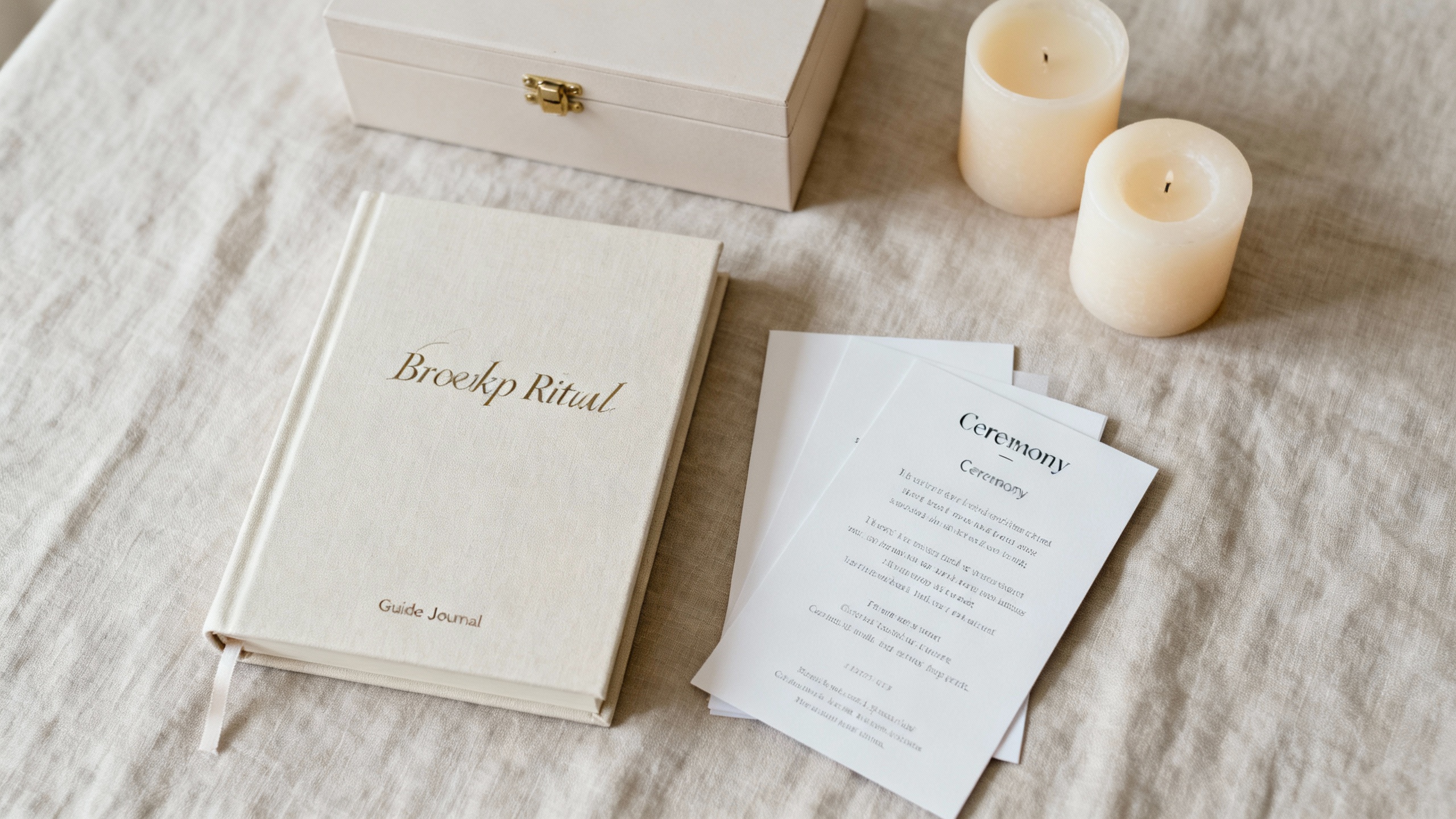
Second, breakup rituals are inherently experiential. A closing ceremony on a beach with sage, journaling, and shared food; a living-room relationship funeral with speeches and tears; a solitary night with candles, a journal, and a box of mementos; all of these are experiences, not just inner decisions. Experiences invite props: journals, candles, printed scripts, altar cloths, affirmation cards, keepsake boxes, and commemorative art.

Third, people are increasingly comfortable blending therapeutic ideas with consumer products. Headspace positions therapy and digital tools as normal responses to breakup pain. McGill’s counseling resources, Verywell Mind, Medical News Today, and Psychology Today all treat serious breakup distress as legitimate mental health concerns. Consumers then look for tangible tools that feel therapeutic even when they are not formal treatment.

For on-demand printing and dropshipping entrepreneurs, this creates a recognizable pattern: a recurring, emotionally intense life event; a growing narrative about handling that event through intentional ritual; and a set of repeatable experiences that benefit from thoughtfully designed physical artifacts.

Business opportunities in the breakup recovery industry

Mapping Research Insights to Product Opportunities

The goal is not to slap the word “closure” on a coffee mug. It is to design products that align with the actual psychological needs shown in the research you shared. The following table summarizes that mapping in a compact way.

Consumer need

Insight from research and expert writing

Product direction for POD or dropshipping

Making sense of why the breakup happened

A longitudinal study on emerging adults finds that understanding the reasons for a breakup predicts better later well-being.

Guided breakup journals and printed question decks that help people construct a coherent story.

Regaining control amid chaos

Norton and Gino’s work on grief rituals and the karaoke study described by Multiamory show rituals restore a sense of control and reduce anxiety.

Simple, repeatable ritual kits with clear steps, such as printed ceremony scripts, checklists, and ritual cards.

Honoring the relationship and its impact

Elephant Journal and HuffPost highlight “relationship funerals” and closing ceremonies that center gratitude and shared memories.

Ceremony invitations, memory books, and customizable “relationship eulogy” templates.

Letting go of painful attachment

Let’s Mend, Sage Therapy, and multiple coaches describe burning letters, disposing of mementos, and decluttering as powerful symbolic acts.

Letter-writing bundles, “goodbye” stationery, and boxes designed for storing or discarding keepsakes.

Rebuilding identity and future vision

Camille Styles, Verywell Mind, and Sage Therapy emphasize life edits, value reflection, and self-transformation rituals.

Vision boards, affirmation card decks, and printable planners framed around post-breakup reinvention.

Notice that none of these directions require you to exaggerate or invent therapeutic claims. They simply translate what clinicians and writers already see working into physical form.

Breakup boxes and self-care kits for heartbreak

Pros and Cons of Breakup Ceremony Products

Any time you commercialize something as tender as heartbreak, you walk an ethical line. As an advisor, I encourage founders to name both the upside and the risk explicitly before they commit to this niche.

On the positive side, breakup ceremony products can validate that grief is real and worthy of care. Many of the sources you shared push back against the idea that one “shouldn’t feel this bad” after a breakup. McGill’s materials normalize intense distress and functional impairment. Headspace and other mental health platforms emphasize that heartbreak has neurological and physiological impacts and is not “just in your head.” When someone buys a breakup ritual kit or closure journal, they are implicitly affirming that their pain matters enough to be held and honored.

Ritual products can also provide accessible structure. Not everyone has immediate access to therapy. Not everyone is ready to attend a workshop or group. Many of the described rituals, from relationship funerals to heart-chakra meditations, are self-led. Well-designed products can gently guide a person through gratitude, grief, and future vision in a way that matches what the research says about meaning-making.

Finally, these products can encourage prosocial narratives rather than revenge fantasies. Articles by Camille Styles, Alexandra Solomon, and others emphasize empathy, self-responsibility, and seeing grief as evidence of capacity to love rather than as personal failure. If your branding leans into growth, compassion, and dignity, your products can support a healthier breakup culture.

On the negative side, there is a real risk of trivializing or commodifying grief. If breakup ceremony products are marketed as quick fixes, they conflict directly with the message from psychologists that healing is nonlinear and cannot be rushed. Verywell Mind, McGill, and multiple experts highlight that grief comes in waves, involves real functional impairment, and sometimes calls for professional help. A candle and a card cannot replace therapy.

There is also the risk of overexposure and performativity. Some closing ceremonies described in lifestyle media involve friends, photos, and shared food. These can be beautiful, but they can also slide into social performance if the couple or individual feels pressured to make their breakup look poetic and “conscious” rather than simply allowing raw emotion. Entrepreneurs have to be careful not to imply that a breakup ceremony must be aesthetically pleasing or socially shared.

Additionally, poorly designed rituals can backfire. Psychology Today’s closure piece notes that repeatedly searching for meaning through writing after marital separation sometimes prolongs distress, whereas short, redemptive writing exercises help. Sage Therapy warns that rituals can temporarily intensify emotions and recommends thoughtful preparation, ideally with professional guidance in more complicated grief. Products that encourage endless rumination, or that promote unsafe behaviors like unsupervised fire use, can do real harm.

Ethically, the safest position for merchants is to present breakup ceremony products as tools, not cures; to avoid promising emotional outcomes; and to consistently encourage therapy and social support when distress is severe.

Designing Breakup Ceremony Products Responsibly

From an entrepreneurial standpoint, this niche rewards depth over hype. Here are key design principles drawn directly from the research landscape you provided, translated into practical product decisions.

Build on Structure, Sequence, and Containment

Sage Therapy notes that helpful grief rituals are time-limited, structured, and consciously designated as “ritual” rather than everyday action. The karaoke study summarized by Multiamory shows that even a short, arbitrary ritual works when it has clear steps.

Translate that into products by giving consumers a beginning, middle, and end. A breakup ceremony kit might include a printed opening script, a set of guided questions for the body of the ritual, and a closing affirmation. A journal might be divided into phases: honoring the past, releasing the present, and envisioning the future. Each component should have a clear purpose and endpoint to discourage compulsive repetition.

Align with Honoring, Letting-Go, and Self-Transformation

The Sage Therapy framework of honoring, letting-go, and self-transformation is a robust backbone for your product ecosystem.

You might create one line of products geared toward honoring rituals: elegant memory books, minimalist printed “relationship eulogy” prompts, or ceremony invitations for a small circle of trusted friends. A second line could focus on letting-go: letter-writing sets with safe burning or shredding instructions, boxes labeled for “temporary storage” versus “final release,” and printed ceremony guides for decluttering. A third line could serve self-transformation: decks of reflective questions, values-based planners inspired by “life edit” ideas, or wall art and apparel using metaphors like Kintsugi to represent growth through brokenness.

This segmentation not only respects psychological nuance; it also makes merchandising cleaner and helps customers choose what fits their stage of healing.

Integrate Evidence-Informed Prompts

Multiple sources emphasize specific cognitive and emotional tasks that support healing. The Better Humans piece on metabolizing breakup grief encourages recognizing negative thought loops, setting aside time to process feelings, and rewriting one’s breakup story with self-compassion. The longitudinal breakup study highlights the importance of understanding why the relationship ended. PsychCentral, Alexandra Solomon, and others all stress distinguishing between closure as mutual explanation and closure as internal acceptance.

In practice, this means your printed content should not just say “let go.” It should help people clarify questions such as what they feared losing, what the relationship taught them, which patterns they do not want to repeat, and what “moving on” actually looks like. Curl Maven’s deep-reflection questions, Talane Miedaner’s cord-cutting visualization, and Psychology Today’s suggestions about redemptive writing all point toward structured self-inquiry rather than vague positivity.

Respect Boundaries and Avoid Re-Enactment

A consistent thread across closure literature is the warning against seeking endless conversations with an ex. Alexandra Solomon, PsychCentral, Shelley J. Whitehead, and Tiny Buddha–style advice all caution that chasing closure through the other person often reinforces powerlessness and prolongs trauma. Healthy closure is framed as largely an “inside job,” sometimes supplemented by one honest conversation, but not dependent on it.

Your products should reflect that boundary. Ceremony scripts and journal prompts should not encourage surprise visits, repeated messages, or elaborate joint rituals when there is active hostility or no consent. Instead, they can offer alternatives when a mutual closing ceremony is impossible, such as unsent letters, visualization exercises, or private rituals of release.

From a practical safety perspective, include language reminding customers to follow local guidelines for fire or outdoor activities and to avoid rituals that feel unsafe physically or emotionally.

Design for Accessibility and Subtlety

Not every customer wants a highly visible “breakup” product on their shelf. Many people prefer subtlety. A journal titled “New Chapter Reflections” or an art print featuring a Kintsugi-inspired design may serve the same healing purpose without advertising someone’s personal history to every visitor.

On-demand printing is well-suited to this kind of subtle customization. You can offer designs that look like general self-development products on the outside, while including breakup-specific guidance on the inside pages or in a tucked-in ceremony guide. This lets consumers control how public their healing process becomes.
How rituals help process romantic grief and loss

Is This a Trend or a Lasting Niche?

It is tempting to dismiss breakup ceremony products as a passing fad fueled by a few viral essays about relationship funerals and closing ceremonies. The research you shared suggests otherwise.

Breakups are not going away. Emerging-adult studies show that many young adults experience multiple romantic endings as they learn how to form intimate relationships. Counseling resources catalog the mental health impacts of these endings, from depression and sleep disturbance to identity disruption. Articles on on-and-off relationships document cycles of breaking up and reconciling that carry their own psychological costs.

At the same time, humans have used rituals to navigate loss for as long as we have records. The Ahead App piece connects modern heartbreak to ancient practices across cultures, from Buddhist mindfulness to Hindu transition ceremonies. Sage Therapy’s review of grief rituals reminds us that rituals around death, home, and identity shifts are deeply embedded in human behavior. The novelty is not that people crave ritual in breakups; it is that they no longer see those rituals as solely private or purely religious.

In that context, breakup ceremony products look less like a fad and more like a long-term niche within the broader market for emotional wellness, self-care, and life-transition goods. The specific aesthetics will evolve, but the underlying needs—meaning, control, honoring, release, and redefinition—are enduring.

FAQ: Breakup Ceremony Products and Your E‑Commerce Strategy

Are breakup ceremony products only for highly spiritual or “woo” audiences?

No. While some rituals described in your notes use crystals, sage, or astrological language, others are very grounded: structured letter-writing, decluttering, journaling, and small gatherings with friends. Counseling handouts, medical news outlets, and mainstream mental health sites all recommend behaviors like writing unsent letters, removing reminders of the ex, and creating new routines. You can position products anywhere on the spectrum from secular and science-informed to spiritual and symbolic, depending on your brand.

How do I avoid exploiting people when they are most vulnerable?

Anchor everything in respect. That means using language that normalizes grief, frames products as optional tools, and repeatedly acknowledges that healing is a process. It means not making claims that your journal or kit will “heal heartbreak fast.” It means signposting when professional help might be appropriate, echoing guidance from McGill, Headspace, and Verywell Mind. If you design from the question “How can this genuinely support someone on a hard night?” rather than “What will get attention on social media?” you are on the right track.

Will people really spend money on products for a breakup?

People already spend heavily on the relational life cycle, from dating experiences to weddings and anniversaries. Your research notes show that they also invest time and energy in healing after things end, with rituals ranging from elaborate ceremonies to small daily self-care practices. Founders I advise see consistent demand for journals, affirmation decks, self-care boxes, and ritual-inspired products in adjacent categories like grief, burnout, and career transition. Breakup ceremony products tap into the same willingness to invest in meaning, not just in celebration.

Closing Thoughts for Founders

If you decide to step into the breakup ceremony space, treat it as more than a novelty. The articles and studies you shared depict heartbreak as a profound, sometimes identity-shaking loss, and rituals as one of the oldest human technologies for making sense of that loss. As an entrepreneur, your leverage comes from translating those insights into physical experiences that are beautiful, practical, and psychologically respectful.

Do that well, and you are not just selling candles or cards. You are offering people a way to pause, honor what was, consciously release what is gone, and take one small, tangible step toward the life they are building next. That is a meaningful business to be in.

References

  1. https://pmc.ncbi.nlm.nih.gov/articles/PMC6051550/
  2. https://betterhumans.pub/3-rituals-to-help-metabolize-grief-after-a-breakup-c3771b9aad0f
  3. https://www.verywellmind.com/8-ways-to-feel-better-after-a-breakup-5089116
  4. https://curlmaven.ie/how-to-get-over-a-break-up/
  5. https://dralexandrasolomon.com/how-to-get-closure-after-a-breakup/
  6. https://www.headspace.com/articles/therapy-for-a-breakup
  7. https://www.huffpost.com/entry/closing-ceremony-breakup_n_5b9bef57e4b046313fbad43f
  8. https://www.letsmend.com/posts/feeling-stuck-5-reasons-rituals-help-you-heal
  9. https://www.medicalnewstoday.com/articles/on-and-off-relationships
  10. https://www.multiamory.com/podcast/409-can-a-ritual-save-your-relationship

Like the article

0
Analyzing the Rise of Breakup Ceremony Products in Consumer Culture

Analyzing the Rise of Breakup Ceremony Products in Consumer Culture

From Private Heartbreak to Public Ritual

For most of modern consumer history, we have developed elaborate products and rituals for beginnings. Engagement rings, wedding registries, baby showers, graduation parties, and housewarming gifts all come with clear scripts and entire industries attached to them. Endings, especially romantic breakups, have been treated very differently. The expectation has often been to “just move on,” ideally quietly and quickly.

The content emerging from relationship experts, therapists, and writers over the last decade tells a very different story. Articles from platforms like Elephant Journal describe the idea of a “relationship funeral,” a conscious ritual to honor and end a partnership with the same seriousness we give to a wedding. A widely shared story from a major lifestyle publisher describes a couple that held a “closing ceremony” instead of a conventional breakup, complete with structured stages of gratitude, honoring the relationship, and envisioning separate futures. Other writers document breakup haircuts, house-clearing rituals, and defined “mourning periods” followed by re-entry into life.

As a mentor working with on-demand printing and dropshipping founders, I have watched these ideas move from niche essays into visible consumer behavior. Merchants now tell me that “breakup boxes,” closure journals, “relationship funeral” invitations, and self-led ceremony kits sell alongside more familiar self-care products. While hard sales data is still sparse, the pattern is clear: once a life transition becomes ritualized, consumer culture quickly begins designing objects to support it.

Understanding this shift matters for entrepreneurs because breakup ceremony products are not just another novelty trend. They sit at the intersection of grief psychology, identity reconstruction, and a massive, recurring life event that almost every adult lives through. Done well, they can offer real value. Done poorly, they slide into shallow commodification of pain.

Consumer trends focusing on relationship funerals and closure

Why Rituals Work After a Breakup

To design responsibly in this space, you need a working understanding of why rituals help at all. The research notes you provided paint a consistent picture across clinical work, wellness writing, and academic studies.

Breakups are repeatedly framed as serious losses rather than minor disappointments. Counseling resources such as McGill University’s student services describe romantic breakups as major life stressors that disrupt routines, identity, and concentration. Headspace highlights a 2011 study on unmarried relationship dissolution showing that breakups are linked to declines in mental health and life satisfaction. Verywell Mind calls them a form of “ambiguous loss,” because the person is still alive but the shared future, habits, and roles vanish.

A longitudinal study of emerging adults summarized in a counseling research article adds an important nuance. It finds that simply being the one who initiated the breakup does not automatically protect people. In fact, higher perceived control at the time of breakup predicted more internalizing symptoms later. What did predict better long-term outcomes was having a coherent understanding of why the breakup happened. Participants who could make sense of the ending later reported less emotional distress and better romantic functioning. In other words, meaning-making is the active ingredient.

This is where rituals come in. Sage Therapy, drawing on research by Norton and Gino, defines a grief ritual as a symbolic activity performed around a meaningful event in order to achieve a psychological outcome, such as comfort, closure, or a sense of control. Their review notes that rituals can reduce grief distress and help people feel steadier, even when they do not believe rituals are powerful. The mechanism is less about magic and more about structure: rituals give you something to do when you otherwise feel helpless.

The Multiamory podcast brings in a broader ritual literature. A 2016 study by Alison Wood Brooks and colleagues asked participants to perform a short ritual before singing Journey’s “Don’t Stop Believin’” for a stranger, with performance scored by a karaoke game and a cash incentive. Those who performed the ritual reported less anxiety and sang more accurately than people who simply waited or were told to “calm down.” In a heart-rate version of the experiment, everyone’s heart rate spiked at the announcement, but only the ritual group’s heart rate dropped more afterward. Again, a simple sequence of actions reduced anxiety and improved performance.

Breakup-focused writing echoes these mechanisms. An article from Ahead App frames ancient practices like Japanese Kintsugi, Native American smudging, Buddhist mindfulness, and Hindu transition ceremonies as tools to create “sacred space” and move through heartbreak rather than around it. Other writers describe self-care rituals such as journaling, movement, and tea ceremonies as anchors when life feels disorienting. Sage Therapy emphasizes three useful traits of grief rituals: they are consciously recognized as rituals, they are time-limited containers for strong emotions, and they feel “sacred” or distinct from everyday behavior.

All of this converges on a simple insight. Breakups generate intense emotion and narrative confusion. Rituals help by offering a meaningful story, a clear start and end, and a small zone of control. Breakup ceremony products are essentially tools to scaffold those rituals.

The Emerging Landscape of Breakup Rituals

When you survey the notes you shared, three broad families of breakup rituals show up repeatedly. Understanding them is crucial if you want to build products that genuinely support consumers instead of just surfing a buzzword.

Honoring Rituals

Honoring rituals focus on gratitude, acknowledgment, and respect for what the relationship meant. Elephant Journal’s “relationship funeral” is a good example. After a period of post-breakup space, former partners meet to share what they loved about each other, discuss what happened, express anger and sadness, and consciously bless one another to move on. A closing ceremony described in a HuffPost piece follows a similar arc with stages of gratitude, honoring, and future vision.

Other sources echo this honoring instinct. Camille Styles writes about using breakup grief as a chance to deepen self-knowledge and gratitude, including gratitude for the relationship’s lessons. Curl Maven’s ritual includes letters of appreciation to parents and ex-partners, focusing on what each relationship taught rather than re-opening blame. Sage Therapy’s category of “honoring rituals” for breakup grief includes visiting meaningful places and gathering friends to talk about the relationship.

Honoring rituals are not about sugarcoating harm. They are about telling a fuller, more balanced story: both the good and the reasons the relationship ended. For many people, this narrative completeness is exactly what helps with closure.

Letting-Go Rituals

Letting-go rituals focus on releasing attachment, resentment, or fantasy. They are often more dramatic and are the ones most likely to generate product ideas.

Curl Maven’s heartbreak ceremony includes answering deep questions about fears, worst-case scenarios, and the gap between the relationship’s potential and reality, then optionally burning the writing as a symbolic release. Life coach Talane Miedaner recommends uncensored letters to an ex that are later torn up, burned, or buried. Sage Therapy suggests journaling painful feelings and then destroying or releasing the pages. The Let’s Mend article on rituals without closure describes burning photos or mementos and references a Scientific American discussion of how destroying objects can alleviate grief by making the ending feel more real.

Psychology Today’s essay on “breakup rituals for romantics” is filled with object-based letting-go, from burying a horse skull to burning wedding photos and throwing rings into a river. Elephant Journal and Let’s Mend both explore “relationship funerals” and deliberately discarding or boxing up items connected to the ex. Several sources recommend decluttering the home after a breakup, rearranging furniture, and even moving to create physical and psychological distance.

The common thread is externalization. By moving letters, photos, rings, and furniture, people move their relationship story from an internal loop into a visible, symbolic act. Products that facilitate letting-go rituals therefore tend to focus on tangible materials and guided destruction or transformation.

Self-Transformation Rituals

The third family of rituals aims at identity work: who you become after the breakup. Verywell Mind talks about designing solo experiences, experimenting with new activities, and redefining your identity as a single person. Camille Styles introduces the idea of a “life edit,” using the spaciousness after a breakup to reorganize habits, environments, and goals around your values. Curl Maven frames breakups around astrological cycles and encourages heart-chakra meditations, crystals, and affirmations designed to invite healthier future relationships.

Sage Therapy’s category of “self-transformation” rituals includes journaling lessons learned, clarifying values, updating one’s living space, and creating art that represents an evolving sense of home. Several sources emphasize affirmation practices and future-focused writing. Psychology Today’s closure article notes that “redemptive” writing over a few days, focusing on positive outcomes and growth, can reduce distress, whereas repeatedly searching for meaning can keep people stuck.

In short, self-transformation rituals are about turning pain into direction. Products aligned with this function help consumers articulate values, set intentions, and practice new self-concepts.

Psychological benefits of breakup rituals and ceremonies

Breakup Ceremonies as Consumer Experiences

Once you recognize these three ritual functions, it becomes easier to see why consumer interest is shifting.

First, there is a ritual gap. Elephant Journal points out that modern culture offers rituals for beginnings but few for endings. Writers at Let’s Mend and others argue that we need “relationship funerals” and even relationship bereavement leave because the emotional impact is comparable to other forms of loss. In a culture where we buy decor and printed invitations for almost every milestone, it is unsurprising that people start seeking physical markers of romantic endings as well.

Second, breakup rituals are inherently experiential. A closing ceremony on a beach with sage, journaling, and shared food; a living-room relationship funeral with speeches and tears; a solitary night with candles, a journal, and a box of mementos; all of these are experiences, not just inner decisions. Experiences invite props: journals, candles, printed scripts, altar cloths, affirmation cards, keepsake boxes, and commemorative art.

Third, people are increasingly comfortable blending therapeutic ideas with consumer products. Headspace positions therapy and digital tools as normal responses to breakup pain. McGill’s counseling resources, Verywell Mind, Medical News Today, and Psychology Today all treat serious breakup distress as legitimate mental health concerns. Consumers then look for tangible tools that feel therapeutic even when they are not formal treatment.

For on-demand printing and dropshipping entrepreneurs, this creates a recognizable pattern: a recurring, emotionally intense life event; a growing narrative about handling that event through intentional ritual; and a set of repeatable experiences that benefit from thoughtfully designed physical artifacts.

Business opportunities in the breakup recovery industry

Mapping Research Insights to Product Opportunities

The goal is not to slap the word “closure” on a coffee mug. It is to design products that align with the actual psychological needs shown in the research you shared. The following table summarizes that mapping in a compact way.

Consumer need

Insight from research and expert writing

Product direction for POD or dropshipping

Making sense of why the breakup happened

A longitudinal study on emerging adults finds that understanding the reasons for a breakup predicts better later well-being.

Guided breakup journals and printed question decks that help people construct a coherent story.

Regaining control amid chaos

Norton and Gino’s work on grief rituals and the karaoke study described by Multiamory show rituals restore a sense of control and reduce anxiety.

Simple, repeatable ritual kits with clear steps, such as printed ceremony scripts, checklists, and ritual cards.

Honoring the relationship and its impact

Elephant Journal and HuffPost highlight “relationship funerals” and closing ceremonies that center gratitude and shared memories.

Ceremony invitations, memory books, and customizable “relationship eulogy” templates.

Letting go of painful attachment

Let’s Mend, Sage Therapy, and multiple coaches describe burning letters, disposing of mementos, and decluttering as powerful symbolic acts.

Letter-writing bundles, “goodbye” stationery, and boxes designed for storing or discarding keepsakes.

Rebuilding identity and future vision

Camille Styles, Verywell Mind, and Sage Therapy emphasize life edits, value reflection, and self-transformation rituals.

Vision boards, affirmation card decks, and printable planners framed around post-breakup reinvention.

Notice that none of these directions require you to exaggerate or invent therapeutic claims. They simply translate what clinicians and writers already see working into physical form.

Breakup boxes and self-care kits for heartbreak

Pros and Cons of Breakup Ceremony Products

Any time you commercialize something as tender as heartbreak, you walk an ethical line. As an advisor, I encourage founders to name both the upside and the risk explicitly before they commit to this niche.

On the positive side, breakup ceremony products can validate that grief is real and worthy of care. Many of the sources you shared push back against the idea that one “shouldn’t feel this bad” after a breakup. McGill’s materials normalize intense distress and functional impairment. Headspace and other mental health platforms emphasize that heartbreak has neurological and physiological impacts and is not “just in your head.” When someone buys a breakup ritual kit or closure journal, they are implicitly affirming that their pain matters enough to be held and honored.

Ritual products can also provide accessible structure. Not everyone has immediate access to therapy. Not everyone is ready to attend a workshop or group. Many of the described rituals, from relationship funerals to heart-chakra meditations, are self-led. Well-designed products can gently guide a person through gratitude, grief, and future vision in a way that matches what the research says about meaning-making.

Finally, these products can encourage prosocial narratives rather than revenge fantasies. Articles by Camille Styles, Alexandra Solomon, and others emphasize empathy, self-responsibility, and seeing grief as evidence of capacity to love rather than as personal failure. If your branding leans into growth, compassion, and dignity, your products can support a healthier breakup culture.

On the negative side, there is a real risk of trivializing or commodifying grief. If breakup ceremony products are marketed as quick fixes, they conflict directly with the message from psychologists that healing is nonlinear and cannot be rushed. Verywell Mind, McGill, and multiple experts highlight that grief comes in waves, involves real functional impairment, and sometimes calls for professional help. A candle and a card cannot replace therapy.

There is also the risk of overexposure and performativity. Some closing ceremonies described in lifestyle media involve friends, photos, and shared food. These can be beautiful, but they can also slide into social performance if the couple or individual feels pressured to make their breakup look poetic and “conscious” rather than simply allowing raw emotion. Entrepreneurs have to be careful not to imply that a breakup ceremony must be aesthetically pleasing or socially shared.

Additionally, poorly designed rituals can backfire. Psychology Today’s closure piece notes that repeatedly searching for meaning through writing after marital separation sometimes prolongs distress, whereas short, redemptive writing exercises help. Sage Therapy warns that rituals can temporarily intensify emotions and recommends thoughtful preparation, ideally with professional guidance in more complicated grief. Products that encourage endless rumination, or that promote unsafe behaviors like unsupervised fire use, can do real harm.

Ethically, the safest position for merchants is to present breakup ceremony products as tools, not cures; to avoid promising emotional outcomes; and to consistently encourage therapy and social support when distress is severe.

Designing Breakup Ceremony Products Responsibly

From an entrepreneurial standpoint, this niche rewards depth over hype. Here are key design principles drawn directly from the research landscape you provided, translated into practical product decisions.

Build on Structure, Sequence, and Containment

Sage Therapy notes that helpful grief rituals are time-limited, structured, and consciously designated as “ritual” rather than everyday action. The karaoke study summarized by Multiamory shows that even a short, arbitrary ritual works when it has clear steps.

Translate that into products by giving consumers a beginning, middle, and end. A breakup ceremony kit might include a printed opening script, a set of guided questions for the body of the ritual, and a closing affirmation. A journal might be divided into phases: honoring the past, releasing the present, and envisioning the future. Each component should have a clear purpose and endpoint to discourage compulsive repetition.

Align with Honoring, Letting-Go, and Self-Transformation

The Sage Therapy framework of honoring, letting-go, and self-transformation is a robust backbone for your product ecosystem.

You might create one line of products geared toward honoring rituals: elegant memory books, minimalist printed “relationship eulogy” prompts, or ceremony invitations for a small circle of trusted friends. A second line could focus on letting-go: letter-writing sets with safe burning or shredding instructions, boxes labeled for “temporary storage” versus “final release,” and printed ceremony guides for decluttering. A third line could serve self-transformation: decks of reflective questions, values-based planners inspired by “life edit” ideas, or wall art and apparel using metaphors like Kintsugi to represent growth through brokenness.

This segmentation not only respects psychological nuance; it also makes merchandising cleaner and helps customers choose what fits their stage of healing.

Integrate Evidence-Informed Prompts

Multiple sources emphasize specific cognitive and emotional tasks that support healing. The Better Humans piece on metabolizing breakup grief encourages recognizing negative thought loops, setting aside time to process feelings, and rewriting one’s breakup story with self-compassion. The longitudinal breakup study highlights the importance of understanding why the relationship ended. PsychCentral, Alexandra Solomon, and others all stress distinguishing between closure as mutual explanation and closure as internal acceptance.

In practice, this means your printed content should not just say “let go.” It should help people clarify questions such as what they feared losing, what the relationship taught them, which patterns they do not want to repeat, and what “moving on” actually looks like. Curl Maven’s deep-reflection questions, Talane Miedaner’s cord-cutting visualization, and Psychology Today’s suggestions about redemptive writing all point toward structured self-inquiry rather than vague positivity.

Respect Boundaries and Avoid Re-Enactment

A consistent thread across closure literature is the warning against seeking endless conversations with an ex. Alexandra Solomon, PsychCentral, Shelley J. Whitehead, and Tiny Buddha–style advice all caution that chasing closure through the other person often reinforces powerlessness and prolongs trauma. Healthy closure is framed as largely an “inside job,” sometimes supplemented by one honest conversation, but not dependent on it.

Your products should reflect that boundary. Ceremony scripts and journal prompts should not encourage surprise visits, repeated messages, or elaborate joint rituals when there is active hostility or no consent. Instead, they can offer alternatives when a mutual closing ceremony is impossible, such as unsent letters, visualization exercises, or private rituals of release.

From a practical safety perspective, include language reminding customers to follow local guidelines for fire or outdoor activities and to avoid rituals that feel unsafe physically or emotionally.

Design for Accessibility and Subtlety

Not every customer wants a highly visible “breakup” product on their shelf. Many people prefer subtlety. A journal titled “New Chapter Reflections” or an art print featuring a Kintsugi-inspired design may serve the same healing purpose without advertising someone’s personal history to every visitor.

On-demand printing is well-suited to this kind of subtle customization. You can offer designs that look like general self-development products on the outside, while including breakup-specific guidance on the inside pages or in a tucked-in ceremony guide. This lets consumers control how public their healing process becomes.

How rituals help process romantic grief and loss

Is This a Trend or a Lasting Niche?

It is tempting to dismiss breakup ceremony products as a passing fad fueled by a few viral essays about relationship funerals and closing ceremonies. The research you shared suggests otherwise.

Breakups are not going away. Emerging-adult studies show that many young adults experience multiple romantic endings as they learn how to form intimate relationships. Counseling resources catalog the mental health impacts of these endings, from depression and sleep disturbance to identity disruption. Articles on on-and-off relationships document cycles of breaking up and reconciling that carry their own psychological costs.

At the same time, humans have used rituals to navigate loss for as long as we have records. The Ahead App piece connects modern heartbreak to ancient practices across cultures, from Buddhist mindfulness to Hindu transition ceremonies. Sage Therapy’s review of grief rituals reminds us that rituals around death, home, and identity shifts are deeply embedded in human behavior. The novelty is not that people crave ritual in breakups; it is that they no longer see those rituals as solely private or purely religious.

In that context, breakup ceremony products look less like a fad and more like a long-term niche within the broader market for emotional wellness, self-care, and life-transition goods. The specific aesthetics will evolve, but the underlying needs—meaning, control, honoring, release, and redefinition—are enduring.

FAQ: Breakup Ceremony Products and Your E‑Commerce Strategy

Are breakup ceremony products only for highly spiritual or “woo” audiences?

No. While some rituals described in your notes use crystals, sage, or astrological language, others are very grounded: structured letter-writing, decluttering, journaling, and small gatherings with friends. Counseling handouts, medical news outlets, and mainstream mental health sites all recommend behaviors like writing unsent letters, removing reminders of the ex, and creating new routines. You can position products anywhere on the spectrum from secular and science-informed to spiritual and symbolic, depending on your brand.

How do I avoid exploiting people when they are most vulnerable?

Anchor everything in respect. That means using language that normalizes grief, frames products as optional tools, and repeatedly acknowledges that healing is a process. It means not making claims that your journal or kit will “heal heartbreak fast.” It means signposting when professional help might be appropriate, echoing guidance from McGill, Headspace, and Verywell Mind. If you design from the question “How can this genuinely support someone on a hard night?” rather than “What will get attention on social media?” you are on the right track.

Will people really spend money on products for a breakup?

People already spend heavily on the relational life cycle, from dating experiences to weddings and anniversaries. Your research notes show that they also invest time and energy in healing after things end, with rituals ranging from elaborate ceremonies to small daily self-care practices. Founders I advise see consistent demand for journals, affirmation decks, self-care boxes, and ritual-inspired products in adjacent categories like grief, burnout, and career transition. Breakup ceremony products tap into the same willingness to invest in meaning, not just in celebration.

Closing Thoughts for Founders

If you decide to step into the breakup ceremony space, treat it as more than a novelty. The articles and studies you shared depict heartbreak as a profound, sometimes identity-shaking loss, and rituals as one of the oldest human technologies for making sense of that loss. As an entrepreneur, your leverage comes from translating those insights into physical experiences that are beautiful, practical, and psychologically respectful.

Do that well, and you are not just selling candles or cards. You are offering people a way to pause, honor what was, consciously release what is gone, and take one small, tangible step toward the life they are building next. That is a meaningful business to be in.

References

  1. https://pmc.ncbi.nlm.nih.gov/articles/PMC6051550/
  2. https://betterhumans.pub/3-rituals-to-help-metabolize-grief-after-a-breakup-c3771b9aad0f
  3. https://www.verywellmind.com/8-ways-to-feel-better-after-a-breakup-5089116
  4. https://curlmaven.ie/how-to-get-over-a-break-up/
  5. https://dralexandrasolomon.com/how-to-get-closure-after-a-breakup/
  6. https://www.headspace.com/articles/therapy-for-a-breakup
  7. https://www.huffpost.com/entry/closing-ceremony-breakup_n_5b9bef57e4b046313fbad43f
  8. https://www.letsmend.com/posts/feeling-stuck-5-reasons-rituals-help-you-heal
  9. https://www.medicalnewstoday.com/articles/on-and-off-relationships
  10. https://www.multiamory.com/podcast/409-can-a-ritual-save-your-relationship

Like the article

0