
Personalized Single Item Orders: How to Build a Business Around One Custom Gift Without Minimums
Personalized single item orders used to be a logistical headache that only big brands or boutique engravers could afford to manage. Today, thanks to print-on-demand and no-minimum fulfillment, one custom mug, a single engraved pen, or one fully branded tote bag can be produced and shipped almost as easily as a generic product pulled off a warehouse shelf.
When I mentor ecommerce founders and corporate marketers, I see a recurring pattern. The brands that lean into high-impact, one-to-one gifts consistently build stronger loyalty and more profitable relationships than those still relying on cheap bulk swag. Market data backs this up. Research featured by merchOne points to a personalized gifts market valued at about $28.19 billion in 2023, heading toward approximately $57.85 billion by 2031, with close to 9.4% compound annual growth. Another analysis from Printbox projects the broader personalized gifts segment at $43.3 billion by 2027. Consumers are signaling what they want: more than a third expect personalization by default, nearly half are willing to wait longer for customized products, and personalization can cut acquisition and retention costs by more than a quarter.
In this environment, “one custom gift without minimums” is not just a nice-to-have perk. It is becoming a core capability for both lean ecommerce businesses and established brands that want to deepen relationships without ballooning inventory risk.
What “Single Item, No Minimum” Really Means
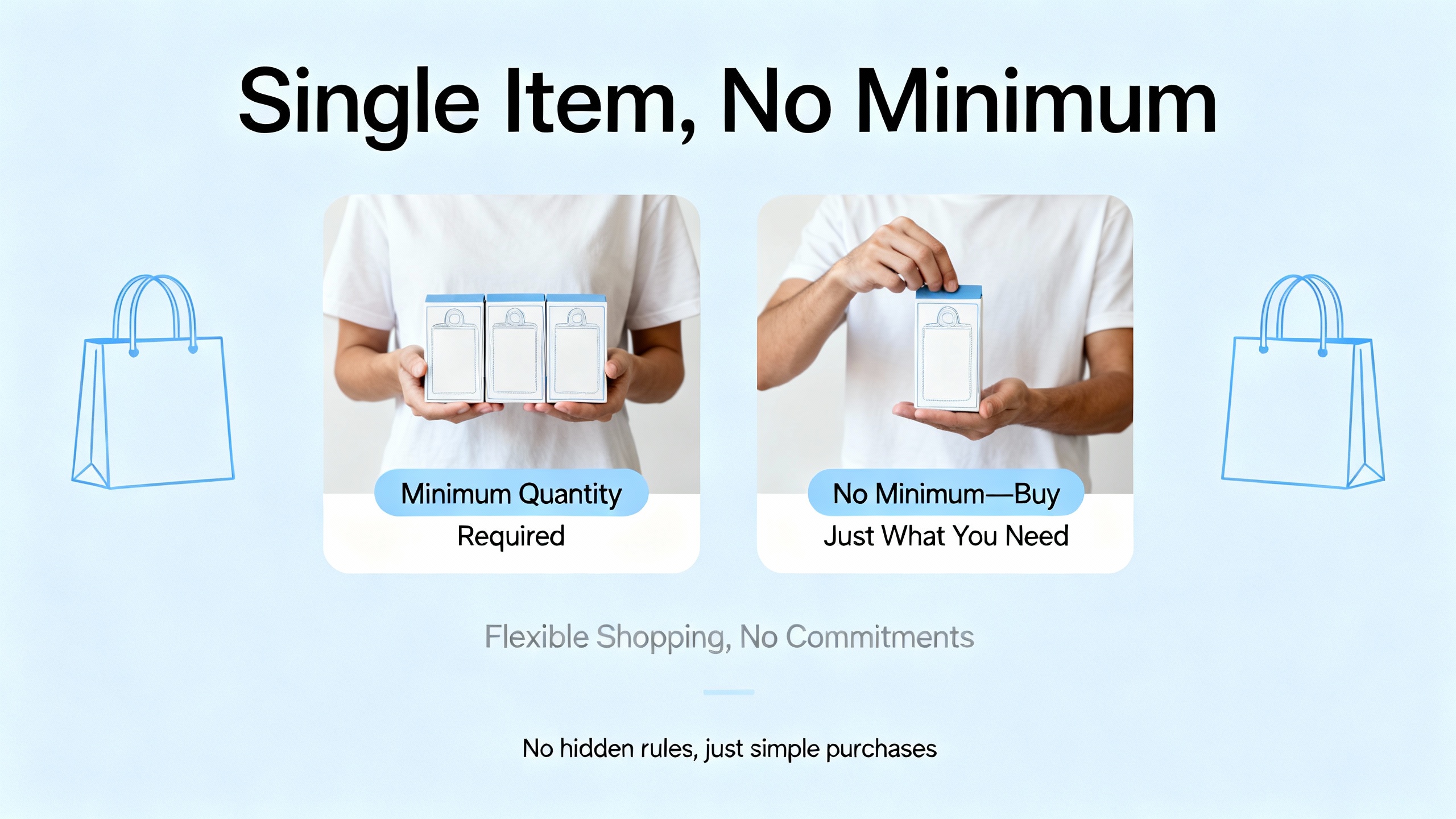
Traditional promotional products and corporate gifts were built around minimum order quantities. If you wanted branded drinkware or apparel, you were often forced into ordering dozens or hundreds of units to unlock decent pricing. That model simply does not fit a world where small teams, niche creators, and micro-targeted campaigns are the norm.
No-minimum promotional products flip that script. As described by providers like UCT Asia and RushOrderTees, these are custom-branded items you can purchase in any quantity, even a single unit, without committing to bulk thresholds. Instead of stocking a closet full of leftover sweatshirts, you can buy one engraved tumbler for a top client, ten personalized notebooks for a project team, or a single executive putter set for a board member.
This flexibility matters because it aligns spend with reality. Early-stage founders and small agencies rarely know if a concept or campaign will resonate. With no-minimum ordering, they can test a design, a message, or a gift category in tiny quantities, watch what performs, and scale only what works. That is exactly the type of low-risk experimentation UCT Asia highlights as transformative for smaller businesses.
The Print-on-Demand Engine Behind One-Off Gifts
Under the hood, most single-item personalized gifts are powered by print-on-demand. Platforms like Gelato, Printful, Printify, StationeryHQ, and SwagMagic all operate variations of the same basic model: products are produced only after an order is placed. The seller does not hold inventory; the print partner handles production and shipping.
Gelato emphasizes the global side of this approach, running millions of print jobs each year through a geographically distributed partner network. That allows creators, startups, and enterprises to offer localized production and faster delivery without building their own factories. StationeryHQ focuses on premium stationery and photo-driven gifts with more than 100 white-label products and no minimums, keeping their branding invisible so you can build your own. SwagMagic positions itself as a corporate gifting and swag partner, combining customization with warehousing and quality control.
Printbox’s analysis of personalized photo gift businesses shows how important the tech stack is for this model. Dynamic product editors, real-time previews, and strong mobile experiences are no longer nice extras. When shoppers design a single custom tote bag or wall print on a cell phone, they expect the editor to be intuitive, responsive, and accurate. Tools that check image resolution on the fly, or even enhance photos automatically, help prevent the nightmare of a one-off order arriving blurry or misprinted.
For individuals, companies like Subliminator frame print-on-demand as an easy way to create unique gifts for birthdays, anniversaries, holidays, and other special events without having to learn the print trade. For founders, the opportunity is more strategic: plug into this infrastructure and you can sell custom gifts globally while remaining asset-light.
Where One Custom Gift Outperforms Bulk Swag
From a relationship standpoint, one thoughtful personalized item can outperform a box of generic giveaways. Multiple sources in your research converge on the same principle: quality and intentionality beat volume.
MOO’s guide to personalized gifting strongly argues for shifting from “cheapest per unit” to “impact per person.” That means sending one engraved, high-quality Twist Pen or water bottle, created just for a specific client or employee, instead of sending hundreds of low-cost stress balls. The psychological effect is significant. Citing survey data, MOO points to the fact that more than four out of five recipients felt closer to companies that sent them a gift. Combine that with research highlighted by UCT Asia, which notes that around 79% of people who receive branded products are inclined to engage with that brand again, and you begin to see why single-item gifts are not just sentimental— they are commercially rational.
On the client side, SmartStart Consulting shows how small businesses can use low- or no-minimum personalized items—engravable pens, custom mouse pads, branded tumblers, puzzles, or even personalized coolers—to keep their brand top of mind on a client’s desk or in their daily routine. Pens.com brings this down to earth with concrete examples of low-quantity celebratory gifts for project milestones, volunteers, family events, and friend groups, often available with minimums as low as one or a handful of units. For employee experience, MOO and SwagMagic both frame customized onboard kits, name-engraved bottles, and individualized gifts as cultural building blocks, not just swag.
For consumers buying gifts, editorial guides from CNN Underscored, Wirecutter, Canva, Printful, and Uncommon Goods all reinforce the same trend. Personalized tote bags, custom sneakers, name jewelry, custom photo books, engraved kitchenware, and monogrammed accessories show up repeatedly as “best gifts” precisely because they feel specific and hard to regift. Printful, in particular, calls out last-minute print-on-demand gifts that can still ship within a few days, combining uniqueness with speed for holiday crunch time.
Pros and Cons of Personalized Single Item Orders
From a founder’s seat, personalized single item ordering has clear advantages, but it is not a free lunch.
On the plus side, you gain extraordinary flexibility. No-minimum ordering through partners like RushOrderTees, StationeryHQ, MOO, and several of the platforms highlighted by Wix means you can match quantities exactly to your use case. Need one custom Basecamp growler for a speaker gift or seven branded mugs for a small team, as Pens.com illustrates with their minimums? You can do that without carrying leftover stock. That flexibility naturally reduces upfront capital risk and inventory waste, aligning with the eco-aware positioning Printbox and Gelato emphasize around made-to-order production and reduced overproduction.
You also tap into the proven performance of personalization. Market research collected by merchOne shows personalization can reduce customer acquisition and retention costs by about 28%. Consumers are not only open to it; a substantial share expects personalization as a default and many are willing to trade shipping speed for customization. Thoughtful gifts also work at the emotional level. MOO’s discussion of reciprocity, drawing on principles from behavioral science, helps explain why recipients who feel genuinely seen often respond with repeat business, referrals, or deeper engagement.
The downsides are mainly operational and economic. Per-unit costs for single print-on-demand items are usually higher than bulk runs of generic stock. You compensate for that through higher pricing, higher perceived value, and stronger retention, but you still need to be conscious about margins. Lead times can also be longer than off-the-shelf stock, especially during peak seasons, which is why CNN Underscored and others advise ordering customized gifts early. Operationally, single-item orders mean less room for error. Printbox is very clear about the risks around image quality and the need for real-time resolution checks and tooling; when you only ship one unit, a misprint is not averaged out across a batch.
In short, personalized single-item ordering is powerful when you are deliberate about pricing, quality control, and expectations. It is not a universal substitute for bulk production, but a complementary tool that shines in high-value relationships and test-and-learn scenarios.
Designing a Strategy Around One Custom Gift
The founders who extract the most value from no-minimum and single-item personalization do not treat it as a novelty. They treat it as a strategy. Drawing from the guidance in the Printbox, SwagMagic, and StationeryHQ analyses, a strong strategy usually starts with a specific audience and story, not with a catalog.
Instead of saying, “We will print on anything,” decide who you are serving first. Printbox suggests niches such as young families, pet lovers, newlyweds, or corporate teams; SwagMagic extends this into employee rewards, event swag, and high-touch corporate gifting. When you know that your audience is, for example, remote software engineers, you can gravitate toward desk accessories, compact tech items, and hoodies that fit their workflow and style. When your audience is family reunion organizers, SmartStart Consulting and Pens.com both demonstrate the power of custom shirts, tote bags, and drinkware carrying shared names, photos, or sayings.
Next, connect the product to daily life. Designs on Demand’s long experience with custom mugs, mouse pads, shirts, and coasters reinforces a simple insight: the best personalized gifts are both practical and visible. A mug that sits on a desk every morning is not just a gift; it is an ongoing reminder of a relationship or event. Canva’s spotlight on tote bags as a more exciting, equally practical alternative to socks is another concrete illustration. The flat, reusable surface of a tote bag is ideal for personal messages, inside jokes, or favorite lyrics, and the bag travels through the recipient’s daily routine.
Finally, design for emotional resonance. CNN Underscored, Wirecutter, and Uncommon Goods all emphasize products that carry names, family stories, shared locations, or key dates. MOO encourages using one detail that proves you were paying attention: a launch date engraved on a pen, a favorite motto on a bottle, a design that reflects a personal in-joke. With single-item capability, you can tailor those details down to the individual.
Comparing Bulk Swag and Single-Item Personalization
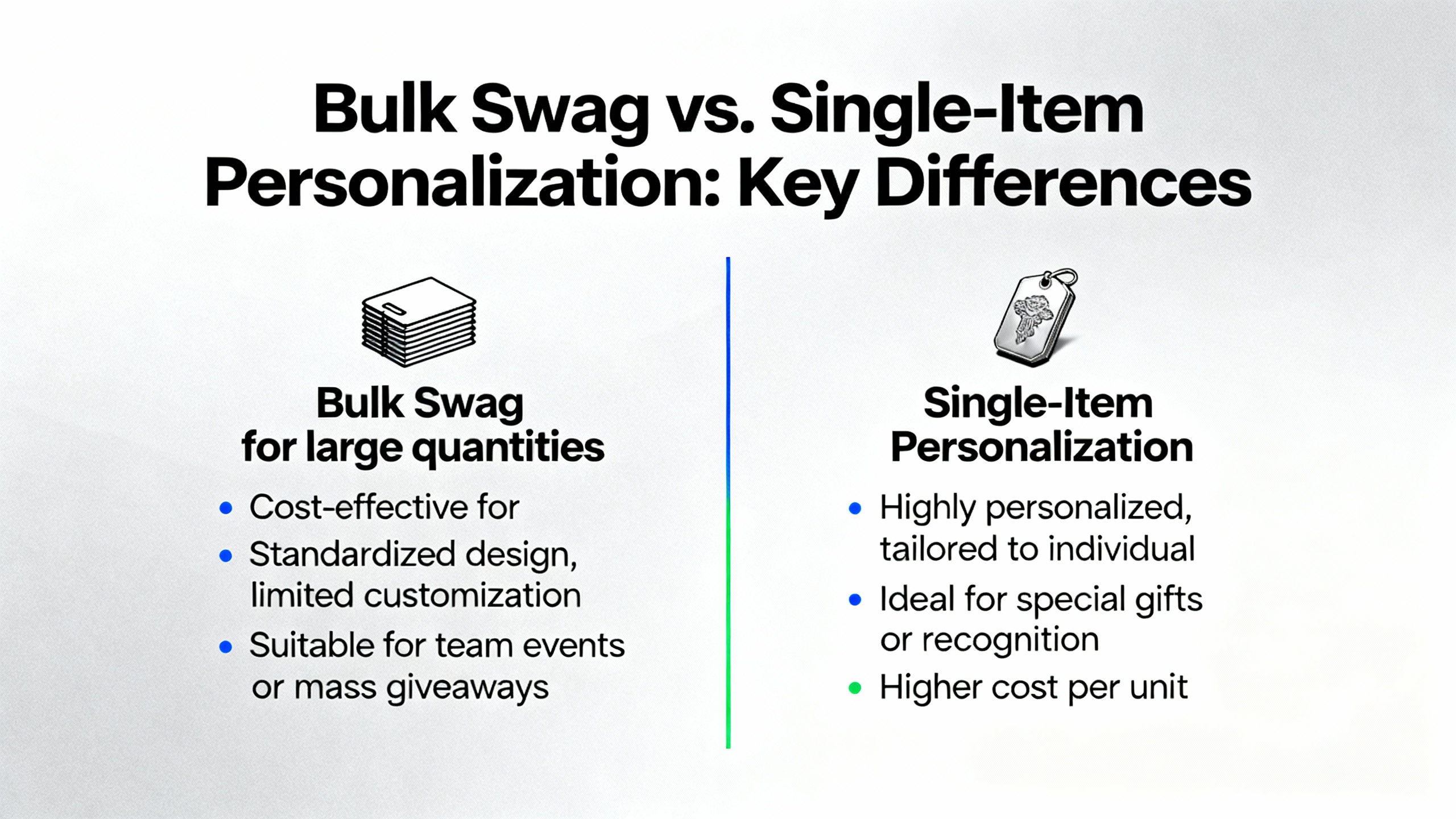
To anchor your strategy, it often helps to see where bulk orders still make sense and where single-item gifts win. The following simplified comparison draws on messaging from UCT Asia, MOO, Pens.com, SwagMagic, and RushOrderTees.
Aspect | Bulk Promotional Swag | Personalized Single-Item Orders |
|---|---|---|
Primary goal | Maximize impressions at lowest cost per unit | Maximize impact per person and deepen relationships |
Typical use cases | Large conferences, mass giveaways, broad brand visibility | Key clients, top volunteers, employees, special life events |
Inventory and risk | Requires storage and upfront capital, risk of leftover stock | Produced on demand, minimal inventory and lower waste |
Perceived value | Often seen as generic; low emotional connection | Feels thoughtful and specific; strong emotional connection |
Data and learning | Harder to attribute impact beyond broad reach | Easier to tie to specific accounts, deals, or customer lifetime value |
Environmental footprint | Risk of overproduction and unused items | Made-to-order aligns better with sustainable, low-waste positioning |
Most modern brands end up using both, but the growth opportunity many founders miss is on the right side of this table.
Operational Playbook: From Idea to Delivered Gift
Turning the concept of “one custom gift without minimums” into a reliable engine for your business requires a few practical building blocks. The good news is that nearly all of them are available off the shelf from the platforms in your research set.
First, choose the right fulfillment partners per product category. Insights from StationeryHQ and the StationeryHQ-focused comparison on Wix show that some providers excel at premium paper goods, photo products, and event stationery, while operators like Printful and Printify specialize in apparel, home goods, and lifestyle items with deep ecommerce integrations. SwagMagic leans into corporate gifting and managed swag programs. Gelato provides global coverage and millions of print jobs worth of capacity for generalized custom gifts. For a small or mid-size brand, it is entirely reasonable to use more than one partner, mapping each to the strengths highlighted in those analyses.
Second, invest in the front-end experience. Printbox stresses the importance of flexible product editors and mobile-first design. Many customers will design gifts from their cell phones—especially for last-minute occasions highlighted by Printful’s gift guide—so your editor needs to be fast, touch-friendly, and forgiving. Show real-time previews, surface warnings about low-resolution images, and make personalization steps obvious but not overwhelming.
Third, bake in quality control and packaging. Printbox’s focus on image quality management and SwagMagic’s emphasis on quality-controlled production are reminders that a single bad print can undo the goodwill a thoughtful gift was meant to generate. Before rolling out a product broadly, order samples from your print partners, as the Wix guidance suggests, and evaluate color accuracy, materials, and packaging. Digitized Logos and Pens.com both underscore how much elevated packaging—rigid boxes, tissue, a short branded note—can lift the perceived value of even a practical item like a tumbler or notebook.
When Personalized Single Orders Make Financial Sense
From a purely financial perspective, founders often ask whether single-item customization is “worth it” compared to bulk. The answer depends on context, but the research in your notes suggests several scenarios where the economics are compelling.
First, consider high-value relationships. When personalization can reduce acquisition and retention costs by about 28%, as highlighted in the merchOne analysis, spending more on one meaningful gift for a pivotal account can be cheaper than another wave of digital ads with weak differentiation. UCT Asia’s statistic that roughly 79% of people who receive branded products are inclined to engage again supports this line of thinking: a well-chosen object on a customer’s desk outperforms an easily ignored email.
Second, factor in risk and waste. Print-on-demand and no-minimum ordering, described by RushOrderTees, StationeryHQ, Gelato, and SwagMagic, shift budget from excess inventory to higher-quality individual pieces. Even if your unit cost is higher, you are not tying up capital in boxes of merchandise that might never move. You can test three mug designs in tiny quantities, see which one people actually use or share on social media, then scale the winner with confidence.
Third, look at long-term loyalty mechanisms. Uncommon Goods’ “forever returns” policy and free shipping for members of its loyalty program signal how retailers are thinking about lifetime value rather than single orders. MOO’s references to “slow productivity” style thinking—doing fewer things with more care—adapt cleanly to gifting: fewer gifts, better chosen, delivered with more intention. If a single personalized gift strengthens an account enough to drive one more project or one more year of renewals, the numbers usually work in your favor.
Avoiding Common Pitfalls
Even strong strategies can be undermined by avoidable mistakes. Patterns across the research set suggest a few traps to watch.
One common issue is treating personalization as a last-minute bolt-on rather than a designed experience. Printful’s last-minute gift article offers plenty of smart ways to rescue a forgotten birthday or holiday, but if your entire program runs on last-minute panic, you will eventually collide with production and shipping realities. Both CNN Underscored and Printful advise giving yourself enough buffer during peak seasons, especially when you are adding names, photos, or engravings.
A second pitfall is low-quality artwork and previews. Printbox repeatedly emphasizes the risk of poor image resolution, which can lead to blurry prints, returns, and damaged margins. Rely on resolution checks, clear guidance on file quality, and, if possible, automated enhancement tools. When customers are designing on a phone, they need the platform to tell them when an image is not good enough.
A third risk is choosing forgettable products. The articles from Canva, MOO, CNN Underscored, Wirecutter, and SmartStart Consulting collectively show that utility and personal meaning matter. A generic stress ball with a logo is easy to toss. A tote bag designed around a fan’s favorite franchise, a pen engraved with a work anniversary, a mug featuring an inside joke, or a photo book tied to a milestone, as highlighted by several of these publishers, is much harder to ignore. If a product would not be meaningful without the logo, it probably will not become meaningful with it.
Finally, avoid ignoring sustainability. Gelato highlights eco-conscious practices and distributed local production; Printbox discusses recycled materials, soy inks, compostable packaging, and the inherent waste reduction of made-to-order workflows. European platforms like TPOP, mentioned in StationeryHQ’s broader comparison, position sustainability as a core differentiator. As consumer expectations around environmental responsibility rise, choosing partners and products that align with these practices is both ethically and commercially prudent.
Brief FAQ
Is there really enough demand to justify building around single-item personalized gifts?
The market data suggests yes. Analyses cited by merchOne and Printbox place the personalized gift market in the tens of billions of dollars with strong growth ahead. Consumer behavior indicators—such as a significant share of shoppers expecting personalization by default and many willing to wait longer for customized products—reinforce that this is not a passing fad. Single-item capability lets you serve that demand without betting heavily on inventory.
Are single-item, no-minimum gifts only useful for B2C brands?
Not at all. UCT Asia, SwagMagic, MOO, SmartStart Consulting, RushOrderTees, and Pens.com all showcase high-impact business use cases, from account-based marketing touches to small-batch volunteer recognition, employee onboarding kits, and executive gifting. The same infrastructure that lets a consumer order one photo blanket for a family member can support a sales team sending one engraved tumbler to a key decision-maker.
How should I pick my first personalized product for single-item orders?
Look for the intersection of daily utility and emotional meaning. Sources like Designs on Demand, Canva, CNN Underscored, Wirecutter, and SmartStart Consulting repeatedly point to items such as mugs, tote bags, notebooks, phone cases, and wearable accessories as strong starting points. These products are used often, have visible surfaces for names or images, and fit many niches. Start with one product that clearly fits your audience, validate demand in very small quantities, refine your approach, and only then widen the catalog.
When you embrace personalized single item orders, you are not just adding another product option; you are changing how your brand shows up in someone’s everyday life. Treat each one-off gift as a small but strategic investment in a specific relationship, supported by the print-on-demand and no-minimum capabilities now widely available. Done with care and intention, one custom gift at a time can become one of the most scalable and defensible assets in your ecommerce business.
References
- https://designsondemand.com/
- https://www.e-corporategifts.com/Logo-Gifts-No-Minimums.html?srsltid=AfmBOoqGj0RoR1yi7WM_xEDJI1FOG4R4UR1JpiVGnEh3bRpPluh85Bi5
- https://www.gelato.com/personalized-gifts
- https://www.personalcreations.com/?srsltid=AfmBOoqWS-WR-KfWv8k1QvJtZhWdVUi1D_kyYPEDywn1aRFaAY8vSVpi
- https://www.personalizationmall.com/?srsltid=AfmBOoo5PPpdXg_fn3DwZz7rv_pQBmONo5-v8TlUvkKXtZvmhgSIIESq
- https://www.subliminator.com/individuals
- https://www.digitizedlogos.com/best-promo-items-with-no-minimum-order-top-picks/?srsltid=AfmBOopt_UkLdrM1m66Qcg-7oe1dvd6849p_CW5PCHbMfzDtZ8ZA4wuf
- https://merchone.com/best-print-on-demand-custom-gifts-fulfiller/
- https://www.printful.com/blog/last-minute-gift-ideas-that-actually-work
- https://smartstartconsulting.ca/client-gifts/