


Printful Alternatives in 2026: Best Custom Product Services Compared

Printful Alternatives in 2026: Best Custom Product Services Compared

Jan 3, 2026 by Iris POD e-Commerce 101

If you have been running a print‑on‑demand store with Printful for a while, you already know the story. The platform is reliable, integrates with all the majors, and can produce high‑quality products across multiple continents. Yet as your volume grows, you start to feel the friction: thinner margins, limited differentiation in product catalog, and the nagging sense that your brand is more dependent on one supplier than it should be.

In my work mentoring ecommerce founders and creators, I see this pattern constantly. The most resilient brands rarely rely on a single production partner. Instead, they match products and regions to the right mix of providers, use data to protect margin, and build a supply chain that can survive stockouts, ad spikes, and platform policy changes.

This article is a practical guide to the best Printful alternatives in 2025, how they actually differ, and how to use them strategically rather than jumping from one app to another by instinct. The goal is not to “replace” Printful blindly, but to redesign your fulfillment stack so it supports your business model over the next three to five years.

Printful’s Strengths – And Why Many Sellers Still Look Elsewhere

Printful remains one of the most capable global print‑on‑demand providers. Research from TrueProfit describes it as offering one of the widest assortments in the space, with more than three hundred products across apparel, accessories, and home decor, backed by standardized equipment in seventeen fulfillment centers throughout North America, Europe, Asia, and Australia. Typical production runs two to five days, with shipping often taking another five to ten, and the company supports branding extras like custom packaging and labels.

Shopify’s own 2026 review of POD companies positions Printful as a leading global service with a strong mockup generator, sample discounts, and a high average review score from thousands of merchants. For new sellers, this combination of coverage, quality, and tooling is a big reason to start with Printful.

However, Fourthwall’s comparison of Printful alternatives surfaces the pain points that more mature sellers run into. Printful’s base prices are often on the high side, which can squeeze margins once you factor in advertising, platform fees, and taxes. Its catalog, while broad, is still heavily weighted toward apparel. Stock shortages during peak seasons are not unheard of. And once many Shopify, Etsy, or creator brands hit consistent volume, they start comparing their numbers against alternatives and realize they are leaving money on the table.

Those frustrations are not a sign that Printful is “bad.” They are a sign that your business has moved from survival to optimization. At that point, diversifying into alternatives is not optional; it is part of building a durable ecommerce operation.

How Print‑on‑Demand Really Works (And Why It Matters When You Switch)

Before you compare platforms, it helps to be precise about what you are buying.

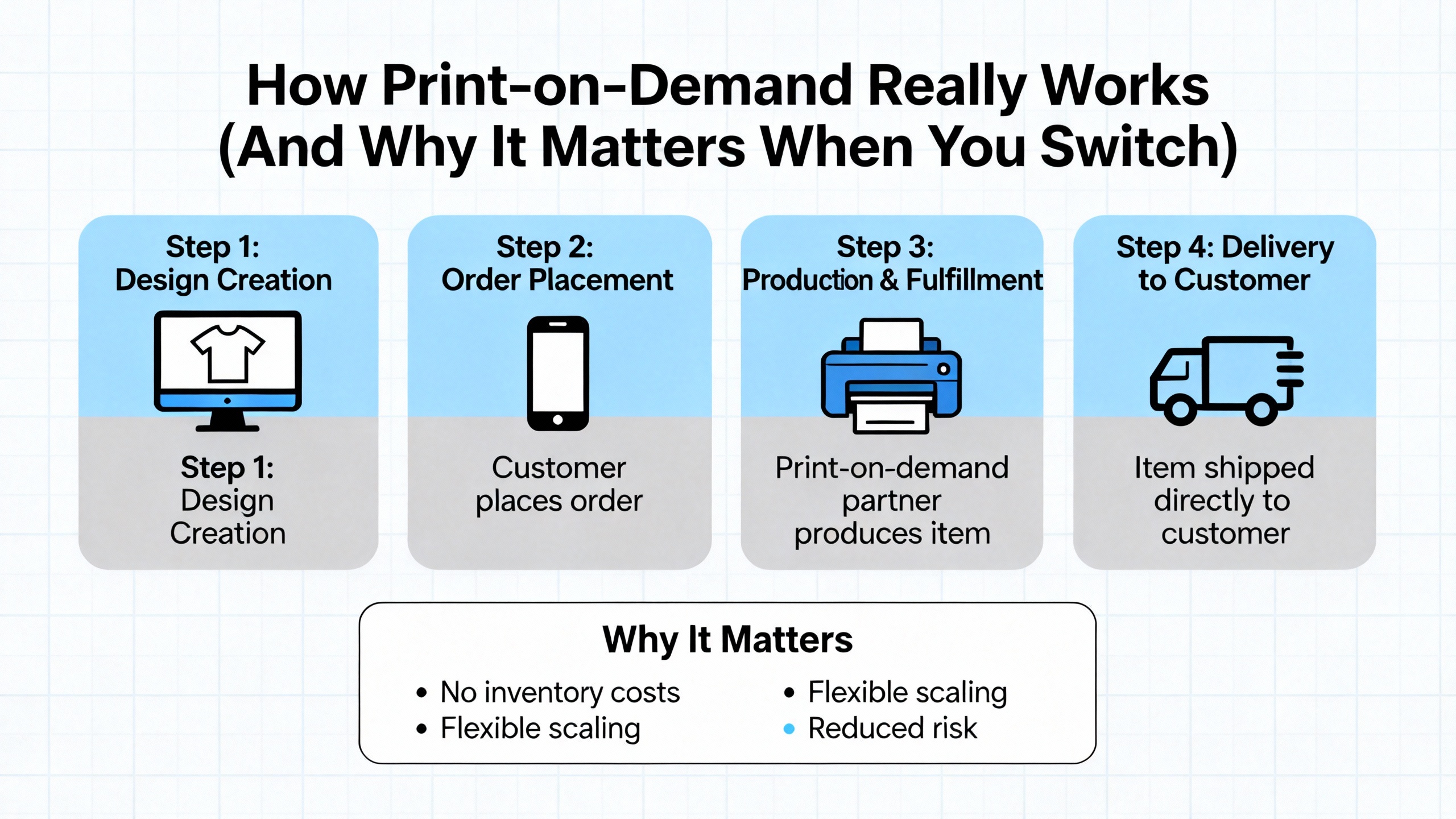
Multiple sources, including Blogging Wizard, Ecomposer, Shopify, and the VistaPrint hub, all converge on a similar definition. Print‑on‑demand is a fulfillment model where products such as clothing, accessories, home decor, or art prints are produced only after a customer places an order. The POD provider handles printing, packing, and shipping while you focus on designing and selling. You pay for the base product, shipping, and taxes only after you have collected money from your customer, which means no inventory risk.

That model explains both the upside and the trade‑offs.

You avoid buying stock, leasing warehouse space, or managing pick‑and‑pack teams. You can test dozens of designs cheaply and kill what does not sell. This is why interest in POD has grown sharply over the last five years, with sources like Dynamic Mockups noting roughly a tripling in attention to the model.

But because production is done one order at a time, per‑unit costs are higher than in bulk printing, as the VistaPrint hub and Shopify both point out. That is why platform choice matters. The right provider for a creator testing five designs a month is not the same as the right provider for a brand shipping hundreds of orders every week.

When you leave Printful or bring in alternatives alongside it, you are not just swapping apps. You are changing how your cost structure, delivery times, and brand control look over the long term.
top print on demand sites like printful

The Criteria That Actually Matter in a Printful Alternative

Different reviews emphasize different angles. The Gelato blog highlights product range, customization options, quality, and integrations. Forbes Advisor’s analysis of online printing services stresses the balance between price and quality. The Ecomposer overview of US POD companies doubles down on fulfillment speed, branding options, and sustainability. From mentoring brands through these decisions, I see the same core dimensions come up again and again.

Product catalog and niche fit

Printify’s marketplace model, described by Shopify and TrueProfit, offers around nine hundred products and access to dozens of print providers worldwide. Gooten, according to TrueProfit and Dynamic Mockups, covers apparel, wall art, and lifestyle items with a strong focus on accessories, home goods, and niche products. AOP+ specializes in all‑over‑print items such as hoodies, tees, phone cases, and home goods, while Podbase zeroes in on tech accessories like phone cases and laptop covers.

The practical question is simple: does this platform carry the products your brand genuinely needs over the next few years? If you plan to grow into eco streetwear, labels like Apliiq with its premium custom apparel and private‑label options may be critical. If you are a fine art photographer, platforms or marketplaces with strong wall art and photo print capabilities, such as Redbubble or specialty photo printers highlighted by Forbes Advisor, may be more relevant than another T‑shirt catalog.

Pricing model and margins

Most POD platforms use a similar structure. Platform access has a free tier and one or more paid plans, while you pay per product and per shipment. Printify, for example, offers a free tier plus a premium plan at about twenty‑nine dollars per month, and an enterprise tier for very high volume, as described in multiple sources. Gelato offers a free tier plus paid plans such as Gelato+ and Gold that can reduce shipping costs by up to fifty percent according to Blogging Wizard and Podbase research.

Some services, like Gooten and Print Aura, charge no subscription fees but set their margins through product pricing. Others, like CustomCat or AOP+, offer both free and paid plans, where the paid tier lowers product pricing. For all of them, base cost and shipping are just the start; you must also consider branding fees, marketplace charges, payment gateway fees, and your own marketing.

The ecommerce entrepreneurs who survive long term build a simple contribution margin model. They calculate total unit cost for each product (production, shipping, taxes, platform fees) and compare it to their planned retail price. Shopify and TrueProfit both emphasize this discipline, because without it, switching platforms based on “cheap” pricing can actually reduce profits once you include shipping zones, membership fees, and app costs.

Fulfillment footprint and speed

The Printful competitor comparison and multiple independent guides make one point very clear: where your provider prints matters. Fulfillment locations range from just the United States and Europe for some providers to a dozen or more distinct regions across the Americas, Europe, Asia‑Pacific, and emerging markets such as Brazil, Mexico, and the Middle East.

Gelato stands out here. Blogging Wizard and TrueProfit both highlight its network of more than one hundred local print partners in thirty‑two countries and logistics partnerships that let roughly nine out of ten orders arrive within about five days when produced locally. Gooten reports shipping millions of products with on‑time rates well over ninety percent and average fulfillment under three days in some analyses. SPOD has more than twenty years of experience with in‑house production in the United States and European Union, often producing within forty‑eight hours.

For US‑centric brands, Ecomposer recommends shortlisting providers with distributed US facilities that can hit two to seven business day delivery reliably, even during peak seasons. For global brands, the calculus is different. You might keep Printful for regions where it has strong coverage and layer in platforms like Gelato, Prodigi, or Printify’s specific providers in countries where local production dramatically lowers shipping time and cost.

Quality, consistency, and branding control

Every POD platform promises quality. Not every platform delivers it consistently. The Gelato blog explicitly warns that one poor‑quality order can permanently damage a customer’s perception of your brand and recommends ordering samples or mock‑ups from multiple providers before committing.

CustomCat invests in proprietary print technologies such as Digisoft, highlighted in both TrueProfit and multiple comparison articles, to deliver vivid and durable prints at scale. Apliiq specializes in premium streetwear, offering woven labels, patches, and detailed branding options. AOP+ emphasizes fully in‑house production and eco‑friendly lines. Inkthreadable focuses on premium materials like organic cotton apparel in the UK and Europe.

Branding and unboxing are no longer optional extras. Ecomposer’s research on the US POD market notes that custom labels, inside neck prints, branded packing slips, inserts, and premium packaging help merchants justify higher price points. Platforms like CustomCat, AOP+, Teemill, and T‑Pop differentiate by giving you more white‑label control, from labels and tags to eco‑friendly, plastic‑free packaging.

Integrations, storefront tools, and automation

For many entrepreneurs, the technical experience matters as much as the print quality. Shopify’s and TrueProfit’s rundowns of POD platforms highlight deep integrations with Shopify, Etsy, WooCommerce, Amazon‑like marketplaces, and BigCommerce as a key factor. Better integrations mean orders are automatically imported, routed to the right facility, fulfilled, and tracked without manual intervention.

Some providers go further by bundling the storefront itself. Sellfy is a clear example. Blogging Wizard positions it as an all‑in‑one ecommerce platform with a site builder, templates, cart, email tools, upsells, and built‑in POD. Fourthwall offers a full‑featured creator commerce platform with storefront builder, digital products, memberships, and deep integrations with social platforms such as YouTube, Twitch, and TikTok. Spring (formerly Teespring) functions similarly as a creator‑first platform with no subscription fees, free storefronts, and direct integrations into social channels.

On the tooling side, Dynamic Mockups is not a printer at all but a companion tool that has become strategically important for serious brands. It provides AI mockup generation, bulk mockup creation for up to about one hundred variations in seconds, a free mockup library, and an API for automation. Across dozens of stores I have advised, better visuals are one of the most reliable levers for improving conversion rate without touching ad spend, and tools like this let you upgrade that layer independently of your fulfillment choice.

Sustainability and long‑term positioning

Sustainability is not just a marketing story anymore; it is reshaping buyer behavior. Ecomposer cites data showing that nearly half of Americans bought an environmentally friendly item in the previous month, up from the prior year, and that younger generations are particularly willing to pay more for personalized and sustainable products. The LinkedIn industry analysis on custom printing services predicts that vendors prioritizing eco‑friendly practices will gain a competitive edge, and that the market will increasingly lean on automation and AI‑driven customization.

Platforms like Gelato, Teemill, AOP+, and T‑Pop have leaned into this direction with local‑first production, organic fabrics, recycled materials, and low‑waste packaging. If you are building a brand you hope to sell one day, aligning your supply chain with these trends now can become a real asset later.

Side‑by‑Side: Leading Printful Alternatives and Their Best Use Cases

At this point, it is helpful to zoom out. Based on the research synthesis, here is a simplified comparison of several major Printful alternatives.

Platform

Best for

Key strengths

Watch‑outs

Gelato

Global, eco‑conscious brands needing fast delivery

Local production in over thirty countries, strong margins with paid tiers

Catalog smaller than marketplace‑style platforms

Printify

Sellers wanting maximum catalog breadth and pricing choice

Around nine hundred products, many print providers, strong global reach

Quality and speed vary by chosen provider, requires active management

Gooten

Scaling brands needing operational resilience

Strong lifestyle and homeware catalog, order management system, high accuracy

Less ideal for very low volume, some technical overhead

Sellfy

New sellers needing storefront plus POD

All‑in‑one store, supports digital and subscriptions, built‑in marketing

Not a pure backend; you may still want marketplace reach elsewhere

SPOD

US/EU‑focused brands prioritizing fast production

In‑house facilities, roughly forty‑eight‑hour production, large design library

Limited fulfillment footprint outside US/EU

Zazzle

Artists who value marketplace traffic

Built‑in audience, powerful design tools, free store setup

Less brand control, more competition, Zazzle‑branded packaging

CustomCat

Budget‑conscious US apparel sellers

Fast domestic turnaround, competitive pricing, proprietary print tech

Slower international shipping, limited marketplace integrations

Podbase

Tech‑accessory‑led brands needing speed and branding

In‑house fulfillment, one to three day turnaround on many items, white‑label branding

Narrower product range than large POD marketplaces

This table is not exhaustive. It does not list strong specialist players like Apliiq for custom apparel branding or AOP+ for all‑over prints, nor marketplaces such as Redbubble that emphasize built‑in traffic. It does, however, illustrate a critical lesson. You are not choosing a “better Printful.” You are choosing the platform whose strengths map cleanly to your strategy.

Gelato: Local‑First Production and Margin Leverage

Blogging Wizard ranks Gelato as the best overall Printful alternative, and the data supports that for many brands. With more than one hundred thirty production facilities in at least thirty‑two countries and logistics partners serving over two hundred regions, Gelato’s network is built around local production. TrueProfit’s analysis notes that this often translates to delivery within one to seven days for many local orders.

On the margin side, Gelato’s paid tiers such as Gelato+ and Gold can offer significant shipping discounts, sometimes up to fifty percent, as well as better base pricing and analytics. For a mid‑size brand shipping consistent volumes, this is exactly the lever you want: you trade a predictable monthly fee for lower variable costs and better predictability.

In practice, I see Gelato work particularly well for brands with global audiences and a catalog that leans into its strengths in apparel, stationery, wall art, and phone cases. The main trade‑off is that the catalog is more curated than giant marketplaces, so if you rely on exotic product categories, you may need to pair Gelato with a second provider.

Printify: Supplier Marketplace for Catalog Depth and Price Competition

Printify is often positioned as Printful’s largest direct competitor, and both Shopify and Dynamic Mockups emphasize why. Rather than owning all production, Printify connects you to more than eighty print providers in over one hundred locations across four continents, with around nine hundred products in its catalog. You can compare providers on price, quality ratings, and location, then choose the partner that fits each product.

For founders who are comfortable with a bit more complexity, this is extremely powerful. You can optimize for margin in some products, fast local shipping in others, and test multiple providers for a single bestseller before standardizing. The premium monthly plan adds global discounts on all orders, which can materially improve margins.

The downside is that Printify’s flexibility requires active management. Quality and fulfillment times depend on your specific provider choices. As a mentor, I recommend Printify for entrepreneurs who are willing to treat supply chain as a competitive advantage, not something to set and forget.

Gooten: Operational Partner for Brands Ready to Scale

Gooten shows up consistently in research aimed at more mature sellers. Blogging Wizard describes it as a better fit for established, scaling stores rather than brand‑new ones, and the Podbase and TrueProfit articles support this positioning. Gooten offers a catalog of apparel, accessories, home goods, and wall art, with particular strength in lifestyle products like puzzles, yoga mats, notebooks, towels, and blankets. It backs this with multiple production techniques and a track record of shipping millions of products at high on‑time and accuracy rates.

Critically, Gooten behaves less like a consumer app and more like a supply‑chain partner. It provides an order management system, fixed production partners for consistency, and integrations with major ecommerce platforms. However, it is not designed for stores sending a handful of orders each month; the recommendation from Blogging Wizard is that it works best once you are doing at least a few hundred orders per month.

If you are mentoring yourself past the “side hustle” stage into a durable brand, Gooten is worth a serious look as part of your mix.

Sellfy, Fourthwall, and Spring: When You Need the Storefront Too

Not every brand comes into POD with a fully built Shopify or WooCommerce site. Some creators primarily need a storefront and an audience layer. For them, platforms that combine ecommerce and POD can accelerate launch.

Sellfy, as Blogging Wizard outlines, is an all‑in‑one platform where you can build a store, sell physical products, digital downloads, and subscriptions, and leverage built‑in email and upsell tools. POD is just one component of a broader creator commerce toolkit.

Fourthwall and Spring (Teespring) occupy a similar space for social‑led creators. Fourthwall offers storefronts, memberships, digital products, mobile shop apps, and integrations with Twitch, YouTube, and TikTok, alongside a catalog of hundreds of POD items. Spring specializes in free storefronts tied directly to social channels, allowing creators to sell merch to audiences in more than one hundred eighty countries without subscription fees.

The upside is clear: minimal technical setup and direct integration with where your audience already lives. The downside is that you are heavily tied to one ecosystem, and your options for advanced customization or multi‑store strategies may be more limited than with a standalone ecommerce platform plus backend POD providers.

SPOD, CustomCat, and US‑First Fulfillment

For brands primarily serving customers in the United States and Europe, local speed and reliability often matter more than global coverage. SPOD, with more than twenty years of experience and in‑house production facilities in the United States and several European Union countries, focuses on quick production, often within about forty‑eight hours, and offers a catalog of over two hundred products with tens of thousands of pre‑made designs. That combination can be ideal for gift stores and trend‑driven apparel brands that prioritize fulfillment speed within those regions.

CustomCat similarly invests in fast, budget‑friendly US fulfillment. TrueProfit and multiple comparison guides note that it runs its own facilities, offers roughly three hundred or more products heavily focused on apparel and accessories, and typically processes orders within a few days, with options for expedited shipping. Its proprietary Digisoft printing technology is designed for durable, vivid colors at scale.

The trade‑offs with both SPOD and CustomCat are similar: international shipping is available but slower, branding options are more limited compared to eco‑focused or premium‑branding specialists, and integrations may be narrower than the very largest players. For US‑centric brands that care deeply about turnaround time and cost, though, they are worth considering as primary or secondary partners.

Zazzle, Redbubble, and Marketplace‑First Strategies

Zazzle and Redbubble represent a different path altogether. Instead of functioning as white‑label backends for your own storefront, they are marketplaces with built‑in traffic. Blogging Wizard, Ley Design Studio, and TrueProfit all note that creators can open free stores, upload designs, apply them to a wide range of products, and set royalty rates. The platform handles production, shipping, and customer service, while you focus on design and basic merchandising.

The upside is that you tap into existing demand, which can be especially valuable for new artists and designers without an established audience. The downside is loss of control. Packaging and branding are tied to the marketplace, your store competes alongside thousands of others, and you have less ability to build a standalone brand that can move between platforms.

In practice, I often advise creators to treat these marketplaces as discovery channels. Use them to learn what designs resonate and to build an audience, while gradually developing a standalone brand powered by Printful, Printify, Gelato, or other backends in parallel.

Specialized Players: AOP+, Apliiq, Podbase, Teemill, and T‑Pop

Some of the most powerful Printful alternatives are specialists. AOP+ focuses on all‑over‑print and sublimation products and offers fully in‑house production and eco‑friendly options. Apliiq targets serious apparel brands that care about garment quality and deep customization, from woven neck labels to patches and limited runs. Podbase optimizes for tech accessories and high‑speed fulfillment with advanced personalization tools and warehousing support, at tiered price points detailed in Podbase’s own comparison guide.

Teemill and T‑Pop are noteworthy on the sustainability front. Teemill offers organic apparel and free storefronts while emphasizing renewable energy and circularity. T‑Pop, as described in the Podbase research, offers apparel and accessories with zero‑plastic packaging, fully customizable packing slips, and the option to trademark labels after consistent monthly sales, with free and paid plans denominated in euros.

None of these will replace Printful wholesale for a generalist store. But if your brand strategy is to become the go‑to name for eco‑streetwear, premium all‑over prints, or tech accessories, these are the partners that can give you a defensible edge.

Choosing the Right Platform for Your Brand Strategy

Once you understand the landscape, the next question is practical. How do you actually pick the right mix of Printful alternatives for your store?

The VistaPrint hub’s guide to online printing emphasizes starting with your primary use case rather than chasing the cheapest option. Forbes Advisor makes a similar point: value is not the lowest price; it is the best combination of price, quality, and service for your specific needs. Shopify’s and TrueProfit’s evaluations of POD platforms echo this advice in the ecommerce context.

In coaching sessions, I usually walk founders through a simple sequence.

First, clarify your core product thesis. Are you building a design‑led apparel line, a home decor brand, a personalized gift shop, or a hybrid? If apparel is central and branding is your differentiator, platforms like Apliiq, CustomCat, or Teemill deserve extra weight. If you sell a mix of posters, wall art, and home goods, Gelato, Gooten, and AOP+ may rise to the top.

Second, map your customer geography. Look at your last twelve months of orders and list where customers actually live. If eighty percent of your buyers are in the United States, US‑centric providers like SPOD, CustomCat, or certain Printify partners may make sense as primary suppliers. If your demand is split across North America and Europe, local‑first networks like Gelato or Gooten become more valuable.

Third, run the numbers. Use real product examples and plug in base cost, shipping, and any membership fees from each candidate platform. Then layer in your advertising and operations costs. You will often find that a slightly higher base price with local production still yields better net margin than a lower base price plus long, expensive shipping.

Fourth, consider your operational tolerance. If you are a solo founder who hates spreadsheets, you may prefer one or two opinionated platforms with strong automation, even if the theoretical margin is slightly lower. If you enjoy optimization, marketplace models like Printify or multi‑provider stacks with Gooten, Gelato, and others can reward your effort.

Finally, factor in where the market is going. Industry analyses from Shopify, Ecomposer, and LinkedIn all point to a POD and custom printing market growing at roughly the low twenties percent compound rate through the early 2030s, with rising emphasis on automation and sustainability. Choose providers that are investing in these areas, not just catching up.

printful competitors for ecommerce

A Practical Migration Playbook for Moving Beyond Printful

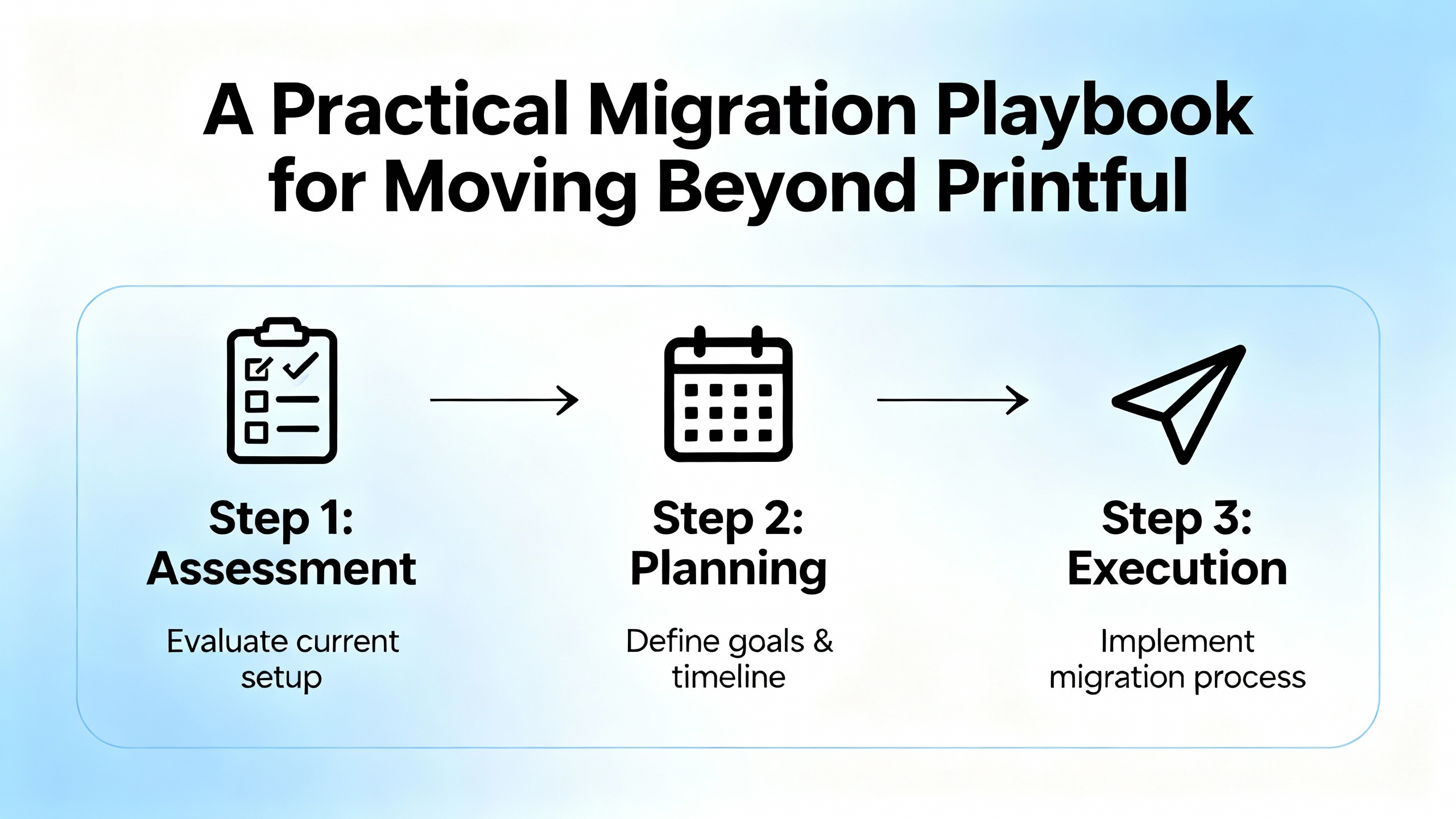
The worst way to move away from Printful is to flip a switch overnight. The best way is to treat migration as a controlled experiment.

Start by identifying two or three candidate platforms based on the criteria above. Order samples of your top five products from each platform, including at least one complex design or specialty print method. Gelato’s and the Gelato blog’s advice to physically inspect samples before committing is critical here. Inspect print quality, color accuracy, garment or material feel, packaging, and the unboxing experience. Do not just look at them under studio lighting; try them in natural light and, in the case of apparel, after a few washes.

Next, run live A/B tests in your store. For a small subset of products, route some orders through a new provider while keeping Printful as a control. Monitor delivery times, tracking reliability, customer feedback, and refund or complaint rates. Gooten’s and Printify’s networks, for example, may perform very differently depending on the specific provider you choose.

Communicate clearly with your customers. When you extend delivery times or test a new provider, update product pages and post‑purchase emails so buyers understand what to expect. In my experience, most customers tolerate an extra day or two of delivery if they get a better product, but they do not tolerate surprises.

Once you have data, start segmenting your catalog. Maybe your standard T‑shirts move to CustomCat for better pricing, your premium hoodies go to Apliiq, your wall art and posters move to Gelato, and you keep a subset of all‑over‑print items on Printful or AOP+. Only after you have proven reliability and margins should you fully retire a provider from a category.

Throughout the process, use tools that give you visibility into profitability. TrueProfit emphasizes the importance of tracking design‑level performance and using structured cash‑flow models. Whether you adopt a dedicated analytics solution or build your own spreadsheets, do not rely on top‑line revenue or ad dashboard data alone. Margin lives in the details of your fulfillment stack.

Finally, invest in your visuals and branding. Dynamic Mockups’ focus on high‑quality, AI‑powered mockups reflects an important truth. In a space where many sellers use the same base products from the same fulfillment partners, how you present your products is one of the few levers left. Upgraded mockups, lifestyle imagery, and consistent branding across channels often deliver better returns than another round of provider switching.
reliable print on demand services comparison

FAQ

Is it better to use one POD provider or several?

For very new stores, starting with a single provider like Printful, Printify, or Gelato keeps operations simple while you validate demand. Once you begin to see consistent orders, diversifying across two or three providers is usually healthier. It reduces dependency on any one company’s stock levels or policy changes and lets you optimize different product lines for margin, speed, or branding. Research from multiple sources, including Shopify and TrueProfit, supports the idea that more mature brands treat POD providers as modular building blocks rather than one‑stop shops.

How do I protect my margins when moving away from Printful?

Begin by modeling your current margins with Printful accurately, including production, shipping, taxes, platform fees, and marketing costs. When you evaluate alternatives like Printify, Gelato, Gooten, or CustomCat, compare full landed costs, not just base prices. Consider membership tiers that offer lower product or shipping rates, such as Gelato’s paid plans or Printify’s premium tier, and only upgrade once your volume justifies it. Tools and frameworks recommended by TrueProfit, such as design‑level profitability tracking and cash‑flow modeling, can help you make decisions based on data rather than guesswork.

Are marketplaces like Zazzle or Redbubble a real alternative to Printful?

They are an alternative strategy rather than a one‑for‑one replacement. Zazzle and Redbubble operate as marketplaces with built‑in traffic, where you upload designs and earn royalties while the platform handles fulfillment and customer service. They are excellent for discovery and for creators who do not want to manage a full ecommerce stack. However, you trade away brand control, data ownership, and flexibility. Many successful creators use marketplaces as part of a portfolio that also includes a standalone store powered by providers such as Printful, Printify, Gelato, or others.

Where does an embroidery‑focused business fit into this picture?

Embroidery deserves special attention because it often commands higher perceived value and more complex production. The Printify blog’s beginner guide to starting an embroidery business recommends using Printify as a central platform to choose products and digitize designs, with digitization offered at no extra cost in that context. In practice, embroidery‑heavy brands often layer additional partners over time, such as Apliiq for premium apparel or specialists identified through platforms like Printify’s provider marketplace, once they know exactly what their customers value and are willing to pay for.

Closing thoughts

Printful has earned its place in the print‑on‑demand ecosystem, but your business deserves a fulfillment strategy that is bigger than any single platform. The data from Shopify, Forbes Advisor, Gelato, Ecomposer, and others all point toward a market that is growing quickly while becoming more competitive and more demanding.

As a founder, your edge will not come from finding a secret provider nobody else knows about. It will come from understanding your own brand, mapping it to the right mix of providers, testing rigorously, and building systems that make your margins and customer experience resilient. If you approach Printful alternatives with that mindset, you are not just chasing cheaper hoodies. You are designing the supply chain that will support your business for years to come.

References

  1. https://www.office.fedex.com/?srsltid=AfmBOopYzUar1W4YlB69Qai1U-KzMHxy6z2mcrP5Y3rpfsAA2EXsvAP6
  2. https://www.gotprint.com/home.html?srsltid=AfmBOor5iaL1Jj0mtqUOR0PdZnlzVXGQS9u2JTWaTiN9WwdKjRMr7PAB
  3. https://www.printful.com/competitor-comparison
  4. https://www.printivity.com/
  5. https://www.printplace.com/custom-printing?srsltid=AfmBOooJX0GlgMWoKGiBECFtYiY_UdquZUKpv2Q9Vrsr1iu7auUFgEuY
  6. https://www.theupsstore.com/print
  7. https://www.vistaprint.com/?srsltid=AfmBOopRZHwlDDtxTWVn7GBGrUnWDjx_Wx0DH_j7CRaL0EsRPGiTOk8I
  8. https://www.avery.com/custom-printing/
  9. https://bloggingwizard.com/printful-alternatives/
  10. https://www.canva.com/print/

Like the article

0
Printful Alternatives in 2026: Best Custom Product Services Compared

Printful Alternatives in 2026: Best Custom Product Services Compared

If you have been running a print‑on‑demand store with Printful for a while, you already know the story. The platform is reliable, integrates with all the majors, and can produce high‑quality products across multiple continents. Yet as your volume grows, you start to feel the friction: thinner margins, limited differentiation in product catalog, and the nagging sense that your brand is more dependent on one supplier than it should be.

In my work mentoring ecommerce founders and creators, I see this pattern constantly. The most resilient brands rarely rely on a single production partner. Instead, they match products and regions to the right mix of providers, use data to protect margin, and build a supply chain that can survive stockouts, ad spikes, and platform policy changes.

This article is a practical guide to the best Printful alternatives in 2025, how they actually differ, and how to use them strategically rather than jumping from one app to another by instinct. The goal is not to “replace” Printful blindly, but to redesign your fulfillment stack so it supports your business model over the next three to five years.

Printful’s Strengths – And Why Many Sellers Still Look Elsewhere

Printful remains one of the most capable global print‑on‑demand providers. Research from TrueProfit describes it as offering one of the widest assortments in the space, with more than three hundred products across apparel, accessories, and home decor, backed by standardized equipment in seventeen fulfillment centers throughout North America, Europe, Asia, and Australia. Typical production runs two to five days, with shipping often taking another five to ten, and the company supports branding extras like custom packaging and labels.

Shopify’s own 2026 review of POD companies positions Printful as a leading global service with a strong mockup generator, sample discounts, and a high average review score from thousands of merchants. For new sellers, this combination of coverage, quality, and tooling is a big reason to start with Printful.

However, Fourthwall’s comparison of Printful alternatives surfaces the pain points that more mature sellers run into. Printful’s base prices are often on the high side, which can squeeze margins once you factor in advertising, platform fees, and taxes. Its catalog, while broad, is still heavily weighted toward apparel. Stock shortages during peak seasons are not unheard of. And once many Shopify, Etsy, or creator brands hit consistent volume, they start comparing their numbers against alternatives and realize they are leaving money on the table.

Those frustrations are not a sign that Printful is “bad.” They are a sign that your business has moved from survival to optimization. At that point, diversifying into alternatives is not optional; it is part of building a durable ecommerce operation.

How Print‑on‑Demand Really Works (And Why It Matters When You Switch)

Before you compare platforms, it helps to be precise about what you are buying.

Multiple sources, including Blogging Wizard, Ecomposer, Shopify, and the VistaPrint hub, all converge on a similar definition. Print‑on‑demand is a fulfillment model where products such as clothing, accessories, home decor, or art prints are produced only after a customer places an order. The POD provider handles printing, packing, and shipping while you focus on designing and selling. You pay for the base product, shipping, and taxes only after you have collected money from your customer, which means no inventory risk.

That model explains both the upside and the trade‑offs.

You avoid buying stock, leasing warehouse space, or managing pick‑and‑pack teams. You can test dozens of designs cheaply and kill what does not sell. This is why interest in POD has grown sharply over the last five years, with sources like Dynamic Mockups noting roughly a tripling in attention to the model.

But because production is done one order at a time, per‑unit costs are higher than in bulk printing, as the VistaPrint hub and Shopify both point out. That is why platform choice matters. The right provider for a creator testing five designs a month is not the same as the right provider for a brand shipping hundreds of orders every week.

When you leave Printful or bring in alternatives alongside it, you are not just swapping apps. You are changing how your cost structure, delivery times, and brand control look over the long term.

top print on demand sites like printful

The Criteria That Actually Matter in a Printful Alternative

Different reviews emphasize different angles. The Gelato blog highlights product range, customization options, quality, and integrations. Forbes Advisor’s analysis of online printing services stresses the balance between price and quality. The Ecomposer overview of US POD companies doubles down on fulfillment speed, branding options, and sustainability. From mentoring brands through these decisions, I see the same core dimensions come up again and again.

Product catalog and niche fit

Printify’s marketplace model, described by Shopify and TrueProfit, offers around nine hundred products and access to dozens of print providers worldwide. Gooten, according to TrueProfit and Dynamic Mockups, covers apparel, wall art, and lifestyle items with a strong focus on accessories, home goods, and niche products. AOP+ specializes in all‑over‑print items such as hoodies, tees, phone cases, and home goods, while Podbase zeroes in on tech accessories like phone cases and laptop covers.

The practical question is simple: does this platform carry the products your brand genuinely needs over the next few years? If you plan to grow into eco streetwear, labels like Apliiq with its premium custom apparel and private‑label options may be critical. If you are a fine art photographer, platforms or marketplaces with strong wall art and photo print capabilities, such as Redbubble or specialty photo printers highlighted by Forbes Advisor, may be more relevant than another T‑shirt catalog.

Pricing model and margins

Most POD platforms use a similar structure. Platform access has a free tier and one or more paid plans, while you pay per product and per shipment. Printify, for example, offers a free tier plus a premium plan at about twenty‑nine dollars per month, and an enterprise tier for very high volume, as described in multiple sources. Gelato offers a free tier plus paid plans such as Gelato+ and Gold that can reduce shipping costs by up to fifty percent according to Blogging Wizard and Podbase research.

Some services, like Gooten and Print Aura, charge no subscription fees but set their margins through product pricing. Others, like CustomCat or AOP+, offer both free and paid plans, where the paid tier lowers product pricing. For all of them, base cost and shipping are just the start; you must also consider branding fees, marketplace charges, payment gateway fees, and your own marketing.

The ecommerce entrepreneurs who survive long term build a simple contribution margin model. They calculate total unit cost for each product (production, shipping, taxes, platform fees) and compare it to their planned retail price. Shopify and TrueProfit both emphasize this discipline, because without it, switching platforms based on “cheap” pricing can actually reduce profits once you include shipping zones, membership fees, and app costs.

Fulfillment footprint and speed

The Printful competitor comparison and multiple independent guides make one point very clear: where your provider prints matters. Fulfillment locations range from just the United States and Europe for some providers to a dozen or more distinct regions across the Americas, Europe, Asia‑Pacific, and emerging markets such as Brazil, Mexico, and the Middle East.

Gelato stands out here. Blogging Wizard and TrueProfit both highlight its network of more than one hundred local print partners in thirty‑two countries and logistics partnerships that let roughly nine out of ten orders arrive within about five days when produced locally. Gooten reports shipping millions of products with on‑time rates well over ninety percent and average fulfillment under three days in some analyses. SPOD has more than twenty years of experience with in‑house production in the United States and European Union, often producing within forty‑eight hours.

For US‑centric brands, Ecomposer recommends shortlisting providers with distributed US facilities that can hit two to seven business day delivery reliably, even during peak seasons. For global brands, the calculus is different. You might keep Printful for regions where it has strong coverage and layer in platforms like Gelato, Prodigi, or Printify’s specific providers in countries where local production dramatically lowers shipping time and cost.

Quality, consistency, and branding control

Every POD platform promises quality. Not every platform delivers it consistently. The Gelato blog explicitly warns that one poor‑quality order can permanently damage a customer’s perception of your brand and recommends ordering samples or mock‑ups from multiple providers before committing.

CustomCat invests in proprietary print technologies such as Digisoft, highlighted in both TrueProfit and multiple comparison articles, to deliver vivid and durable prints at scale. Apliiq specializes in premium streetwear, offering woven labels, patches, and detailed branding options. AOP+ emphasizes fully in‑house production and eco‑friendly lines. Inkthreadable focuses on premium materials like organic cotton apparel in the UK and Europe.

Branding and unboxing are no longer optional extras. Ecomposer’s research on the US POD market notes that custom labels, inside neck prints, branded packing slips, inserts, and premium packaging help merchants justify higher price points. Platforms like CustomCat, AOP+, Teemill, and T‑Pop differentiate by giving you more white‑label control, from labels and tags to eco‑friendly, plastic‑free packaging.

Integrations, storefront tools, and automation

For many entrepreneurs, the technical experience matters as much as the print quality. Shopify’s and TrueProfit’s rundowns of POD platforms highlight deep integrations with Shopify, Etsy, WooCommerce, Amazon‑like marketplaces, and BigCommerce as a key factor. Better integrations mean orders are automatically imported, routed to the right facility, fulfilled, and tracked without manual intervention.

Some providers go further by bundling the storefront itself. Sellfy is a clear example. Blogging Wizard positions it as an all‑in‑one ecommerce platform with a site builder, templates, cart, email tools, upsells, and built‑in POD. Fourthwall offers a full‑featured creator commerce platform with storefront builder, digital products, memberships, and deep integrations with social platforms such as YouTube, Twitch, and TikTok. Spring (formerly Teespring) functions similarly as a creator‑first platform with no subscription fees, free storefronts, and direct integrations into social channels.

On the tooling side, Dynamic Mockups is not a printer at all but a companion tool that has become strategically important for serious brands. It provides AI mockup generation, bulk mockup creation for up to about one hundred variations in seconds, a free mockup library, and an API for automation. Across dozens of stores I have advised, better visuals are one of the most reliable levers for improving conversion rate without touching ad spend, and tools like this let you upgrade that layer independently of your fulfillment choice.

Sustainability and long‑term positioning

Sustainability is not just a marketing story anymore; it is reshaping buyer behavior. Ecomposer cites data showing that nearly half of Americans bought an environmentally friendly item in the previous month, up from the prior year, and that younger generations are particularly willing to pay more for personalized and sustainable products. The LinkedIn industry analysis on custom printing services predicts that vendors prioritizing eco‑friendly practices will gain a competitive edge, and that the market will increasingly lean on automation and AI‑driven customization.

Platforms like Gelato, Teemill, AOP+, and T‑Pop have leaned into this direction with local‑first production, organic fabrics, recycled materials, and low‑waste packaging. If you are building a brand you hope to sell one day, aligning your supply chain with these trends now can become a real asset later.

Side‑by‑Side: Leading Printful Alternatives and Their Best Use Cases

At this point, it is helpful to zoom out. Based on the research synthesis, here is a simplified comparison of several major Printful alternatives.

Platform

Best for

Key strengths

Watch‑outs

Gelato

Global, eco‑conscious brands needing fast delivery

Local production in over thirty countries, strong margins with paid tiers

Catalog smaller than marketplace‑style platforms

Printify

Sellers wanting maximum catalog breadth and pricing choice

Around nine hundred products, many print providers, strong global reach

Quality and speed vary by chosen provider, requires active management

Gooten

Scaling brands needing operational resilience

Strong lifestyle and homeware catalog, order management system, high accuracy

Less ideal for very low volume, some technical overhead

Sellfy

New sellers needing storefront plus POD

All‑in‑one store, supports digital and subscriptions, built‑in marketing

Not a pure backend; you may still want marketplace reach elsewhere

SPOD

US/EU‑focused brands prioritizing fast production

In‑house facilities, roughly forty‑eight‑hour production, large design library

Limited fulfillment footprint outside US/EU

Zazzle

Artists who value marketplace traffic

Built‑in audience, powerful design tools, free store setup

Less brand control, more competition, Zazzle‑branded packaging

CustomCat

Budget‑conscious US apparel sellers

Fast domestic turnaround, competitive pricing, proprietary print tech

Slower international shipping, limited marketplace integrations

Podbase

Tech‑accessory‑led brands needing speed and branding

In‑house fulfillment, one to three day turnaround on many items, white‑label branding

Narrower product range than large POD marketplaces

This table is not exhaustive. It does not list strong specialist players like Apliiq for custom apparel branding or AOP+ for all‑over prints, nor marketplaces such as Redbubble that emphasize built‑in traffic. It does, however, illustrate a critical lesson. You are not choosing a “better Printful.” You are choosing the platform whose strengths map cleanly to your strategy.

Gelato: Local‑First Production and Margin Leverage

Blogging Wizard ranks Gelato as the best overall Printful alternative, and the data supports that for many brands. With more than one hundred thirty production facilities in at least thirty‑two countries and logistics partners serving over two hundred regions, Gelato’s network is built around local production. TrueProfit’s analysis notes that this often translates to delivery within one to seven days for many local orders.

On the margin side, Gelato’s paid tiers such as Gelato+ and Gold can offer significant shipping discounts, sometimes up to fifty percent, as well as better base pricing and analytics. For a mid‑size brand shipping consistent volumes, this is exactly the lever you want: you trade a predictable monthly fee for lower variable costs and better predictability.

In practice, I see Gelato work particularly well for brands with global audiences and a catalog that leans into its strengths in apparel, stationery, wall art, and phone cases. The main trade‑off is that the catalog is more curated than giant marketplaces, so if you rely on exotic product categories, you may need to pair Gelato with a second provider.

Printify: Supplier Marketplace for Catalog Depth and Price Competition

Printify is often positioned as Printful’s largest direct competitor, and both Shopify and Dynamic Mockups emphasize why. Rather than owning all production, Printify connects you to more than eighty print providers in over one hundred locations across four continents, with around nine hundred products in its catalog. You can compare providers on price, quality ratings, and location, then choose the partner that fits each product.

For founders who are comfortable with a bit more complexity, this is extremely powerful. You can optimize for margin in some products, fast local shipping in others, and test multiple providers for a single bestseller before standardizing. The premium monthly plan adds global discounts on all orders, which can materially improve margins.

The downside is that Printify’s flexibility requires active management. Quality and fulfillment times depend on your specific provider choices. As a mentor, I recommend Printify for entrepreneurs who are willing to treat supply chain as a competitive advantage, not something to set and forget.

Gooten: Operational Partner for Brands Ready to Scale

Gooten shows up consistently in research aimed at more mature sellers. Blogging Wizard describes it as a better fit for established, scaling stores rather than brand‑new ones, and the Podbase and TrueProfit articles support this positioning. Gooten offers a catalog of apparel, accessories, home goods, and wall art, with particular strength in lifestyle products like puzzles, yoga mats, notebooks, towels, and blankets. It backs this with multiple production techniques and a track record of shipping millions of products at high on‑time and accuracy rates.

Critically, Gooten behaves less like a consumer app and more like a supply‑chain partner. It provides an order management system, fixed production partners for consistency, and integrations with major ecommerce platforms. However, it is not designed for stores sending a handful of orders each month; the recommendation from Blogging Wizard is that it works best once you are doing at least a few hundred orders per month.

If you are mentoring yourself past the “side hustle” stage into a durable brand, Gooten is worth a serious look as part of your mix.

Sellfy, Fourthwall, and Spring: When You Need the Storefront Too

Not every brand comes into POD with a fully built Shopify or WooCommerce site. Some creators primarily need a storefront and an audience layer. For them, platforms that combine ecommerce and POD can accelerate launch.

Sellfy, as Blogging Wizard outlines, is an all‑in‑one platform where you can build a store, sell physical products, digital downloads, and subscriptions, and leverage built‑in email and upsell tools. POD is just one component of a broader creator commerce toolkit.

Fourthwall and Spring (Teespring) occupy a similar space for social‑led creators. Fourthwall offers storefronts, memberships, digital products, mobile shop apps, and integrations with Twitch, YouTube, and TikTok, alongside a catalog of hundreds of POD items. Spring specializes in free storefronts tied directly to social channels, allowing creators to sell merch to audiences in more than one hundred eighty countries without subscription fees.

The upside is clear: minimal technical setup and direct integration with where your audience already lives. The downside is that you are heavily tied to one ecosystem, and your options for advanced customization or multi‑store strategies may be more limited than with a standalone ecommerce platform plus backend POD providers.

SPOD, CustomCat, and US‑First Fulfillment

For brands primarily serving customers in the United States and Europe, local speed and reliability often matter more than global coverage. SPOD, with more than twenty years of experience and in‑house production facilities in the United States and several European Union countries, focuses on quick production, often within about forty‑eight hours, and offers a catalog of over two hundred products with tens of thousands of pre‑made designs. That combination can be ideal for gift stores and trend‑driven apparel brands that prioritize fulfillment speed within those regions.

CustomCat similarly invests in fast, budget‑friendly US fulfillment. TrueProfit and multiple comparison guides note that it runs its own facilities, offers roughly three hundred or more products heavily focused on apparel and accessories, and typically processes orders within a few days, with options for expedited shipping. Its proprietary Digisoft printing technology is designed for durable, vivid colors at scale.

The trade‑offs with both SPOD and CustomCat are similar: international shipping is available but slower, branding options are more limited compared to eco‑focused or premium‑branding specialists, and integrations may be narrower than the very largest players. For US‑centric brands that care deeply about turnaround time and cost, though, they are worth considering as primary or secondary partners.

Zazzle, Redbubble, and Marketplace‑First Strategies

Zazzle and Redbubble represent a different path altogether. Instead of functioning as white‑label backends for your own storefront, they are marketplaces with built‑in traffic. Blogging Wizard, Ley Design Studio, and TrueProfit all note that creators can open free stores, upload designs, apply them to a wide range of products, and set royalty rates. The platform handles production, shipping, and customer service, while you focus on design and basic merchandising.

The upside is that you tap into existing demand, which can be especially valuable for new artists and designers without an established audience. The downside is loss of control. Packaging and branding are tied to the marketplace, your store competes alongside thousands of others, and you have less ability to build a standalone brand that can move between platforms.

In practice, I often advise creators to treat these marketplaces as discovery channels. Use them to learn what designs resonate and to build an audience, while gradually developing a standalone brand powered by Printful, Printify, Gelato, or other backends in parallel.

Specialized Players: AOP+, Apliiq, Podbase, Teemill, and T‑Pop

Some of the most powerful Printful alternatives are specialists. AOP+ focuses on all‑over‑print and sublimation products and offers fully in‑house production and eco‑friendly options. Apliiq targets serious apparel brands that care about garment quality and deep customization, from woven neck labels to patches and limited runs. Podbase optimizes for tech accessories and high‑speed fulfillment with advanced personalization tools and warehousing support, at tiered price points detailed in Podbase’s own comparison guide.

Teemill and T‑Pop are noteworthy on the sustainability front. Teemill offers organic apparel and free storefronts while emphasizing renewable energy and circularity. T‑Pop, as described in the Podbase research, offers apparel and accessories with zero‑plastic packaging, fully customizable packing slips, and the option to trademark labels after consistent monthly sales, with free and paid plans denominated in euros.

None of these will replace Printful wholesale for a generalist store. But if your brand strategy is to become the go‑to name for eco‑streetwear, premium all‑over prints, or tech accessories, these are the partners that can give you a defensible edge.

Choosing the Right Platform for Your Brand Strategy

Once you understand the landscape, the next question is practical. How do you actually pick the right mix of Printful alternatives for your store?

The VistaPrint hub’s guide to online printing emphasizes starting with your primary use case rather than chasing the cheapest option. Forbes Advisor makes a similar point: value is not the lowest price; it is the best combination of price, quality, and service for your specific needs. Shopify’s and TrueProfit’s evaluations of POD platforms echo this advice in the ecommerce context.

In coaching sessions, I usually walk founders through a simple sequence.

First, clarify your core product thesis. Are you building a design‑led apparel line, a home decor brand, a personalized gift shop, or a hybrid? If apparel is central and branding is your differentiator, platforms like Apliiq, CustomCat, or Teemill deserve extra weight. If you sell a mix of posters, wall art, and home goods, Gelato, Gooten, and AOP+ may rise to the top.

Second, map your customer geography. Look at your last twelve months of orders and list where customers actually live. If eighty percent of your buyers are in the United States, US‑centric providers like SPOD, CustomCat, or certain Printify partners may make sense as primary suppliers. If your demand is split across North America and Europe, local‑first networks like Gelato or Gooten become more valuable.

Third, run the numbers. Use real product examples and plug in base cost, shipping, and any membership fees from each candidate platform. Then layer in your advertising and operations costs. You will often find that a slightly higher base price with local production still yields better net margin than a lower base price plus long, expensive shipping.

Fourth, consider your operational tolerance. If you are a solo founder who hates spreadsheets, you may prefer one or two opinionated platforms with strong automation, even if the theoretical margin is slightly lower. If you enjoy optimization, marketplace models like Printify or multi‑provider stacks with Gooten, Gelato, and others can reward your effort.

Finally, factor in where the market is going. Industry analyses from Shopify, Ecomposer, and LinkedIn all point to a POD and custom printing market growing at roughly the low twenties percent compound rate through the early 2030s, with rising emphasis on automation and sustainability. Choose providers that are investing in these areas, not just catching up.

printful competitors for ecommerce

A Practical Migration Playbook for Moving Beyond Printful

The worst way to move away from Printful is to flip a switch overnight. The best way is to treat migration as a controlled experiment.

Start by identifying two or three candidate platforms based on the criteria above. Order samples of your top five products from each platform, including at least one complex design or specialty print method. Gelato’s and the Gelato blog’s advice to physically inspect samples before committing is critical here. Inspect print quality, color accuracy, garment or material feel, packaging, and the unboxing experience. Do not just look at them under studio lighting; try them in natural light and, in the case of apparel, after a few washes.

Next, run live A/B tests in your store. For a small subset of products, route some orders through a new provider while keeping Printful as a control. Monitor delivery times, tracking reliability, customer feedback, and refund or complaint rates. Gooten’s and Printify’s networks, for example, may perform very differently depending on the specific provider you choose.

Communicate clearly with your customers. When you extend delivery times or test a new provider, update product pages and post‑purchase emails so buyers understand what to expect. In my experience, most customers tolerate an extra day or two of delivery if they get a better product, but they do not tolerate surprises.

Once you have data, start segmenting your catalog. Maybe your standard T‑shirts move to CustomCat for better pricing, your premium hoodies go to Apliiq, your wall art and posters move to Gelato, and you keep a subset of all‑over‑print items on Printful or AOP+. Only after you have proven reliability and margins should you fully retire a provider from a category.

Throughout the process, use tools that give you visibility into profitability. TrueProfit emphasizes the importance of tracking design‑level performance and using structured cash‑flow models. Whether you adopt a dedicated analytics solution or build your own spreadsheets, do not rely on top‑line revenue or ad dashboard data alone. Margin lives in the details of your fulfillment stack.

Finally, invest in your visuals and branding. Dynamic Mockups’ focus on high‑quality, AI‑powered mockups reflects an important truth. In a space where many sellers use the same base products from the same fulfillment partners, how you present your products is one of the few levers left. Upgraded mockups, lifestyle imagery, and consistent branding across channels often deliver better returns than another round of provider switching.

reliable print on demand services comparison

FAQ

Is it better to use one POD provider or several?

For very new stores, starting with a single provider like Printful, Printify, or Gelato keeps operations simple while you validate demand. Once you begin to see consistent orders, diversifying across two or three providers is usually healthier. It reduces dependency on any one company’s stock levels or policy changes and lets you optimize different product lines for margin, speed, or branding. Research from multiple sources, including Shopify and TrueProfit, supports the idea that more mature brands treat POD providers as modular building blocks rather than one‑stop shops.

How do I protect my margins when moving away from Printful?

Begin by modeling your current margins with Printful accurately, including production, shipping, taxes, platform fees, and marketing costs. When you evaluate alternatives like Printify, Gelato, Gooten, or CustomCat, compare full landed costs, not just base prices. Consider membership tiers that offer lower product or shipping rates, such as Gelato’s paid plans or Printify’s premium tier, and only upgrade once your volume justifies it. Tools and frameworks recommended by TrueProfit, such as design‑level profitability tracking and cash‑flow modeling, can help you make decisions based on data rather than guesswork.

Are marketplaces like Zazzle or Redbubble a real alternative to Printful?

They are an alternative strategy rather than a one‑for‑one replacement. Zazzle and Redbubble operate as marketplaces with built‑in traffic, where you upload designs and earn royalties while the platform handles fulfillment and customer service. They are excellent for discovery and for creators who do not want to manage a full ecommerce stack. However, you trade away brand control, data ownership, and flexibility. Many successful creators use marketplaces as part of a portfolio that also includes a standalone store powered by providers such as Printful, Printify, Gelato, or others.

Where does an embroidery‑focused business fit into this picture?

Embroidery deserves special attention because it often commands higher perceived value and more complex production. The Printify blog’s beginner guide to starting an embroidery business recommends using Printify as a central platform to choose products and digitize designs, with digitization offered at no extra cost in that context. In practice, embroidery‑heavy brands often layer additional partners over time, such as Apliiq for premium apparel or specialists identified through platforms like Printify’s provider marketplace, once they know exactly what their customers value and are willing to pay for.

Closing thoughts

Printful has earned its place in the print‑on‑demand ecosystem, but your business deserves a fulfillment strategy that is bigger than any single platform. The data from Shopify, Forbes Advisor, Gelato, Ecomposer, and others all point toward a market that is growing quickly while becoming more competitive and more demanding.

As a founder, your edge will not come from finding a secret provider nobody else knows about. It will come from understanding your own brand, mapping it to the right mix of providers, testing rigorously, and building systems that make your margins and customer experience resilient. If you approach Printful alternatives with that mindset, you are not just chasing cheaper hoodies. You are designing the supply chain that will support your business for years to come.

References

  1. https://www.office.fedex.com/?srsltid=AfmBOopYzUar1W4YlB69Qai1U-KzMHxy6z2mcrP5Y3rpfsAA2EXsvAP6
  2. https://www.gotprint.com/home.html?srsltid=AfmBOor5iaL1Jj0mtqUOR0PdZnlzVXGQS9u2JTWaTiN9WwdKjRMr7PAB
  3. https://www.printful.com/competitor-comparison
  4. https://www.printivity.com/
  5. https://www.printplace.com/custom-printing?srsltid=AfmBOooJX0GlgMWoKGiBECFtYiY_UdquZUKpv2Q9Vrsr1iu7auUFgEuY
  6. https://www.theupsstore.com/print
  7. https://www.vistaprint.com/?srsltid=AfmBOopRZHwlDDtxTWVn7GBGrUnWDjx_Wx0DH_j7CRaL0EsRPGiTOk8I
  8. https://www.avery.com/custom-printing/
  9. https://bloggingwizard.com/printful-alternatives/
  10. https://www.canva.com/print/

Like the article

0