
Will AI Change Print on Demand? What Sellers Need to Know About AI-Generated Merch
Key Takeaways
- Amazon’s AI custom merch feature allows shoppers to create and personalize products with AI, changing how customers discover and buy custom merchandise.
- AI will create more competition for generic POD designs, but sellers with strong niche knowledge, branding, and product quality can still stand out.
- Sellers using AI-generated designs need to follow marketplace rules, including AI disclosure and production partner requirements.
- The best way to use AI in POD is to improve research and creative workflows while keeping human control over quality, originality, and customer experience.
Will AI Change Print on Demand?
Yes, AI will change print on demand, but it will not replace every seller. The biggest impact will be on generic designs that are easy to recreate.
Sellers who understand their audience, create products with real value, and deliver a better customer experience can still build successful POD businesses.
What is AI merch?
- AI-generated merch is merchandise whose artwork, text concept, image variation, or design draft is created or edited with artificial intelligence before being printed or sold.
- AI print on demand is a workflow where AI supports design, personalization, listing content, or shop operations while products are printed only after an order is placed.
- Amazon AI custom merch refers to Amazon's Alexa for Shopping experience that lets customers use prompts and optional images to create or edit designs for Merch on Demand products, according to Amazon's June 8, 2026 announcement.
What Amazon’s AI Custom Merch Feature Means for POD Sellers
Amazon’s AI custom merch feature is changing one important part of the POD journey: customers can now take part in the design process before making a purchase.
Instead of searching through existing listings, shoppers can start with an idea. They can describe what they want, adjust the result, and turn that concept into a custom product.
For example, a customer planning a family vacation may want matching shirts with a unique phrase. A pet owner may want a mug featuring their dog’s name. A small group may need custom apparel for an event.
These purchases have always existed in POD. The difference is that AI makes creating the first design idea faster and more accessible.
For sellers, this does not mean customers will suddenly stop buying from POD shops. Most buyers still need help turning an idea into a product that looks professional, prints correctly, and feels worth purchasing.
A generated image is only the starting point. Product selection, design refinement, print quality, customer communication, and brand trust still influence whether someone completes an order.
The biggest change is that simple designs become easier to create. Sellers who only compete with basic phrases or common graphics may face more competition, while sellers who understand their audience can continue to create valuable products.
How Does Amazon AI Merch Work?
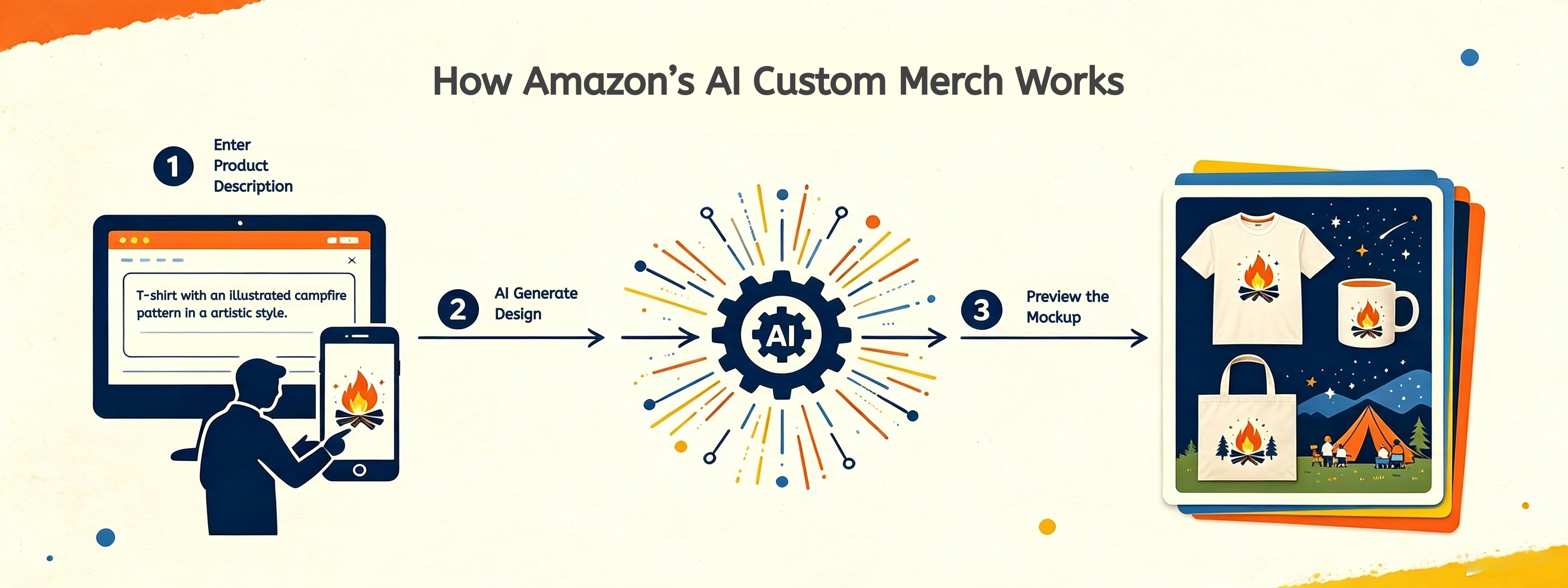
Amazon AI merch allows customers to create or customize designs through AI before applying them to eligible Merch on Demand products.
The general process looks like this:
- The customer describes a product idea using a prompt.
- AI generates or modifies the design.
- The customer reviews the result and applies it to a product.
- The product is produced and delivered through Amazon’s fulfillment system.
For POD sellers, the important takeaway is not simply that AI can create designs. And customers are becoming more comfortable with personalized products.
This creates a new expectation: buyers may want products that feel more specific to them instead of choosing from thousands of similar designs.
That means POD sellers need to focus less on creating more designs and more on creating better products.
AI Merch Makes Generic Designs Harder to Sell
AI will not affect every POD business in the same way.
Sellers who rely on broad trends, simple quotes, or basic graphics may find it harder to compete because these ideas are easier for anyone to recreate.
For example, a “Dog Mom” shirt with a paw print is a product idea that many sellers—and now many buyers—can create quickly.
But a collection designed for a specific group tells a different story. This is where human creativity still matters.
Successful POD products usually connect with a specific reason for buying:
- A gift for special moment
- A product that represents a hobby or community
- A design that helps someone express their identity
- A personalized item with emotional value
AI can help generate ideas, but it does not automatically understand why a customer would choose one product over another.
What Makes a POD Design Harder for AI to Replace?
As AI makes basic design creation easier, the strongest POD sellers will compete in areas beyond artwork.
Understanding a Specific Audience
A broad audience usually leads to generic products.
Instead of targeting “pet lovers,” successful sellers often focus on smaller groups with clearer needs, such as:
- Corgi owners who looking for pet vest
- Camping enthusiasts who looking for portable stove
- Nurses working night shifts who looking for compression socks
- Local sports communities that sourcing custom jerseys
Creating Stronger Product Collections
One random design rarely builds a memorable brand.
Successful POD shops often create collections around a theme, including related products, matching styles, and designs that encourage repeat purchases.
For example, a hiking-themed brand may offer:
- Outdoor shirts
- Camping mugs
- Trail stickers
- Adventure accessories
A collection approach is harder to replace than individual AI-generated designs because it requires product strategy and customer understanding.
The more specific the audience, the easier it becomes to create products that feel relevant.
Improving the Final Product Quality
A design that looks good on a screen does not always work well when printed.
Sellers still need to check:
- Image quality
- Print placement
- Product colors
- Text readability
- Customer expectations
This is especially important as more AI-generated designs enter the market. Better quality control can become a key way for sellers to stand out.
Why Print-Ready Files Are Still a Seller Advantage
AI tools can create impressive images quickly, but many outputs still need adjustments before they are ready for physical products.
Common issues include:
- Poor typography
- Low-quality details
- Unwanted backgrounds
- Incorrect proportions
- Designs that do not fit the product
A shirt design is not just an image. It needs to work within a specific print area, fabric color, and product style.
Experienced sellers understand this difference between a digital concept and a finished product.
The ability to refine designs, prepare print-ready files, and test products before selling remains an important advantage—even as AI becomes more accessible.
What POD Sellers Should Check Before Uploading AI-Generated Merch
AI can help sellers create new design ideas faster, but an AI-generated image is not automatically ready to sell.
Before uploading a design, sellers should review three things: whether it is safe to use, whether it will print well, and whether customers will actually want it.
A design that looks impressive on a screen may still create problems if it contains copyrighted elements, has poor print quality, or does not match the product.
AI-generated merch pre-upload checklist:
- Confirm the design does not use protected brands, logos, characters, celebrity likenesses, sports teams, lyrics, copied slogans, or prompts that imitate a specific artist's protected style.
- Review platform rules for the channel, including Amazon policies, Etsy Creativity Standards, AI disclosure requirements, and production partner disclosure requirements.
- Check whether the human contribution is meaningful: concept selection, arrangement, modification, typography, product placement, and final editing.
- Inspect file resolution, background transparency, edge cleanup, color contrast, and readability at thumbnail size.
- Test the design on the actual product color, size range, and print area, not only on a flat white preview.
- Write listing copy that accurately describes materials, personalization limits, production method, processing times, and what the buyer will receive.
- Order samples for important collections when feasible, especially for premium, personalized, or ad-supported launches.
What About Copyright Protection for AI-Generated Designs?
Copyright is one area where AI-generated merch requires extra attention.
Purely AI-generated content may not receive the same copyright protection as human-created work. However, meaningful human contributions—such as creative direction, editing, arrangement, or modification—may matter depending on the situation.
For sellers, the practical takeaway is simple: do not treat an AI output as automatically unique or protected. Add your own creative input, keep records of your design process, and review every product before publishing.
How Different POD Sellers Should Adapt to AI
AI will affect different types of POD sellers in different ways. The best approach depends on where your business currently creates value.
| Seller type | Challenge | How to Adapt |
| New POD seller | Creating too many random AI designs without understanding demand | Start with one niche, research your audience, and build a small collection instead of uploading hundreds of designs |
| Established marketplace seller | Competing with easier-to-create designs | Improve existing best sellers, add personalization, and strengthen your brand identity |
| Artist-led seller | Losing a unique style by relying too much on AI | Use AI for brainstorming while keeping your own creative direction and final design decisions |
| Personalization shop | Managing more custom requests and customer expectations | Create clear customization options, examples, and approval processes |
| Multi-channel seller | Keeping up with different platform requirements | Track AI policies, disclosure rules, and product requirements for each sales channel |
Should POD Sellers Still Build Their Own Brand?
Yes.
As AI makes creating individual products easier, having a recognizable brand becomes even more valuable.
A customer may discover one AI-generated shirt today, but they are more likely to return to a shop they trust for future gifts, seasonal products, and related items.
Building a brand can include:
- Creating consistent design styles
- Developing themed collections
- Growing an email list or social community
- Offering products beyond one-off designs
AI can help sellers move faster, but a strong brand gives customers a reason to choose one shop over another.
Turn Your AI Art Into Products with Inkedjoy
Creating an AI-generated design is only the first step. Turning that idea into a product customers can actually buy is where the real opportunity begins.
With Inkedjoy, sellers can transform AI-generated artwork into custom products without managing complex production steps. Upload your design, choose from a wide range of customizable products, and create ready-to-sell merchandise that can be fulfilled on demand.
Whether you are testing a new niche, launching a seasonal collection, or adding personalized products to your store, Inkedjoy helps bridge the gap between AI creativity and real-world products.
Frequently Asked Questions
What are Amazon's royalty groups for Merch on Demand?
Amazon’s royalty rates can change over time, so sellers should check the latest information in their Merch on Demand account. Avoid using outdated charts when calculating your potential profit.
How does Amazon AI merch work?
Amazon AI merch allows shoppers to create or edit designs with AI and apply them to eligible Merch on Demand products. For POD sellers, the key change is that customers can now create more personalized products instead of only choosing from existing designs.
Will AI replace print on demand sellers?
AI will make basic design creation easier, but it is unlikely to replace sellers who understand their audience and build strong product collections. The biggest impact will be on generic designs that are easy to copy.
Can AI-generated merch be profitable?
Yes, but AI alone does not create a profitable product. Success still depends on choosing the right niche, creating designs customers want, and managing pricing, fulfillment, and customer experience.
Can AI designs be sold on Etsy?
Yes, but sellers must follow Etsy’s rules for AI-generated content and production partners. They should also avoid designs that copy brands, characters, or other creators’ work.
Can AI-generated merch be copyrighted?
Pure AI-generated content may not receive the same copyright protection as human-created work. Adding your own creative input, editing, and design decisions can make your work stronger.
What is the best channel for AI print on demand sellers?
The best channel depends on your business goals. Amazon offers marketplace reach, Etsy works well for personalized products, and Shopify gives sellers more control over their brand.
Read more
Written by
Gina
A skilled marketing specialist with expertise in e-commerce marketing, and print-on-demand product research. She has extensive experience in keyword research, market analysis, and content strategy, helping brands find uncover profitable opportunities, improve search visibility, and drive sustainable growth through data-driven marketing.
Editorial note: This article uses official source links where available and conservative print on demand guidance. Sellers should verify current Amazon, Etsy, intellectual property, production partner, Inkedjoy product, print setting, shipping, fee, and disclosure requirements before publishing listings. No earnings, ranking, delivery, conversion, or sales outcome is guaranteed.